Although the focus of the British Media this weekend is on the Royal Albert Hall and the Cenotaph there is also an important service of commemoration and thanksgiving around the Tomb of the Unknown Warrior in Westminster Abbey. When the Unknown Warrior was granted a full state funeral by King George V on 11 November 1920, the end of World War I had not been declared and the fledgling Polish army was still fighting for its life against the Soviet Red Army.
So much that was happening then chimes with what is happening now. In Britain, there was a desperate desire for Peace, but conflict was still tearing Eastern Europe apart. The British government under David Lloyd George had no appetite to put boots on the ground and deployed only military advisors to help the Poles. The Russian government saw this weakness and plotted to expand its control. An uneasy peace existed until September 1939 when Russia and Germany split Poland under the terms of the German-Soviet Frontier Treaty – the beginning of World War II.
There is a particular poignancy about the attack in Krakow this weekend. The escalation of Russian hybrid war in Europe cannot be disguised. The Allied creation of Multi-National Force Ukraine (MNF-I) will particularly annoy the Moscow Hawks. The MNF-I two-week peacekeeping exercise, which begins in Poland tomorrow and involves hundreds of British troops, is no doubt the reason for the attack in Krakow.
I worked with the Polish Armed Forces in Krakow in 1996, when Britain forged a strong military partnership to train our armoured brigades. The exercise tomorrow does not involve heavy armour, but it is a step in the right direction to prove MNF-I is not just a Paper Tiger. What we need to do is to publicise these military manoeuvres on our mainstream media, every day this week to demonstrate our solidarity with Poland and Ukraine and to shift the emphasis from the past to the future.
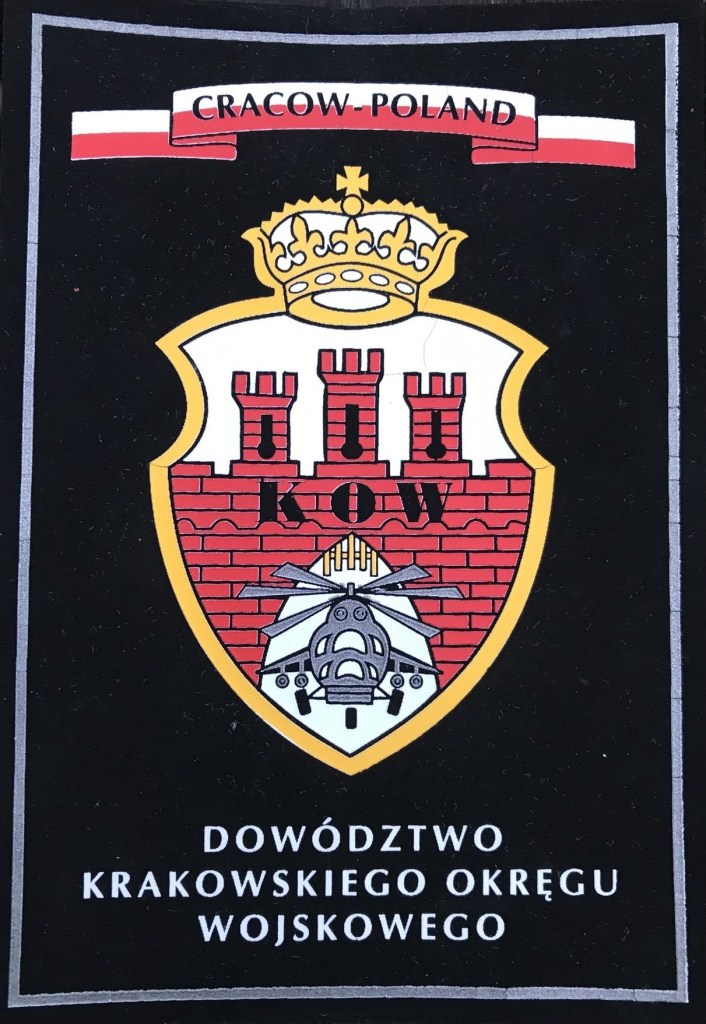
Badge of the Armed Forces Command in Krakow Military District 1996

