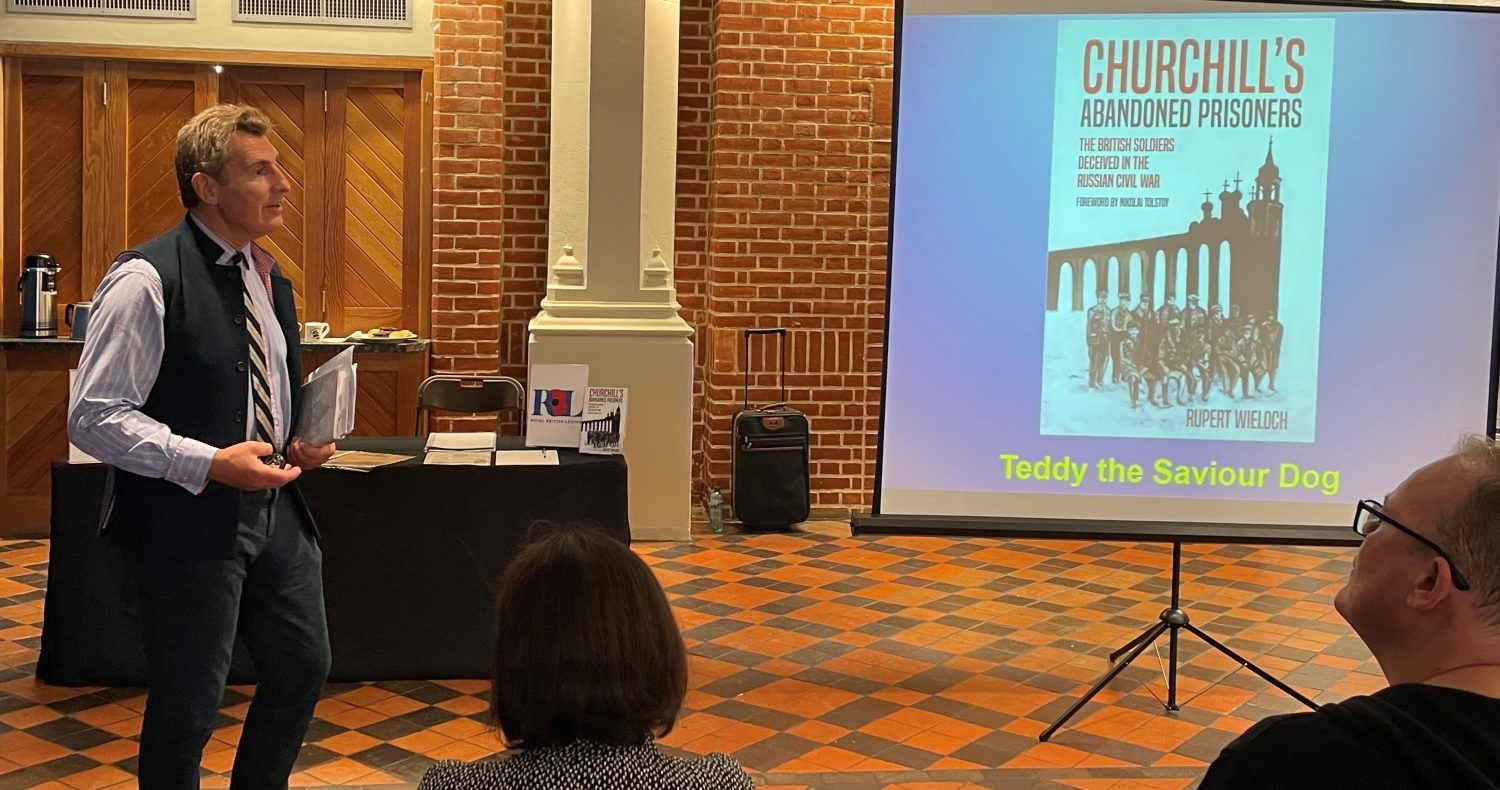
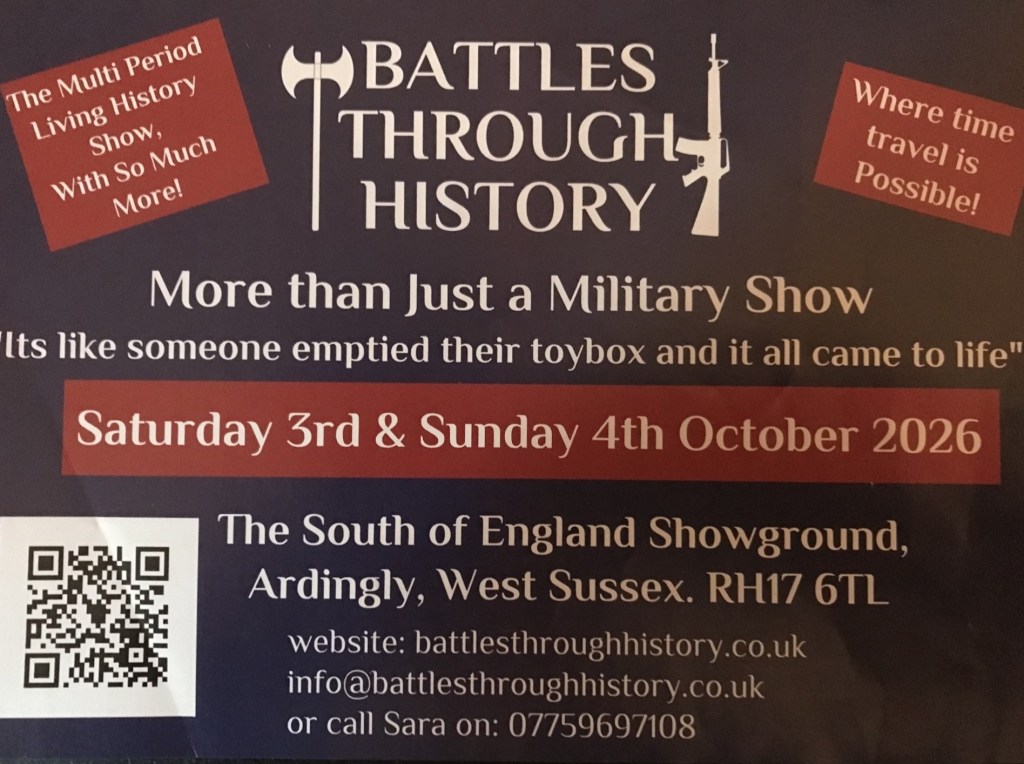
I am looking forward to giving my talks at the Battles Through History show next weekend. It’s the third iteration of this excellent show, which is now established as the last hurrah for military re-enactors, vintage vehicles, model makers and living history buffs.What I particularly like about it is the variety; one can bump into a Roman Legionnaire one minute and a Star Wars fan around the next corner.
I will be in the Norfolk Pavilion, with my books, on Saturday and Sunday talking about the Victoria Cross awards in North Africa and Operation Torch (Hard Lessons From Tunisia). I am sure there will also be lots of discussions about the current state of the British Forces and in particular the latest debacle about Ajax. For the full list of authors and activities over the weekend, please refer to the website through the QR code below.
The cordial meeting between the Prime Minister and NATO’s Secretary General this week masked three deepening tensions centred on Defence Spending, Russia and Ukraine.
The first is the Government’s inability to deliver the 2025 recommendations made by former NATO SG, Lord Roberton. The funding gap for re-armament is bad enough, but the real issues are the shortage of recruits and the lack of preparedness in society. The paucity of Territorial Army Centres in Britain’s towns exacerbates the problem and needs to be corrected pronto.
The second is the portrayal of Russia by the Government, which is totally flawed. Putin is neither isolated internationally, nor domestically. His reserves dwarf NATO’s and now are hardened by years of combat. The UK Chief of Defence may have said this week that we are living in the most dangerous period of his service life, but why are MPs silent? They are the ones who should be telling the public about Russia’s European war plans and manoeuvres.
The third dynamic is the skewed reporting from Ukraine. The focus on drone attacks provides a glimpse of the war, but these are like wasps attacking a crocodile. The real business is happening in the Donbas, where an intense ground war continues after twelve years. The Media needs to stop pretending that close combat is a thing of the past.
It is the business of strategists to identify weaknesses in order to counter threats and provide opportunities for success. However, it is the job of politicians to stiffen the resolve of a nation and to ensure that military capability is in place to withstand the first attack. It is time to act.
Tehran will be delighted at the outcome of the Brics meeting this weekend; Washington will not.
For the record, Russia, India and China are the 1st, 7th and 3rd largest countries in the World by area; the 9th, 1st and 2nd by population; and the 9th, 6th and 2nd greatest economies by GDP. Brazil and South Africa are leading nations in the two largest southern hemisphere continents.
Brics is usually a disjointed group, which generally follows the lead of the USA, but this year, they have been badly affected by Washington’s economic tariffs and war with Iran. The members are now hitting back diplomatically, with three anti-American messages in their New Delhi Declaration: Stop attacking civilian infrastructure; Return to the Two-State Solution; and Remove unilateral sanctions. Reading between the lines, the implied warning is obvious: if you don’t respect International Rules, then we will not follow your lead.
For Iran, the message is also clear. We will buy your oil and support you in your conflict with the USA. It is no surprise, therefore, that the President warned the military for the long haul and announced this week that his war will continue beyond the November mid-terms.
It’s sad to see Argentina’s sabre rattling this week and especially disappointing to observe the encouragement from Washington as a result of messing up their war with Iran. It was very different 25 years ago.
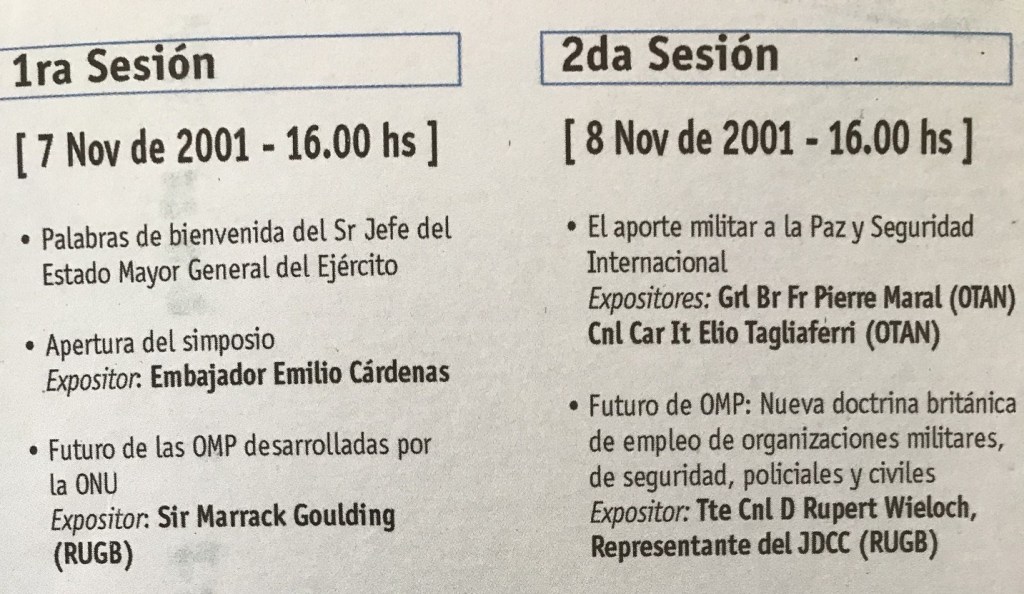
After 9/11, Argentina extended a hand of friendship to the USA and UK and I was asked to accompany Sir Marrack Goulding to Buenos Aires and to address a government conference about peacekeeping. At that time, the Argentinian Army was interested in the British way of conducting peace support operations and also the international security force that was about to deploy to Kabul.
After giving my talk on the Thursday, I was invited to a personal audience with the Head of the Argentinian Army. The British Defence Attaché accompanied me deep into the heart of the Ministry of Defence and confided that I was the first British officer to receive this invitation since the Falklands War. What I didn’t realise was that there would be fourteen senior Argentinian officers around the table and that they would ask many detailed questions about the state of the British Army in 2001.
In the end, Argentina chose not to become involved inAfghanistan, but to remain committed to traditional peacekeeping operations such as the Cyprus Green Line. So, what does this mean in the context of President Milei’s bluster this week?
Well, to my mind, Argentina’s military missed out on a decade of difficult operations, which helped many countries maintain their ability to fight high intensity warfare. This leads me to believe that although, British forces have reduced in the past decade, they are still ahead of their South American counterparts and if we went to war over the Falklands tomorrow, the result would be the same as 1982. That is not to say the gap cannot be closed, but at the moment, I rate Argentina’s rugby and football teams as better than their military.
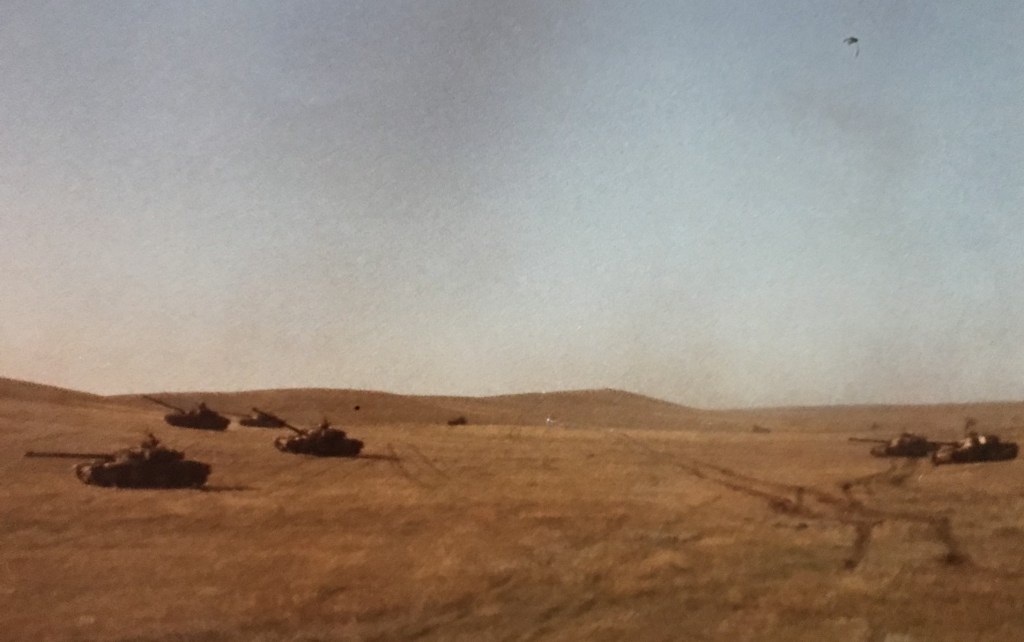
With news that collective Army training is being curtailed, including tank firing at Castlemartin Ranges and Apache Helicopter manoeuvres, I am reminded of the track mileage moratoriums imposed on the Army in the past. But to my mind, these are vital parts of building military capability, not “nice-to-have” exercises as some ignorant observers suggest. So what will be lost if these events are cancelled?
One of the hardest jobs I had as Head of Defence Training Capability in the MoD was to explain to civil servants, politicians and other services why Army collective training was so important. It is much simpler to describe the consequences of not buying equipment by highlighting the financial penalty clauses written into contracts by Defence Industry and quoting the stark English proverb For Want Of A Horse Shoe Nail.
I used two methods in the argument about collective training. The first was to ask what force was needed by a certain date and then build a picture of the steps from individual competence to battle group efficiency. The force elements at readiness (FE@R) model was hard enough to describe to staff college students, but in London the eyes glazed over very quickly. The second way was to liken the task to cinema production, or the Premier League. This was more successful because there are plenty of examples of Films and Soccer Clubs which fail miserably because they focus on individual stars, rather than the collective. The Premier League analogy is also useful because the consequences of team failure; 20 years ago, the British Army was still one of the top six, now we are in danger of relegation, if we give up collective training.