
VE Day Tribute

My mother, whose name is on the Bletchley Park Roll of Honour for those who worked in Signals Intelligence during the War, was selected to march past Buckingham Palace on VE Day 1945.

She was posted to HMS Flowerdown as a Morse operator soon after her 18th birthday and listened to German and Italian radio messages from Libya and the Mediterranean.  She took down code words for alphabet and cipher for numbers; the hardest part was mid sentence at the end of the page when she had to move the carbon paper and cardboard (everything was recorded in triplicate) without missing a letter.  She reported “Benghazi Gone!” when it was re-captured by the 8th Army in November 1942.

By May 1945, she had moved to HMS Hornbill and after Victory in Europe, she volunteered for overseas work, sailing to Colombo on the SS Athlone Castle before working in Bombay (Mumbai) for ten months.  In 1946, she deployed to South Africa on the aircraft carrier HMS Vindex, joining a female officer and a nurse, whose floor she slept on rather than being alone in a 20 bunk cabin!

VE Day

The Mysterious Hector J Boon

The train with Rex Carthew that arrived in Irkutsk to collect the British prisoners and refugees at the beginning of April also brought an American, named Hector Boon.  It seems strange that at a time when everyone sought to escape from Bolshevik Russia, this mysterious man arrived and rented a lavish apartment in the middle of Irkutsk.

Was he an American spy like Margueritte Harrison in Moscow, or merely an enterprising, but naive, businessman who didn’t understand that the Soviet system banned all capitalist trade?

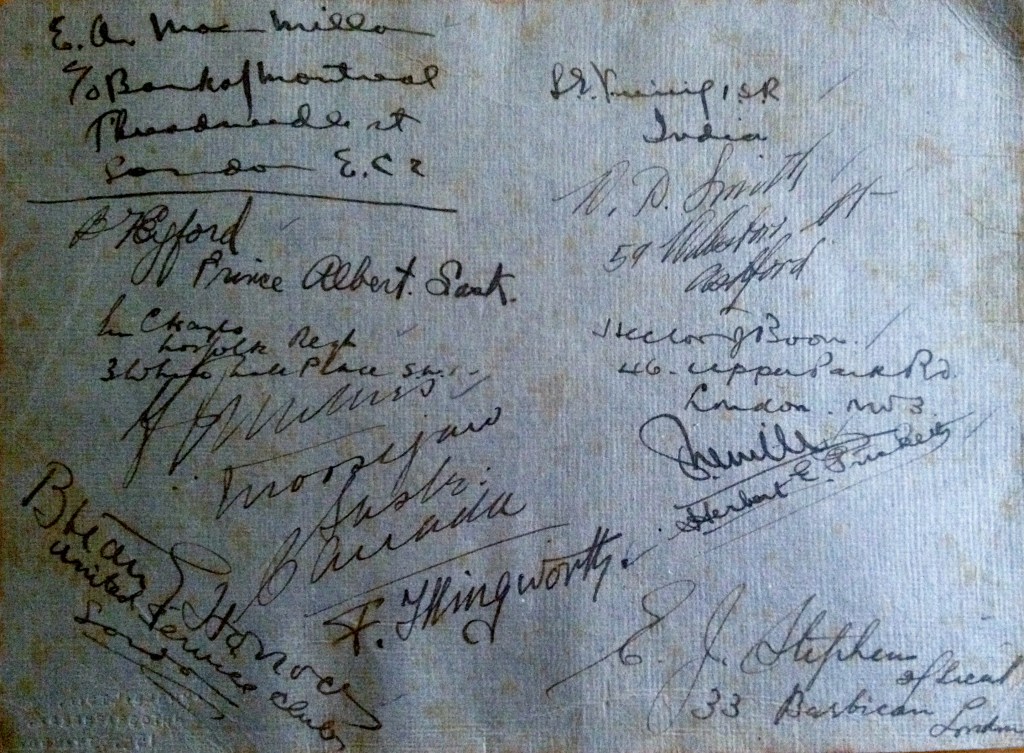
Whatever his ulterior purpose, he was most generous to Brian Horrocks and the abandoned British prisoners by giving them food and money to buy clothes.  I haven’t found any subsequent trace of him other than his signature on the back of a photograph later in 1920, when he gives his address as 46 Upper Park Road, a large house in a leafy suburb of North London!


San Remo Conference April 1920

Apart from accepting the mandates for Mesopotamia, Palestine and Syria, the San Remo conference, chaired by the Prime Minister of Italy, agreed the WWI Allies’ policy on Soviet Russia.

Believing that all the British prisoners-of-war held by the Bolsheviks were on their way home, Prime Minister David Lloyd George, supported by Foreign Secretary Lord Curzon, agreed on 25th April to adopt a resolution to restore trade with the Russian Soviet Federative Socialist Republic.

Little did they know that Captain Brian Horrocks and his compatriots in Irkutsk had been deceived by the Commissars and the train that had arrived under command of Captain Rex Carthew to rescue British citizens, was allowed to collect only the civilian families.

When he heard this news, the War Secretary, Winston Churchill, who did not attend the San Remo conference, lobbied the government to make the safe return of “all British prisoners-of-war captured in Siberia…” the essential condition of any trade negotiations.

IMG_3012Lord Curzon with the Cabinet Secretary, Sir Maurice Hankey, en route to San Remo for the Allies’ Conference in April 1920


Good Friday 1920

On the night of Good Friday, 2nd April 1920, Captain Francis McCullough was arrested by the Soviet Secret Police in Moscow and taken from his room at the Savoy Hotel to the notorious Lubjanka prison.   He was arrested for sending a signal to the War Office informing them about Captain Brian Horrocks and the other British Army prisoners-of-war he left behind in Krasnoyarsk.

He had just removed the photograph with Director of Military Intelligence stamped on the back from the lining of his coat, which is just as well because the armed guards searched his belongings thoroughly.  In Lubjanka, he suffered the de-humanising process of three intrusive body searches and was then shoved into a cell with a wrenching smell of urine and excreta.  On the third day of solitary confinement, with his senses tortured by light and noise assaults, he was interrogated by the infamous Tcheka inquisitors Xenofontov and Mogilevsky.

After several hours of questioning, they switched tack and tried to recruit him into the Soviet intelligence network.  All this is revealed in the MI6 report written after he returned to London and was interviewed in the Hyde Park Hotel.

McCullough Moscow March Signal

British Medical Support in Siberia March 1920

On 26th March 1920,  Brian Horrocks and the other British PoWs arrived at Irkutsk anticipating that they would be heading east to Vladivostok before the ice on the river melted in April.  A few days later, Sgt Frank Illingworth and Lieutenant Edward Stephens joined them after “Illy” had recovered from a bout of dysentery.

While they waited for a connecting train, the commander of the British Military Mission to Siberia, Lieutenant Colonel Charles Wickham, updated the War Secretary in London and sent the following signal: A full train load of medical stores, drugs and clothing has been despatched to Chita area in charge of Colonel Young, Captain O’Driscoll RAMC and Captain Peacock.  This is the best consignment of medical stores ever supplied by the Mission.  It will be able to satisfy the urgent demand for drugs which is being made by every hospital from Harbin westward into which the sick from the remnants of the Siberian army are crowding in numbers out of all proportion to the space, staff or material available to deal with the situation. (WO 106/1278)

O'Driscoll


Lydia Yates heavily pregnant in a disease ridden city…

Shortly before the British PoWs departed from Krasnoyarsk, it was decided that Lydia Yates, a British refugee with her husband William and son Ernest, was too heavily pregnant to travel with them in the 4th class carriages they were assigned.

Lydia had to give birth in one of the most disease-ridden cities in the world.  There were 30,000 cases of epidemic typhus reported during February 1920 and the hospitals where these poor people went to die were crammed full of patients lying in their own vomit and excreta.

William Yates, who was born in Ekaterinburg to English parents, was trying to take his family back to England where they could live with his uncle, William Glover, a renowned explorer of the Siberian forests.  Glover was now the Congregational Minister in Tiverton and lived at The Manse, having moved from Heaton in Newcastle.

The Manse, 2 St Peter St, Tiverton

One Hundred Years Ago Today…

On 18th March 1920, Captain Brian “Jorrocks” Horrocks and Sergeant Frank “Illy” Illingworth had fully recovered from the epidemic typhus that had laid them low for a month and the British prisoners’ train departed from Krasnoyarsk.

Travelling east, they were led to believe their destination was Vladivostok, which was still in the hands of the Allies.  During the first day, however, Illy suffered severe gastric problems and Major Leonard Vining was concerned that he needed specialist medical care.  They took him to a hospital during a two-hour halt and Lieutenant Edward Stephens volunteered to remain with him for the duration of his illness.  When Vining returned to the station, the train had vanished and he had to hitch a lift for 25 miles before catching up with his compatriots at Ilanskaya.

That evening, he was visited by the Tcheka; the notorious secret police “indulging today in an orgy blood the like of which has never been seen”…

IMG_2712Brian Horrocks with his fellow prisoners-of-war at Krasnoyarsk in March 1918

International Women’s Day

Hot on the heels of World Book Day, we are “Realizing Women’s Rights” on Sunday.

One of the themes in Churchill’s Abandoned Prisoners is women in the Russian Civil War.  In May 1918, women’s food protests sparked the first wave of worker’s unrest against the new Bolshevik authority in Petrograd.  Later in the war, tireless women of all classes put their menfolk to shame as they stood up to the Red Army and sustained the orthodox faith.

The resistant spirit of Russian women was observed by many of the British soldiers in Siberia, who held them in awe and wrote about the strength of their character.  Apart from the bravery and magnificent work of the Red Cross nurses, my book includes inspiring examples of superior female mental fortitude, witnessed by the British PoWs in Siberia, Moscow and Petrograd during their ordeal in 1920.

IMG_2650

March Events

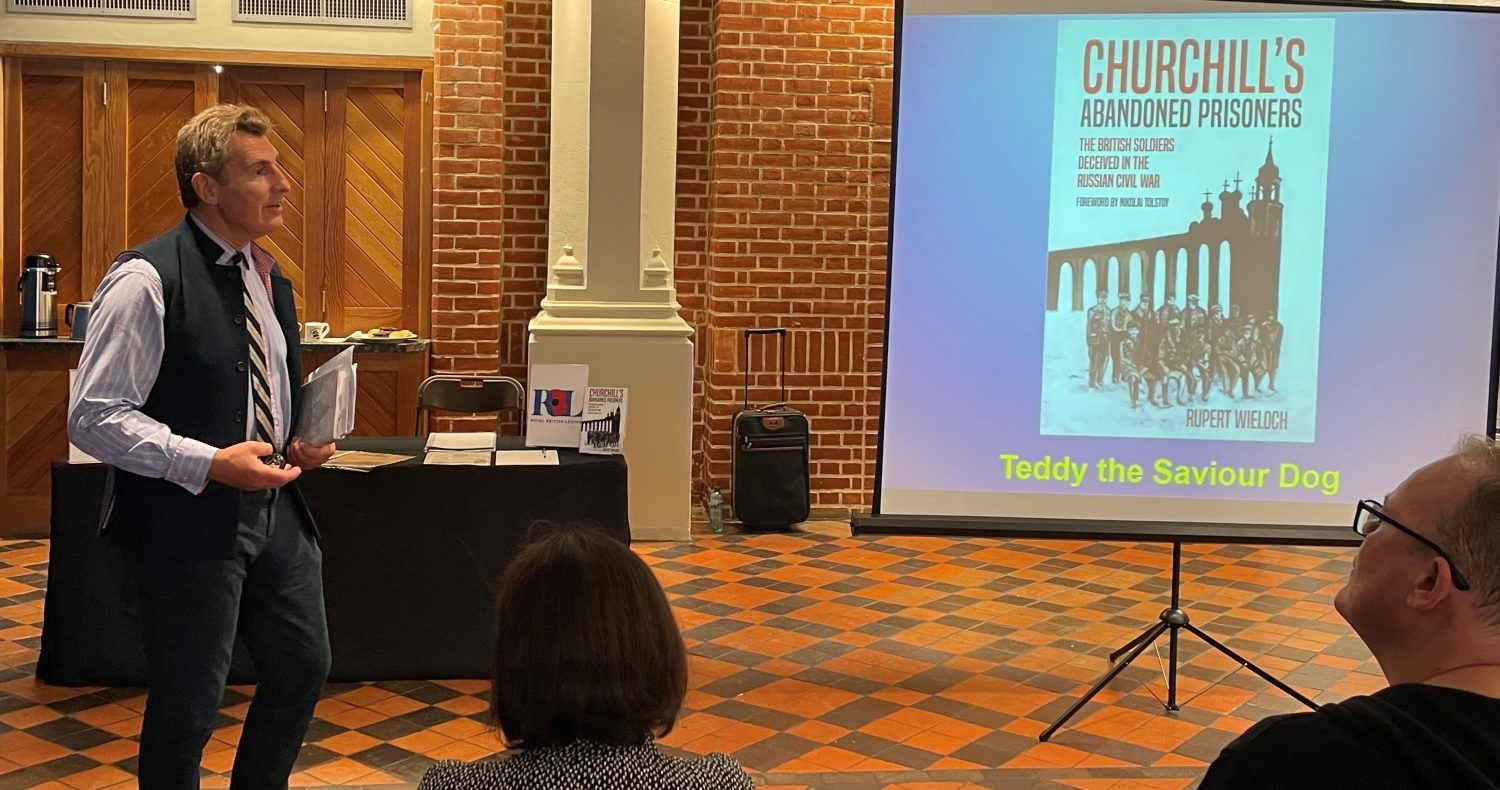
I’ll be in conversation with the renowned Sophie Neville (who played Titty in the original film of Swallows and Amazons) and reading from my book, Churchill’s Abandoned Prisoners, on Wednesday 11th March at the Old Library, Pilgrims School in the close of Winchester Cathedral, starting at 8pm.  Please contact Laura Brill for more details or to reserve a place, on 01962 854189 or email thelibrary@pilgrims-school.co.uk

Alternatively, I am giving a talk about the British prisoners’ ordeal in Russia one hundred years ago, with a very special guest, at the English Speaking Union, Dartmouth House, 37 Charles Street in London on Tuesday 31st March at 7pm.  Tickets are available at: https://www.eventbrite.co.uk/e/london-branch-talk-by-author-rupert-wieloch-on-his-book-churchills-abandoned-prisoners-tickets-89775168947

IMG_2712British Prisoners of War in Krasnoyarsk March 1920

Britain At War February Article

The story of last British PoWs of World War is now available to read in the January and February editions of Britain At War magazine.

In the January issue I explain what the soldiers were doing in Siberia and how they were captured by the Bolsheviks one hundred years ago.  In the February follow-up, I tell the story about the prisoners’ ordeal and how they managed to return to England just after the Unknown Soldier was buried in Westminster Abbey.

The February magazine can be purchased online at the following link:

https://britainatwar.keypublishing.com/the-magazine/view-issue/?issueID=7875

IMG_2642