
Captured in Siberia
On 6th January 1920, two months after escaping from Omsk, a group of fifteen British soldiers were held up in a queue of trains approaching Krasnoyarsk. They put the long halt down to the fact that the locals were celebrating Russian Christmas Eve.
Suddenly, the locomotive in front blew its whistle and their train replied, but it did not move forward. Sergeant Joe Rooney struck up on the banjo and sang “Take me back to dear old Blighty”. Then someone remarked “A Russian officer has just thrown his sword over the bank”.
Several more officers followed his example and all around, they saw White Army soldiers throwing down their rifles and pistols. They had traveled 900 miles by train, sleigh and on foot through the bitter Siberian winter, but now they realized this was the end of their forlorn flight to freedom and the beginning of their captivity at the hands of the Russian Soviet Federative Socialist Republic.
Sledges Used By British Soldiers on the Retreat From Omsk
Rewriting History?
In the list of the worst rail accidents in the world, there is no mention of the disaster at Achinsk which held up the British refugees fleeing from the Red Army.
On 31st December 1919, Leonard Vining, Brian Horrocks and Emerson MacMillan walked past dozens of trains into the town to find a scene of utter desolation. They discovered that the station was completely destroyed because three days earlier, a freight train carrying dynamite had exploded in the centre of a dozen refugee trains standing on parallel tracks. More than five hundred people were killed instantly and thousands injured; many of them women, children and babies. Emerson wrote “the dead were piled up like cordwood. There were hundreds of them but they were luckier than the injured, who lived and who could not possibly receive medical attention.”
In ordinary times, this would rank as a global disaster, but here it was just another episode in the unfolding tragedy of the retreat from Omsk.
Trans Siberian Railway Line From Omsk To Irkutsk – 1,500 Miles
Last Stand in Siberia
On 23rd December 1919, the Siberian Army fought its final battle, whilst the despondent “Supreme Leader”, Alexander Kolchak was held up in his train carrying the Imperial Treasury, by the Czech Legion at Krasnoyarsk.
Reporting on the comprehensive defeat, the Manchester Guardian commented: “the shattered remains of Kolchak’s army scattered and all stores, munitions and practically all artillery were lost”. General Kappel issued orders to establish a defensive line near Krasnoyarsk, but this proved impossible as 45 echelons of the White Army were stuck on the railway line with frozen engines stalled between Bogotol and Kozulka.
The following evening, the last British contingent out of Omsk made the best of their situation. Forty people, squeezed into a carriage designed for 16, ate their Christmas Eve supper of soup, rice and vodka. A whisky bottle was shared and they held an impromptu sing-song until 11.30 pm with a magnificent rendition of Helen of Troy and Give Me The Moonlight.
The last British group that escaped from Omsk in the winter of 1919
December 1919
One hundred years ago, Leonard Vining, leading an “abandoned” group of refugees in their attempt to escape from the Red Army, wrote in his diary:
December 12th. We moved on a few more versts. Hear that Novo-Nik has fallen. The Russian officer fairly excited, came and told us that within the next 24 hours the Reds will cut in at Oiash; if that happens we have to take to the road. It would not be very much to worry about if we had not women and children with us. So many claimed British nationality at the last moment, and we were compelled to evacuate them.
Poor old Bates could not find his wagon with his child and all worldly possessions in it. From Novo-Nik he went back to Barabinski to hunt for his wagon. It is like hunting for a needle in a haystack. Mrs Bates is with us and spends most of her time crying…it is as bad a case as could be.
Major Leonard Vining of the Royal Engineers
Frustrating Dash For Freedom
At the beginning of December 1919, Brian Horrocks and his compatriots were held up in their train for five days at Novo-Nikolaevsk. Whilst waiting for the line ahead to clear, some of them took the opportunity to buy amethyst, turquoise, beryl and alexandrite stones from the Urals, which were readily available in the market outside the station.
On 6th December, their train pulled out of the station at 1.30 p.m., but the weight of the carriages was so heavy that a banking engine had to push them up the hill. There was a shortage of fuel and water, so many broken down locomotives blocked the line. Sometimes their train was halted for hours and the soldiers had to form a human chain passing baskets of snow forward, in order to maintain the steam pressure in their locomotive.
Francis McCullagh wrote: “All our energies were concentrated on satisfying our locomotive’s insatiable cravings. The struggle for water on occasions was a nightmare as half a dozen engines sometimes contended for the privilege of filling their boilers first and as the commandants of rival echelons almost came to blows”.
The rebuilt station at Novo-Nikolaevsk, now named Novosibirsk.
A 50th Birthday At Barabinski
The oldest of Churchill’s Abandoned Prisoners, Warrant Officer Fred Walters, spent a forlorn 50th birthday, on 17th November 1919, stuck in a train at Barabinski, looking after British women and children fleeing from the Red Terror.
Walters was born in Birmingham and emigrated with his wife, Emily, to Canada where they parented eight children. In 1916, he volunteered to join the Army and ended up in the British Railway Mission in Siberia in 1919. He was famed for his “ramrod straight bearing” and was an important father figure to the younger soldiers, worried about what would happen to them.
Uncle Charlie, as he was known, is standing on the left in the photograph below.
Lord Mayor’s Banquet 1919
On 8th November 1919, the Prime Minister, David Lloyd George, revealed that the British Government had sent one hundred million pounds worth of military equipment to support the White Government in Siberia. Knowing that the last British battalion had sailed from Vladivostok on 1st November, he told the Guildhall audience: “We cannot of course, afford to continue so costly an intervention in an interminable civil war”.
At the time, the Prime Minister did not realise that a group of British soldiers ordered to “remain to the last” in Omsk, would extend British involvement in the Russian civil war for a further 12 months. See page 80 of Churchill’s Abandoned Prisoners for this story.

October Escape
On 31st October 1919, the Soviet Government announced that it had captured Petropavlovsk, an important trading town on the river Ishim. In doing so, they cut off two British officers serving with Ataman Dutov’s Cossacks, Captain Phelps Hodges MC and Lieutenant Paul Moss, from their railway route to safety.
The only way of escape was to cross the infamous Gobi Desert by horse and camel. It took them over four months, but eventually they reached the British mission in China and from there, returned to England. Writing about his experiences, Phelps Hodges claimed: “No phase in history is more full of material for the historian or novelist than those four years of bitter civil war in Russia”.
Captain Phelps Hodges MC of the Royal Field Artillery, crossing the Gobi Desert in 1919
October Centenary
On 12th October 1919, the future WWII hero, Captain Brian Horrocks of the Middlesex Regiment was fighting with the White Army on the front line in Siberia when he met Major Leonard Vining of the British Railway Mission at Lebedyja.
Vining had been tasked to ascertain the damage to a bridge that was only 15 yards from the front line. He came under fire whilst taking photographs in a biplane, but survived the ordeal and returned to Omsk before the Red Army broke through the following week.
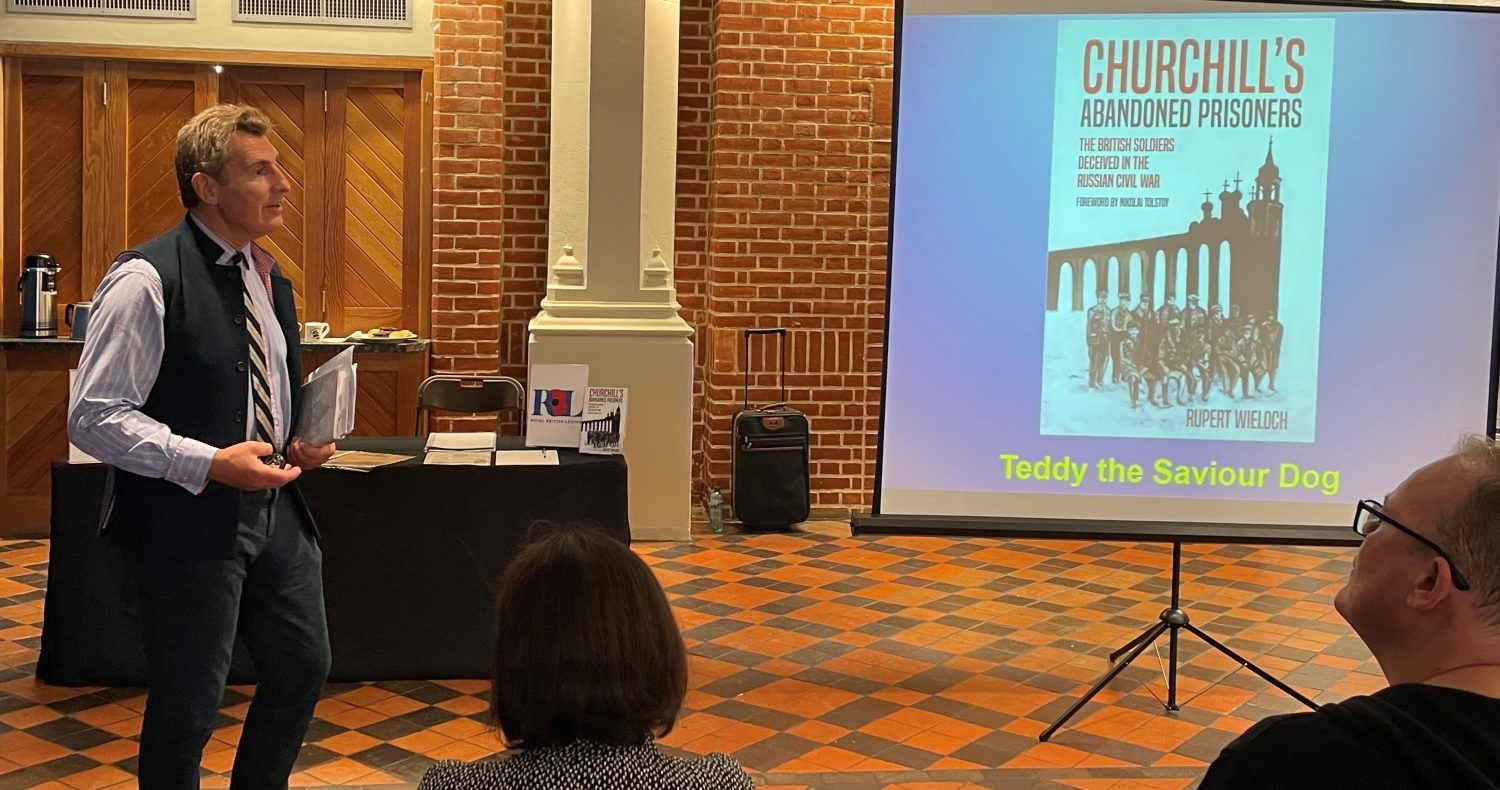
I am looking forward to talking about these exploits at Horrocks’ old school, Uppingham, one hundred years on.


Admiral Kolchak (fur hat) with Captain Francis McCullough (right) who ran the White Government’s Propaganda in Omsk