In 1995, I was in the Balkans during a period when all sides committed war crimes; the worst of which was the genocide in Srebrenica, which resulted in over 8,000 civilian deaths. By then, the International Criminal Tribunal for the Former Yugoslavia had already been established by the United Nations. Those of us deployed with UNPROFOR took evidence after any attacks which we believed contravened the law, such as when white phosphorus was fired into civilian blocks of flats soon after I arrived in Maglaj.
Eight years later, I found myself back in Bosnia planning the NATO military operations to hunt PIFWCs (persons indicted for war crimes). Each military operation involved specialist Italian Carabinieri who set up an inner cordon and a Special Forces arrest team from one of the signatory countries.The secret diplomatic process that was sewn up in capital cities and the Hague, was a brilliant example of the international community working together for a common purpose and provides an exemplary model for those who are calling for war criminals to be indicted in the current war in Ukraine.
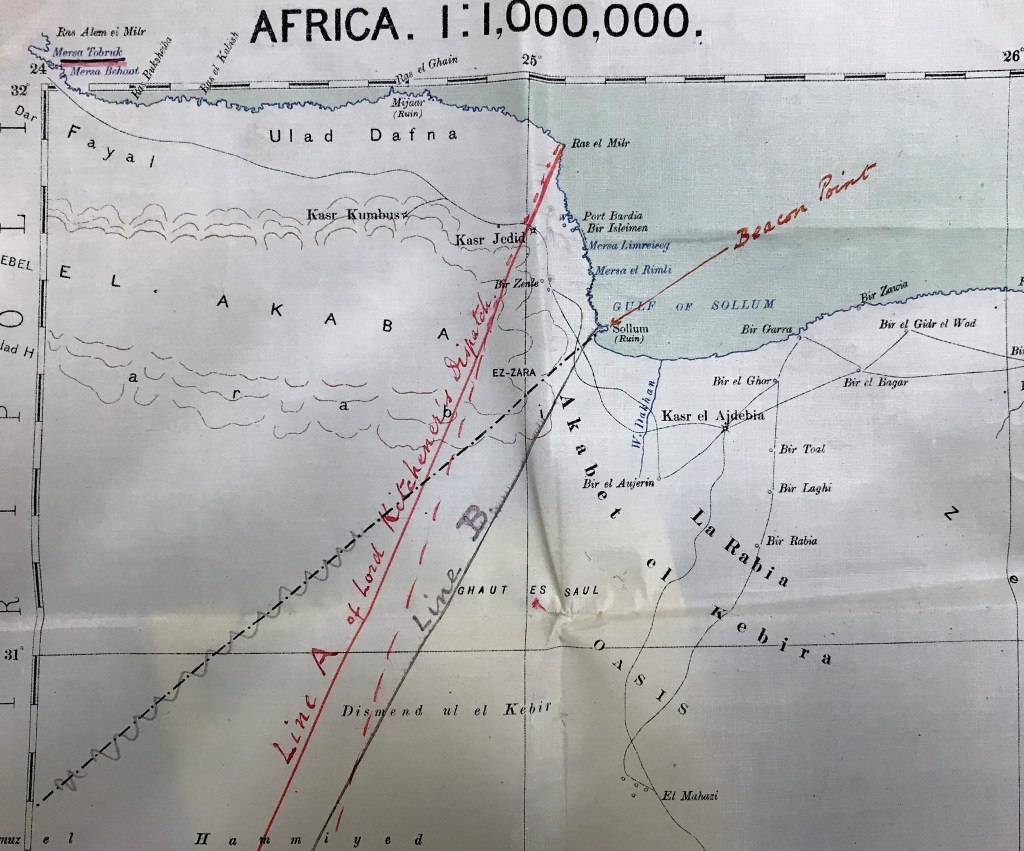
I am looking forward to speaking to the Society for Libyan Studies about Anglo-Libyan relations in the 20th century. One of my discoveries was the map below that reveals how Field Marshal Herbert Kitchener became involved in the long-standing dispute about the Libyan frontier with Egypt. I will also tell the tale of the roller-coaster ride from the policy of non-intervention to the post-war British administration that found itself looking after a devastated and impoverished country and how all this changed after oil was discovered in the Libyan desert.
The humanitarian response to the plight of Ukrainian refugees has been ray of light this week, but with diplomacy failing and military means ruled out, the West’s support to the Kiev Government in its war with Russia remains restricted to Intelligence and Economic levers of power.
Unfortunately, Putin foresaw this and has built huge financial reserves and hoarded key electronics and pharmaceutical goods before launching his invasion. The Russian State is stepping in to keep people at work and the banking system has not collapsed as Washington thought it would. With oil still around $100 per barrel, Russia will earn about four times more than it did last year from exports. It is likely that China will fill the gaps in consumable goods such as cars, that the western governments have sanctioned.
Meanwhile, the Western economies are facing their own problems with post-Covid inflation exacerbated by the lack of badly needed Eastern commodities. For example, the Russian and Ukrainian combined wheat production accounts for 30 per cent of the global demand. Miners are also in a stranglehold with refining costs of copper and platinum group metals increasing dramatically because they require hugely energy-intensive processes.
This all reminds me of the situation in 1920 when Parliament was supporting the White cause in Ukraine and Poland against the Bolsheviks in Moscow. At a Cabinet meeting on 17 November, Lloyd George’s government spent an hour and a half discussing sanctions on Russia. The President of the Board of Trade, Sir Robert Horn made an impassioned plea based on the critical economic situation in Britain, with business confidence very low and unemployment very high and was supported by the Prime Minister, who said: “When I mentioned the possibility of our going to war to support Poland, a shudder passed through the House and those who were clamouring against Bolshevism immediately shewed the white feather… I have heard predictions about the fall of Soviet Government for the last two years, Denikin, Judenitch, Wrangel have all collapsed, but I cannot see any immediate prospect of the collapse of the Soviet Government.”
Unfortunately, Putin’s government seems to be not too different; see Part 2 of Churchill’s Abandoned Prisoners for a grounding in the modern Anglo-Russian relationship.
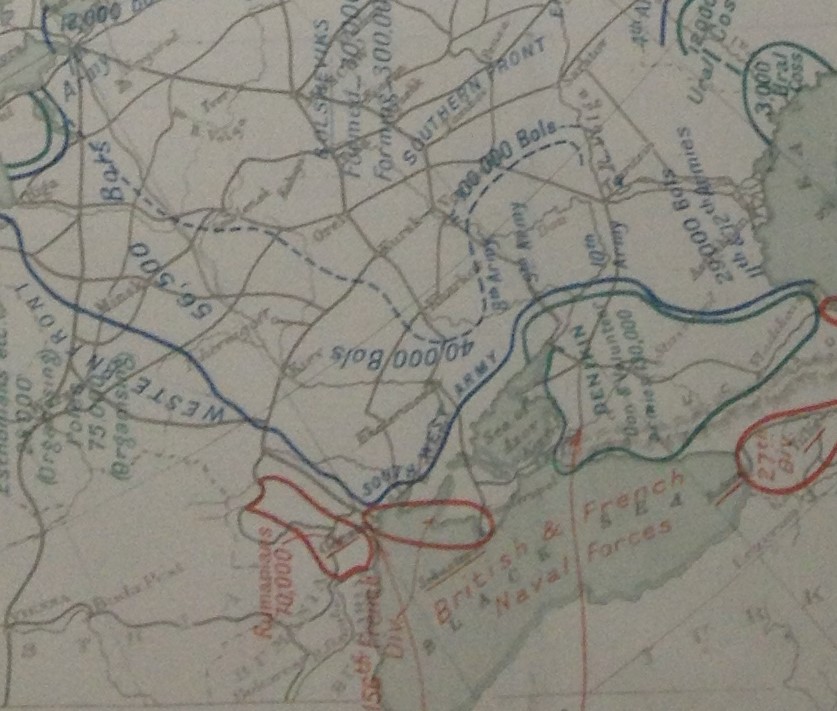
The Kiev and Kharkov Front in the Russian Civil War 1919
I join others around the world who are applauding Marina Ovsyannikova for her brave stand on Russian News. Her placard, which includes the words: “Stop the war, don’t believe the propaganda” was a welcome sign that the tradition of Russian womanhood is as strong as ever. If there is ever going to be a reversal of the current Russian system, it will be founded on the courage and honesty of women such as Ms Ovsyannikova.
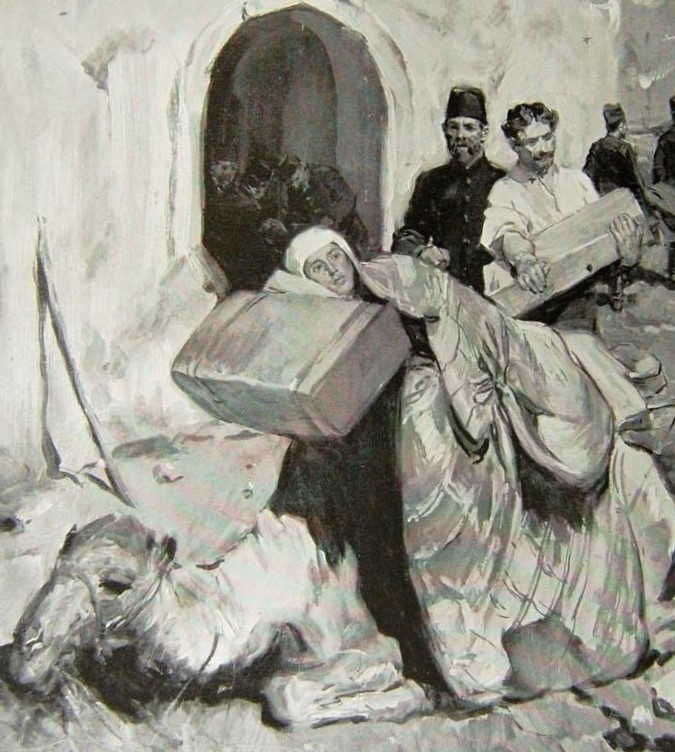
This is another example of the similarities with the Russian civil-war that took place one hundred years ago and reminds me of the story of General Brian Horrocks’ experience at a station near to Krasnoyarsk on 18 March 1920. As he stretched his legs, an unprepossessing girl approached, but was ordered to move away by a Soviet guard who drew his sword from its sheath. Instead of kow-towing to the bully, she sprang towards him with a storm of words. She didn’t say anything that might not be repeated in a court of law, but she “burned him up with retorts that made him cringe” and he retreated to the train, while the girl spoke to the future British corps commander.
“Where you not afraid that he might strike you with his sword?” Horrocks asked.
“Bah, the son of a swine has no heart, none of them have!” she replied.
This was not the only time that the British prisoners-of-war came across heroic Russian women who faced up to state terror. For more tales of the extraordinary bravery of Russian women, see chapters 4, 13 and 14 of Churchill’s Abandoned Prisoners.
Several commentators have observed that the morale of the Russian army fighting in Ukraine is very low and have suggested this is a reason why they will lose the war. Those of us who spent ten years on the Central Front in Germany during the Cold War recognise the same characteristics that contributed to the collapse of the Soviet Union. However, we should not be too hasty in drawing conclusions from what we are seeing in the western media and should in stead, remember what General Horrocks wrote about the Russian soldier.
For those who are not aware, Horrocks was an instructor in the Anglo-Russian Brigade in Ekaterinburg during the civil-war in 1919. He described how ordinary Russian soldiers had to put up with brutish leaders, inadequate equipment and appalling conditions on the front line, but somehow accepted their lot with a shrug and the word “Nichevo”. This was on the lips of every man who suffered the slightest annoyance, but was afraid to do anything about it. It means “Oh never mind!” and is whispered by the trampled man in his mud sepulchre with his last breath, while those above nod in agreement (see chapters 5 and 13 of Churchill’s Abandoned Prisoners).
There are so many similarities between what is happening now in the Russia-Ukraine conflict and what happened in the 1919 civil-war. The railway refugees, the humanitarian catastrophe, the brutality of the campaign and the unbelievable propaganda are all prominent. The big danger is that, just as 100 years ago Trotsky built the formidable Red Army, President Putin is using the current war to build a new army that will look to other horizons. At least Jeremy Hunt has recognised this and has called for the British Government to increase Defence spending, so we can properly deter further aggression.
The news that a Coldstream Guards soldier has gone to fight for Ukraine against Russia reminds us of the long history of British soldiers fighting for other countries and causes. Some of these deployed with an official formation such as the British Auxiliary Legion during the first Carlist War in Spain. Others were individual postings such as the loan service arrangements to help the King of Jordan and the Sultan of Oman against rebel insurgents.
The current situation is more like the sad case of Bertie Montagu of the Northumberland Fusiliers, who went to fight with the Libyan army when Italy invaded in 1911. It did not end well for the young man, although he proved himself to be a courageous commander in battle. The story how he earned the prestigious Order of Medjidie is in Chapter 4 of Liberating Libya, but perhaps more relevant to the current situation is the tale of what happened to him afterwards.
The War Office demanded his resignation when he returned from North Africa, but reinstated him as an officer in the Royal Munster Fusiliers at the outbreak of World War I. He fought with his battalion at Gallipoli and was so badly wounded that he was invalided out of the army. However, a year later, he re-enlisted and deployed to the Western Front, where he was killed in action during the Battle of the Somme on 25 November 1916.
One hopes that history will not repeat itself in this case…
Lieutenant Montagu was treated by the Egyptian Red Cross when he was wounded near Tripoli in 1911
To succeed in a land battle, a military maxim suggests the attacker’s capability needs to be dominant by 3:1, which is pretty much the exact ratio between the totals of the Russian and Ukrainian forces, if you include reservists in the calculation. Of course, with an extensive border to defend, local superiority can be achieved easily by a well-trained, mobile army, but holding onto the captured territory requires more troops on the ground. So why has President Putin invaded his southern neighbour with such a tiny proportion of the Russian army?
What we have seen in the war so far, is a relatively cautious approach compared with the way the Soviet Army planned to invade Germany in the Cold War. There has been nothing like the sort of artillery barrages that the British Army of the Rhine anticipated if the balloon went up in the 1980s. So why has President Putin held back from using the full might of the Russian military?
The answers to these two pivotal questions lie in Putin’s own words and the patterns of recent conflicts. Someone once said that only a fool would try to predict the future, but these vital issues might provide the public with an idea of the length and depth of this war and where Putin might go after Ukraine. It is time the serious UK media commentators focused on the grand strategy, rather than the here and now.
Ukraine’s second city, Kharkiv, is further away from London than Tripoli, but there is still a sense that the Russian military advances in Ukraine are closer to home than anything happening in North Africa.
For all the political outrage that has poured out of Western capital cities in the last few days, the story is the same as the one we have seen in the past decade in Libya, Syria and Afghanistan.
It is no wonder that the Defence Secretary said there was a whiff of Munich in the air, or that George Osborne recently said: “the humiliating retreat from Kabul and the appalling famine looming there is teaching this political generation the heavy price we pay for our absence.”
When will we learn that “Do Nothing” does more harm than good?
When I was the Chair of the Committee of Defence Reliability, I was responsible for looking at statistics to arrive at a judgement about whether something was unlikely, possible, probable, likely, or certain. Looking at recorded data produces a quantatitive percentage that can be translated into a qualitative opinion. The term 98% certain is in fact an oxymoron -something is either certain or it is not.
When this week the President of the USA changed his language from a Russian invasion of Ukraine being probable to possible, I hoped that his advisors were providing him with hard percentages, rather than plucking words out of the ether.
If it is the former, then there is great hope that the crisis has been averted (for now), if it is the latter then we need to tighten our language and explain what we mean more clearly.
I thoroughly applaud the Defence Secretary for his visit to Moscow to reinforce British diplomatic efforts to de-escalate the situation in Ukraine. What he said made absolute sense from the perspective of playing to the American and British public. However, from a practical viewpoint, the economic approach will only hold good if China supports the USA…
The key to conflict prevention remains in President Putin’s December demands. Ukraine became a member of NATO’s Partnership for Peace programme in 1994 after they had already deployed on UN peacekeeping operations in the Former Republic of Yugoslavia. They went on to participate in NATO military operations in Bosnia and Kosovo before 9/11. When three Ukrainian officers were part of my NATO headquarters in Baghdad, there was a very strong prospect of full membership, but this receded under the presidency of Viktor Yanukovych.
The strategic situation changed completely with the Euromaiden uprising in 2014, which preceded the Russian annexation of Crimea and the incursion into Ukraine’s eastern areas. For a time, NATO concentrated on bolstering military support to the Baltic States, while politically supporting Ukraine’s stated desire to become a full member of NATO. It has now come to a head because in June last year NATO announced that Ukraine would become a member despite the Donbas War which up to that point, had been a statutory block to membership.
While NATO countries have reduced their military forces during the past 11 years and withdrawn from conflict zones in Libya, Syria and Afghanistan; the Russian military has grown in power and influence. Russian strategists will now be calculating the two most likely outcomes: Ukraine becoming a member of NATO and thus forming a potential pincer movement with the Baltic states against Moscow; or a limited incursion to stop Ukraine’s progress towards NATO membership with inevitable economic consequences.
The announcement by the USA and a dozen other countries that they are evacuating their diplomats from Ukraine reminds me of the humiliating retreats from Libya, Syria and Afghanistan. Unfortunately, this does not bode well either for the West’s moral authority, or for the likelihood of a successful outcome. If we are serious about assisting the Kiev government, we need to share their risks.