Special Forces’ Victoria Cross Awards

This week sees the anniversary of one of the most contentious Victoria Cross awards in World War II. Geoffrey Keyes was a dashing young cavalry officer, turned Commando, whose father had been Admiral of the Fleet. During a poorly planned raid on a location known to have been used by General Rommel, Keyes was shot dead by his own soldiers. However, the publicity-seeking head of the Commando operation Robert Laycock wrote him up for his “magnificent leadership and outstanding gallantry” as well as setting “an example of supreme self-sacrifice and devotion to duty” and he was subsequently awarded Britain’s highest gallantry medal.

There is no doubt that Laycock’s citation was a fabrication because he did not see the attack for himself. In addition, the detail about the location on Keyes’s gravestone in Benghazi does not correspond with the memoirs of contemporaries, such as Vladimir Peniakoff; so why was this allowed to happen when so many other citations were turned down in the war?

Laycock provided a clue to the answer a few years later, when he wrote: “More than
once [David Stirling] would have won the highest military honour the sovereign
can bestow, were it not for the rule that a senior officer must be present to vouch
for the circumstances of the citation—and senior officers were never well placed to
witness Stirling’s raids behind the lines.”

There is a huge irony that while Laycock was with Keyes on the night of 16 November, Stirling was parachuting into Gazala on an early mission with his Special Air Service. Unfortunately, this operation to attack the new Messerschmitt 109F aircraft fared no better than Keyes’ effort. A low cloud base and high winds conspired to spoil the plan as many soldiers were dragged along the boulder-strewn ground and broke their backs. The dispersal of equipment and explosives over a wide area prevented the group from continuing and the surviving soldiers only just managed to reach their rendezvous with the Long Range Desert Group.

These operations foundered on the jagged rocks of poor preparation, inadequate training and inauspicious weather. However, their failure did not stop Laycock and Stirling, who learned hard lessons and continued to develop ideas for surprise attacks. Although there were more calamities, the strategic shock of these raids forced Rommel to increase the guards on his supply dumps and communication sites, which ultimately benefited Eighth Army.

I visited Keyes’ grave in the Benghazi Commonwealth War Cemetery in 2012 after a number of head-stones had been smashed by local militia in retaliation for events in Afghanistan. However, I was pleased to see that his memorial was untouched.

Regal Respect for Remembrance

Recent years have seen the Media become increasingly over-sentimental when they cover traumatic events, but I felt the King’s respectful participation in the historic Remembrance Ceremony today minimised any mawkishness. The magnificent march-past, wonderfully orchestrated by the Royal British Legion, was inclusive, respectful and cathartic. The large number of groups involved and the long length of time for them to pass the Cenotaph demonstrated clearly how important the Armed Forces are to the British public.

Sadly, this deep public support has not been translated into a robust Defence capability in 2024. This morning, the forlorn Chief of Defence pleaded for more money, but the ensuing arguments about 2.5% of GDP missed the point completely. Our Combat Arms need a complete reboot to replace the tanks and infantry fighting vehicles that came into service in the previous Millennium and what good is 2.5% when we cannot put an armoured division into the field and our adversary is spending 40%?

This week’s US Election result has put UK Defence Spending back on the Agenda. Hopefully, the Government will heed the warnings and fulfil their primary responsibility to the country by ensuring the Royal Navy, Army and Royal Air Force have sufficient personnel and that the Defence Review they are currently producing is focused on the Front Line, not the Bottom Line.

Lutyens Cenotaph Since 1920

Wearing A Poppy

Remembrance Week has been widened to include a commemoration of many other groups than was originally conceived when the Unknown Soldier was buried in Westminster Abbey on 11 November 1920. It is vital to make the event relevant for those who are grieving for family members, who have been killed whilst serving in the Armed Forces during recent military operations. I also understand why the organisers now embrace those who have been affected by conflict because it is important that no sections of society feel disenfranchised.

However, it is equally the case that we should highlight why we wear the red poppy. To my mind, the best articulation of this is the poem written by a Canadian (a country which has been sadly underappreciated for their contributions to the Free World), John McCrae of Montreal.

Poppies For Remembrance

Walking through town this weekend, I saw a number of reassuring sights with poppy sellers and the Royal British Legion out in force. The collectors were a mixture of enthusiastic cadets. loyal friends and perhaps most important, sturdy veterans. Pride of place was held by a distinguished 75-year-old grey-haired soldier, who had served for over forty years in the Army Air Corps, wearing his medals and light blue beret.

There are many veterans charities and all are as worthy as each other. However, at this time of the year it is particularly appropriate that we focus our attention on commemorating not only the end of World War I, but also those who have been killed on operations more recently. There is nothing quite like a ramp parade, when you are part of an honour guard to say farewell to fallen soldiers (or sailors and air personnel) who are returning home in a coffin. We will always remember them and wear our poppy with pride.

United Nations Day

On Thursday 24 October, the United Nations celebrates its 79th birthday, although it is likely to be a muted affair because the international community is more divided now than at any time since the end of World War II. The wars in Ukraine and the Levant take most of the headlines, but there are dozens of armed conflicts and power struggles in Africa and Asia that also worry the UN Security Council. The gap between the Nation States that still believe in traditional values and those who believe in the supremacy of individual human rights is widening.

Much has been made of the deployment of North Korean troops and Chinese weapons to support the Russian Army this week, but it is little more than British, American and German Special Forces, tanks and missiles being used by the Ukrainian Army against Russia. With the entry of China and North Korea in the Ukraine War and the continuing attacks on civilians in Gaza, the prognosis for 2025 is not good.

History shows that military solutions seldom work, so what we need is a compromise, but to achieve that, the United Nations should replace the current bureaucrats, who have failed their diplomatic tests. When I pause on Thursday to commemorate the gallant UN soldiers who have fallen in the cause of Peace, I will also be hoping for this change in leadership in New York.

A Soldier’s Soldier

It is sad to hear that General Sir Mike Jackson has died. He was highly respected in the British Army for his blunt wisdom and fierce loyalty to the cause. Although he did not begin his military career in a combat unit, he was an archetypal Parachute Regiment officer, who understood the use of force in all its complexities.

Apart from the well-published stories of Kosovo, he was also instrumental in closing the gap with Russia during the decade when London shared military intelligence with Moscow. I remember him speaking at a secret UK-France-Russia symposium in Sussex after 9/11, when the three countries pooled information about how they were dealing with the threat of international terrorism. Sadly that entente ended when Putin began his policy of aggression against his neighbours, but it was very important when Al Qaida was at its most threatening.

In many ways, Jackson’s image became the personification of the British Armed Forces when it was at its peak. That is why I used it for the front cover of the first edition of Media Operations (JWP-45) in 2001. When I spoke to him at an event recently, he was disappointed in the way the Army has been treated since his retirement and in his blunt way gave an insightful critique of what needs to happen to put it right. As a legacy to this distinguished man, I hope his advice will be taken in the 2025 Defence Review.

Crown Copyright

UNIFIL Attacked Again

I am relieved to hear that the Italian Government has decided to keep its peacekeepers on the Israel-Lebanon border despite the sporadic attacks on the UN bases along the Blue Line.

When I was based in Cyprus, we saw a lot of the Fijians who made up the bulk of the 4,000 UN peacekeepers in Lebanon. Much has changed since then, with the UNIFIL mission size increased to over 10,000 and 50 countries contributing troops. France, Spain and Italy are among the top military contributors, but it is noteworthy that Britain is not involved.

As we approach the 79th anniversary of the founding of the United Nations in October 1945, the situation in Lebanon seems to be the most important test for UN Peacekeeping since Srebrenica in 1995. The mandate is failing because the civilian population is not being protected. We need to remember Kofi Anan’s advice about what works well: “In Eastern Slavonia, we deployed a [UN] force of heavily mechanised infantry and helicopter gunships. We went in with such strength that we didn’t have to use force and we successfully fulfilled the mandate.”

This is something I hope the Government addresses in their UK Strategic Defence Review. It really is time that we honour Sir Marrack Goulding and dedicate an over the horizon capability to respond to UN peacekeeping emergencies.

UN Peace Support Operations

Where is the Working Group on Arms Control and Security Co-operation?

Sixteen years ago, I was invited to join the Middle East Peace Process working group on Arms Control and Security Cooperation by the University of California’s Institute on Global Conflict and Cooperation (IGCC). For three years, we met every six months and discussed critical military issues in the region from terrorism to nuclear security. Representatives from all the key nations in the MENA region attended, but no terrorist organisations were invited.

The workshops were taken very seriously as we heard privileged information from the IDF about their military operations in Lebanon in 2002 and 2006 and from the US Center for Strategic Studies (CSIS) about Iran’s nuclear capabilities. In the margins, the forum also used military diplomacy to reduce tensions between Israel and its near neighbours, including Egypt, Jordan, Lebanon and Turkey after they cancelled joint naval exercises.

For some reason, the US State Department withdrew funding during the Arab Spring and the group was closed down. It is now very hard to find any of its reports posted on the internet as the IGCC has shifted its focus to US-China relations. This is a great pity as the Middle East totters on the edge of catastrophe.

The world is a very different place in 2024, but the international community still needs mechanisms such as this former working group more than ever to defuse tensions. Israel also needs keep its Allies on side because, as we were told by the CSIS, it is likely that the Arabian Gulf will turn into the front line in the event of an Iranian conflict with Israel and the US.

Churchill’s Second Darkest Hour

I wish to take you back 82 years when the outcome of the war was in doubt and Churchill’s rivals questioned his role as war leader after the heavy losses of Hong Kong, Burma and Singapore. His political opposition comprised an unholy alliance of appeasers, extremists and parliamentary enemies. He also had to contend with waning Commonwealth support especially from the Australian Government, which threatened to pull its troops out of North Africa. And there was huge international pressure on him from Stalin and Roosevelt, as well as the need to prop up the French and Greek governments in exile. Worse was to follow in the summer of 1942, leading him to say: “Defeat is one thing. Disgrace is another.”

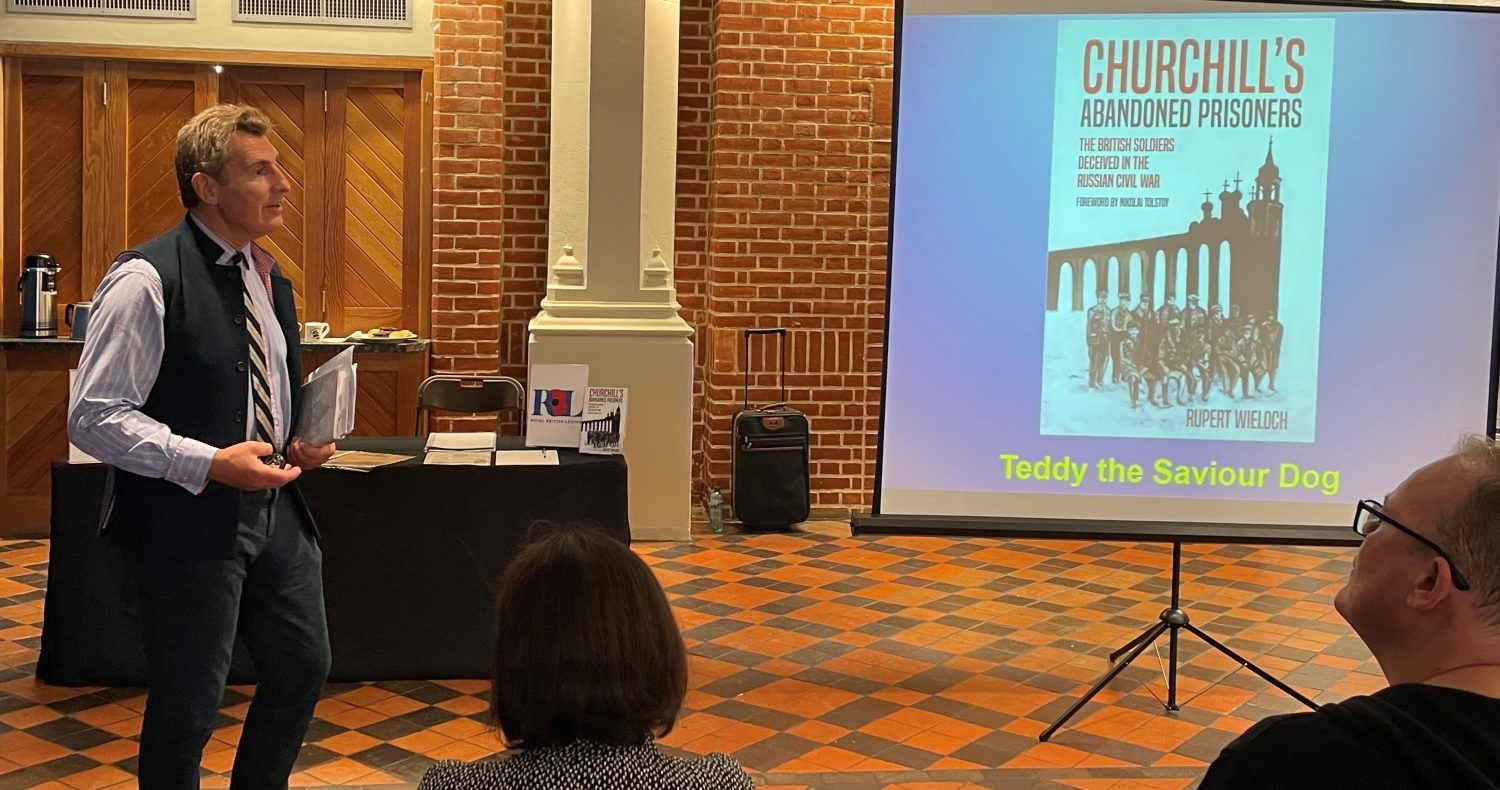
At the Ardingly Military Show this Saturday and Sunday, I will explain why this was Churchill’s “second darkest hour” and how the Prime Minister faced down his enemies and responded to the calamities of 1942 (including the death of the King’s brother in an RAF aircraft). The author’s programme begins at 10 o’clock on 28 September and my half hour time-slot is 3 p.m.

Churchill in North Africa 1942

Airborne and Amphibious Anniversaries

The courageous Airborne Division and other Allied formations that fought at Arnhem 80 years has been widely commemmorated this week. The story, which was brilliantly told in one of the most iconic war films ever made A Bridge Too Far, has made Operation Market Garden into something akin to the Charge of the Light Brigade. However, to my mind, the media narrative for World War II focuses too much on this operation and not enough on the other fierce fighting elsewhere in Europe, such as in Finland, Italy and the Balkans.

One of the greatest tensions in the British Armed Forces during the past fifty years has been the about the utility and efficacy of early entry forces between the Royal Marines and the Parachute Regiment. So on the eightieth anniversary, it is worth remembering a long forgotten amphibious landing on the same day that Arnhem was effectively lost, that led to the defeat of the German army in Greece and Albania – Operation Mercerised.

The beach chosen for Numbers 2 and 40 Commando was Kakome, six miles north of Sarande. The successful landing followed by a brutal two-week fight in monsoon conditions against 2,000 German soldiers led to the capture of the port and the surrender of the German garrison on Corfu. After the war, the Albanian leader whitewashed all British involvement from the records and it was only much later that a memorial was created in Tirana to commemorate the British soldiers and airmen (and Chaplain) who fell in this “side-show”.

With thanks to commandoveterans.co