
October Commemorations

As we approach Armistice Day, it is worth remembering four of the most iconic British battles of the past that were fought on 23 and 25 October.

On St Crispin’s Day, 25 October 1415, an exhausted band of English and Welsh archers defeated a French army twice their size at Agincourt (north of the Somme). This battle was immortalised by Shakespeare and came to represent part of British identity (I remember having to learn the lines of Henry V’s speech at school), but sadly its importance seems to be fading in the modern education curriculum.

On 23 October 1805, Admiral Nelson led the British fleet to a devastating victory at Trafalgar and thus established the United Kingdom as the pre-eminent world naval power for more than 100 years. The man and the myths around him were part of my upbringing, but it was not until I attended a Royal Navy Trafalgar Night that I realised how this battle is stitched into the uniform of every British matelot serving today.

On 25 October 1854, the Charge of the Light Brigade at the Battle of Balaklava provided a shock that reverberated around the world. Immortalised through the pens of the great war journalist, William Howard Russell and the poet laureate Alfred Lord Tennyson and the brushes of Richard Caton-Woodville and Elizabeth Butler, this action, as much as any other, established the unwavering sense of duty that epitomised the British approach to the futile trench offensives of World War I.

On 23 October 1942, a thousand gun barrage began the fourth battle at El Alamein. Lieutenant General Bernard Montgomery was quick to proclaim conceptual ownership of the success, but in reality his plan went awry on two occasions. The first big hiccup resulted in a heated row on 25 October between him and X Corps Commander, Lieutenant General Herbert Lumsden. The dispute about cavalry advancing against well sited artillery guns ironically took place on the 88th anniversary of the Charge of the Light Brigade. After Monty adjusted his plans, he eventually wore down Rommel’s forces and won a superb victory for the Allies. Winston Churchill described this battle as the turning point of the war and its influence was enshrined by the stories of the Desert Rats and through images created by artists such as Terence Cuneo.

I learned about all these iconic conflicts when I was at school, but I wonder how many British children are now being taught about how these historical battles established the freedoms that they enjoy on a day-to-day basis? We will remember them!

New Head of the British Army

I was delighted to be invited by the current Chief of the General Staff to an event last week, where I heard all about his successor. The Government have thankfully steered away from a politically correct appointment and selected someone with a similar background to Patrick Sanders’ predecessor.

Currently, the two most important criteria for the Crown and the Country are ceremonial duties and what I nickname stiletto operations, when Special Forces are deployed without attribution (or difficult Parliamentary debates). It is understandable, therefore, that the new head of the British Army is a Guardsman who held the appointment of Director Special Forces.

General Sanders’ successor (who will not take up the appointment until next year) was born two months before I was commissioned and attended Winston Churchill’s alma mater. He was awarded a DSO for commanding the Grenadier Guards in Afghanistan, so he has the full respect of our closest ally. I have no doubt that he will be included in the most secret briefings about how the US military is supporting both Ukraine and Israel and will be able to advise the Government on these and other UK operations of vital national interest.

Winston Churchill’s Alma Mater

The Wailing Wall Will Be Weeping

The assault on Gaza in retaliation for the terrorist attacks in Israel has divided the world this week. I am no longer in the Middle East Peace Process working group on Security Co-operation, but when I attended the twice yearly gatherings we were given privileged information about the 2006 Israel-Hezbollah war and the last major Israel Defence Forces operation in Gaza in 2008, codenamed Cast Lead.

It does appear that the lessons that were identified after these conflicts have been forgotten as everything that happened before is happening again. One of the big ideas that was enshrined in our post 9/11 work was to build a coalition and win the media war. There was enormous sympathy for Israel after the initial attacks, but the Knesset seems to be losing this global support as human rights organisations claim the force being used is disproportionate.

As the new war plays out, the World has suddenly become even more dangerous, with a significant risk of the conflict spilling across the Middle East and North Africa. In the meantime, the families of civilians killed on both sides will be grieving like never before.

Middle East War A Sign Of The Times

The violence that has erupted on the 50th anniversary of the Yom Kippur War has reinforced the point I made last week about how conflict can spread if the Permanent Members of the UN are at loggerheads. It reminds me of my talk to the Middle East Peace Process working group on arms control and security before the Arab Spring. We are in the middle of an era of persistent conflict driven by six trends: Globalisation; Climate Change; Poverty Gap; Fragile States; Weapons of Mass Destruction; and uncertain natural resource availability.

The war itself is a classic example of how David approached his fight with Goliath using asymmetric methods, but as with many modern conflicts, there is little distinction between the military and civilian participants.

So where next in this tumultuous year and how will it all end? There are many contested lands in Africa and Asia, but the Balkans remains a tinderbox in Bosnia and Kosovo, so I won’t be surprised if some old grudges are used in these hot-spots by political opportunists before the end of the year. The only solution is for the UN Security Council to reach an accord about Ukraine, but I cannot see that happening soon because there is such a deep ideological divide between the West and the rest.

Army Report Shows Little Has Been Done To Address Sexual Harassment Culture

The sad case of nineteen-year-old Gunner Jaysley Beck has exposed the deep problems that remain at British Army training establishments. Larkhill, where she was based, is essentially the training depot for all artillery training from guns to missiles and radar to drones. The fact that she was harassed by her boss there not only shows how the culture is ingrained in the institution, but also demonstrates the low standard of leadership at the base.

This case is worse than the Rafiq racism at Yorkshire CCC because it led to an unnecessary death. However, there are some similarities in the way it is being handled at the very top and I expect this will be used by the Government to change the culture in the Services by trying to appoint a woman to be the Head of the Army. However, as we have seen in the Metropolitan Police, having a woman at the head of an organisation doesn’t always solve the behavioural problems.

Larkhill Training Base

Supporting the Underdog…Sometimes

It is good to hear that the Government is still committed to supporting Ukraine in its fight for independence and that the new Defence Secretary is sending more British troops to bolster the weary Ukrainian army. At its heart, Britain’s allegiance is down to a cultural instinct for fairness and supporting the underdog against bullies. So why are we doing nothing about another scandalous ethnic clear-out on the edge of Europe?

Baku is as much a part of Europe as Kiev. It has hosted the 2015 European games, a European Grand Prix and European soccer finals, but the Government there has been allowed to get away with a military assault similar to Putin’s invasion of Ukraine. The disputed area of Nagorno-Karabakh has been contested since the Bolshevik takeover in 1918. Seventy years later, as the Soviet Union collapsed, a bitter war was fought between Armenians and Azerbaijanis, but this did not resolve the issues and after mediation by the Organization for Security and Cooperation in Europe a ceasefire was agreed on 12 May 1994.

The latest conflict intensified partly because the OSCE work, which is co-chaired by France, Russia and the USA, stalled due to the war in Ukraine. This is a clear example of how conflict can spread in a region if the UN Permanent Members are at loggerheads.

It is reported on the BBC that almost 100,000 people have fled from Nagorno-Karabakh after Azerbaijan seized the region last week. Armenia, which is considered to be a developing country, cannot cope with the instability this will cause, so the Caucasus tinder-box is likely to be lit again if the European Union and the United Nations does not take effective action.

Baku – On the Edge of Europe

Kaba Call is a Very Dangerous Precedent

The call by the Home Office to the MoD asking for armed support to the Metropolitan police this weekend sets a very dangerous precedent in the 21st Century.

Military Aid to Civil Power in mainland Britain has not been used for over a century because our volunteer army has always been very nervous about any role which pitches it against sections of the society from which it draws its recruits.

The Peterloo Massacre in 1819, the Merthyr Riots in 1831 and the Preston Strike in 1842 all proved to be disastrous examples of the British Government using armed troops against the civilian population. They led to the decision not to use armed soldiers to deal with civilian crimes despite many terrible mass shootings and terrorist attacks in the past 50 years. You only have to look at when the army was sent to Northern Ireland in 1969 to see the risks associated with any form of military support to the police.

Senior army officers, serving in the MoD, should have red-flagged this Home Office request as their predecessors did in the past. So is this an example of a major change in military policy, or of a naïve duty officer who did not know his, or her, history?

22 Civilians were killed by the Sherwood Foresters outside the Westgate Hotel in 1839

Southampton International Boat Show

The first day of the biggest boat festival in Britain was a resounding success with glorious weather and astounding attractions that made me yearn to be at sea.

Apart from the fascinating talks on the Foredeck Stage, my favourite was, without doubt, the three master tall ship Thalassa, which reminded me of my time on the historic Baltic Brig Zebu, sailing around the Bay Islands off Honduras. On my next visit, I will look for a Saint Pierre Dory similar to the one that took fourteen of us to Guanaja to dive among the turtles.

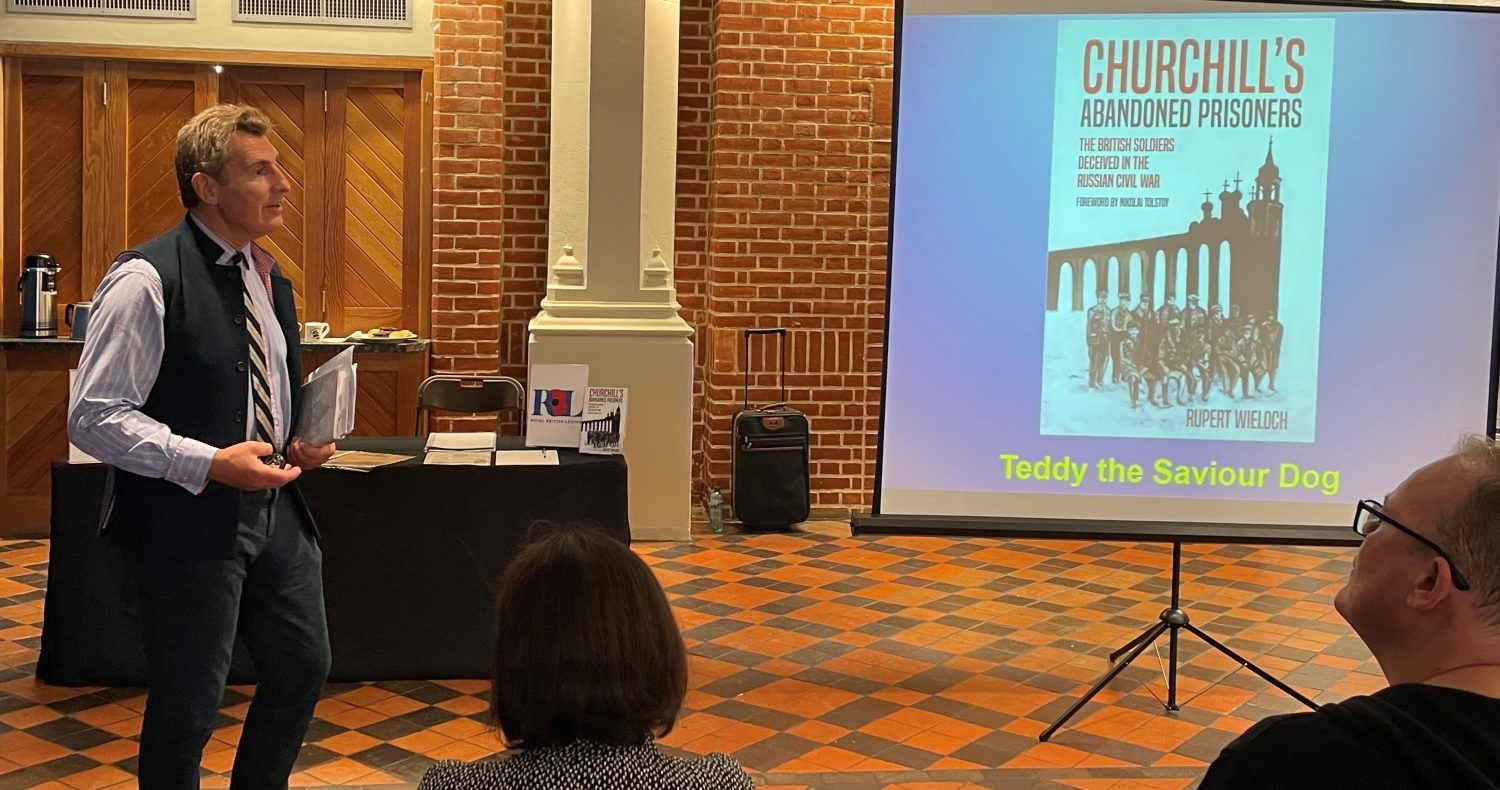
Next Sunday, 24th September, at 3 p.m. I will be giving my talk about the British boats, Royal Navy Prisoners of War and Hampshire Soldiers involved in the Russian Civil War and signing books in Paul and Gina’s excellent Medina Bookshop which is opposite the Bottle Stage.

The Road to Derna’s Devastation

Those who know Libya and Cyrenaica (North-East Libya) in particular, will not be surprised by the disaster that unfolded when Storm Daniel destroyed the dams and caused the devastation that we are seeing on our screens.

Two hundred years ago, Derna was arguably the most important Ottoman port between Alexandria and Tripoli. As a vital trading post, it was the focus of America’s first overseas foray, when a small band of Marines and mercenaries, supported by the US Frigate, Argus captured the castle. However, when Mussolini ruled Libya, he developed the deep water harbour at Tobruk, which relegated Derna to a lesser role in the country.

Derna’s decline continued through Colonel Gadhafi’s regime, when it was populated by devout families, many of whom were independent of the authoritarian network that existed in Libya. As a result, the area was deprived of the oil-wealth and neglected by administrators. The problems were compounded after 2012, when Islamic State established a strong foothold and failed to complete essential maintenance tasks in the city and its surrounds.

The winter weather on the heights above Derna can be atrocious and the rugged wadi is very difficult to traverse. The soil is rich, but turns into a morass very quickly with torrential rain, which is why relief efforts are being hampered and progress has been so slow. It really does need a co-ordinated humanitarian assistance operation run by the United Nations to rescue the situation.

Thanks to Maher Abdussalam for this photograph

North African Calamities

The earthquake in Morocco and Storm Daniel in Libya have brought misery to thousands of people living on the south coast of the Mediterranean Sea. I know both the affected areas and it is a great sadness to see the effects of these natural disasters in places where it is hard to live well.

Both of the calamities have affected widespread areas. In Morocco, the route I took to Marrakesh passes very close to the epicentre, so I know how difficult it is to reach the affected villages. In Libya, all the coastal cities and ports, from Tripoli to Tobruk have been affected but it is isolated Derna that has had the worst of the damage with two broken dams in the Jebel Akhdar causing horrific devastation.

The greatest sadness is that the governments of these regions are very suspicious of outsiders and so vital international humanitarian assistance is not being deployed as rapidly as it might be, so unnecessary lives are being lost. It is time for the United Nations to step up to the mark…

Damage has also been done to the ancient historical sites between Benghazi and Derna.