How To Build A Coalition

In my first book, I revealed what the UK contributed to American thinking after 9/11 (the worst ever terrorist attack on British people). The most important intervention was to delay the US military attacks in Afghanistan until Washington had built a multi-national coalition, similar to those constructed for the Korean War and the Liberation of Kuwait. This was not an easy task.

It certainly helped our cause that the North Atlantic Council declared that 9/11 was a breach of Article 5, treating it as an attack against all Members. In solidarity, the United Nations had also adopted Resolution 1368, calling on all States to bring to justice the perpetrators of the horrific attacks in New York, Washington and Pennsylvania. However, it still needed a huge amount of shuttle diplomacy and creative thinking to develop an agreed strategy.

In the discussions at the highest level in London, there was a tension between the advocates of “strategic patience” and those who were keen to “attack first and ask questions afterwards”. This was replicated in Washington where the hawkish Donald Rumsfeld’s Department of Defense disagreed with Colin Powell’s State Department. When the Prime Minister and a bevy of senior military officers travelled to Washington 10 days after the event, he managed to sway the argument in favour of building a coalition. We then had a frantic week when all the British Ambassadors were given the task of persuading foreign governments to make a contribution to the campaign. To my mind, the resulting coalition is one of the great diplomatic successes of world history. It stood firm until Washington pulled the plug 20 years later and should be used as a teaching example on International Relations university degrees.

Not The Third Gulf War

This week, I have seen several media outlets and analysts tracing the current conflict in the Gulf to the war to liberate Kuwait. Their logic is that the 21st century Middle East wars stem from the decision by the international community (President George Bush) not to overthrow Saddam Hussein after defeating his army in 1991.

I have a different perspective based on the premise that 1979 was the beginning of the modern era. That year began with the Iranian Revolution and continued with horrific massacres by the PLO in Israel and the Muslim Brotherhood in Syria (as well as terrorist attacks in Rhodesia, Britain, Norway, Columbia, USA, Spain, Ireland (Mountbatten) and Netherlands). At the end of the year the siege of the Grand Mosque of Mecca resulted in 244 deaths and spawned Al Qu’aida. To cap it all, the Soviet Union invaded Afghanistan on 24 December.

For me, the First Gulf War began the following year when Saddam Hussein invaded Iran. In the same way that the US Administration supported the Taliban when it attacked Soviet troops, Washington also backed Saddam with satellite and radar intelligence, economic loans, artillery and vehicles. However, this did not result in victory and over a million people died in this conventional war, which lasted nearly eight years. Strangely, both Israel and the USA supported Iran, with the secret Iran-Contra arms sales becoming a national scandal in 1987.

The British Army studied this First Gulf War as it happened and I remember every year, there was a question in the Staff College Exam about its implications. A friend who was translating for the United Nations stayed in Baghdad and his notes remind me of one of the most relevant lessons for 2026: Iraq attempted to expand the scope of the war to reduce its duration, but Iran was happy to plan for the long haul…

Can Soft Power Ever Trump Hard Power?

As I wait patiently in Sri Lanka for a return flight to Blighty, I am seized by this question about the efficacy of soft power. A major part of the Strategic Defence Review in 2010 centred on Defence Diplomacy. The buzz words were “Down Stream Conflict Prevention”, which translated to a range of confidence-building initiatives from disarmament to deployed training assistance teams. However the Down Side was less hard power with huge cuts to the Army to pay for two new Aircraft Carriers and the supporting fleet ships (which have played no part in the latest Middle East crisis).

The prognosis is not good. Hard power is still King, with the advocates of soft power looking impotent. The key tenets of the Geneva convention and other military law books have been shredded. The UN’s agreed rules (minimum force, self-defence, impartiality and consent) have been ignored. And yet, through it all, HM King Charles III has today highlighted a soft power international institution of 56 member nations that has lasted the test of time and still speaks as a Force For Good.

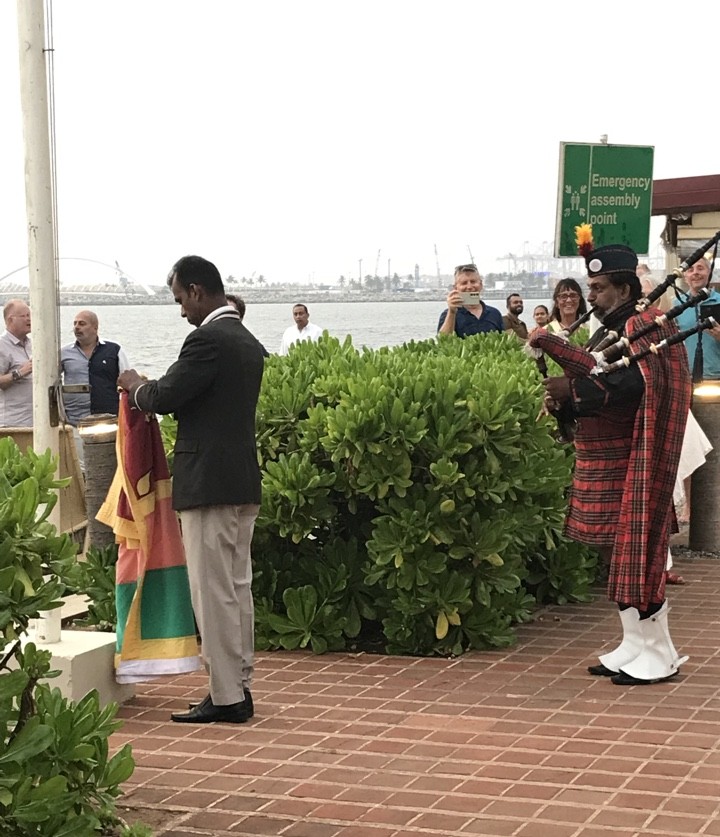
Sri Lanka this week has epitomised the spirit of the Commonwealth by responding to a humanitarian SOS, while maintaining its independence and neutrality. I have found that Sril Lankans are immensely proud of their heritage, whether that is the ancient influences, or the Dutch, Potuguese and British eras. They stopped the Japanese advance after Hong Kong and Singapore surrendered in World War II and have very effective Armed Forces. But, as they raise their flag here each morning, they also act as a beacon to others by saying “don’t give up on soft power”.

RAF Akrotiri Too Important To Lose

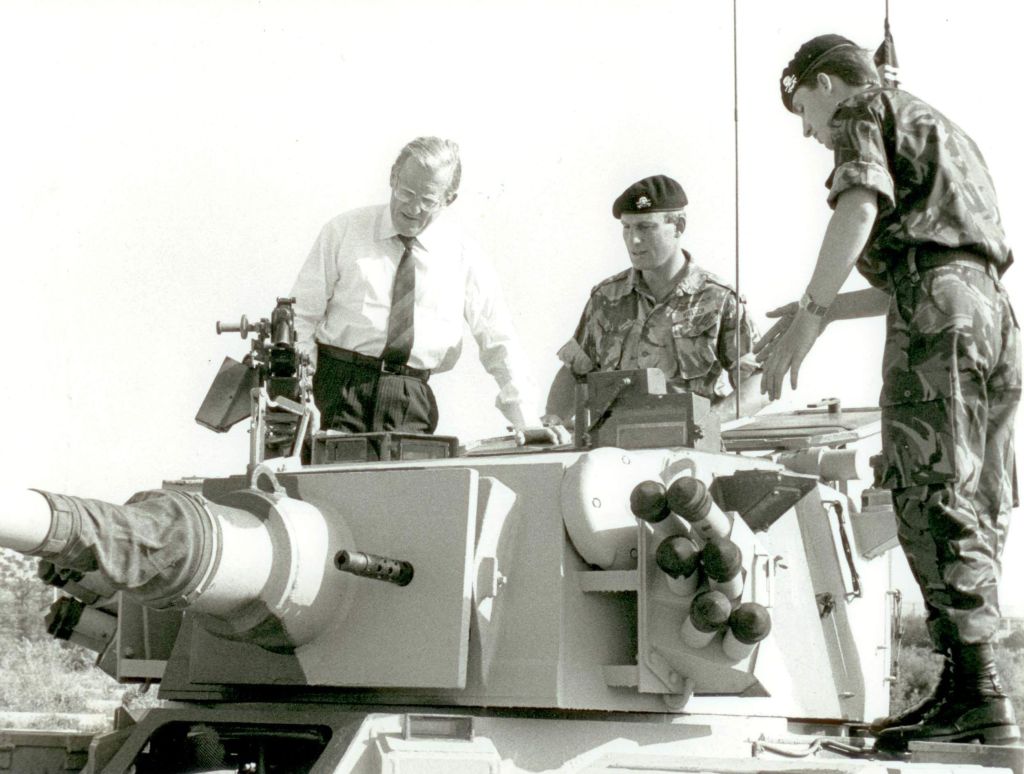
I spent two years patrolling the British Sovereign Base Areas in Cyprus at a pivotal time in world history. It began with attacks by Colonel Gadhaffi and the fall of the Berlin Wall, but was followed by the Gulf War. Shortly before Saddam Hussein invaded Kuwait, I was honoured to host the Secretary of State for Defence, Tom King, at my base (see below).

At the time, Cyprus was considered to be an unimportant side-show compared with the British Army of the Rhine and Northern Ireland. However, each Monday I was briefed on the changing security situation in the Balkans, Trans-Caucasus and Middle East. The briefers were listening in to communications acroos the region and predicted all the wars that took place in the 1990s, sharing that information with the Pentagon. When the Gulf War began, RAF Akrotiri was used as a forward mounting base for British Forces and apart from providing security with my armoured cars, i also had to deploy a tank troop forward with 7 Armoured Brigade.

Thirty five years after the Gulf War, when all our bases in Germany have closed and Northern Ireland is relatively quiet, we are seeing again the vital national importance of the British bases in Cyprus. Saddam Hussein was a conventional opponent and did not manage to attack our bases in 1990. However, Iran is an asymmetric adversary with highly sophisticated weaponry and as we have already seen, they have the means and capability to prolong this war if it comes to national survival.

Just to put this into context, Iran is three times the size of Ukraine and its population is close to 90 million – it is not Gaza. I have seen the modelling results of a US-Iran conflict and it did not look good for the world. As we discovered in Libya when the French Prime Minister declared that Gadhaffi would be toppled by April, air power alone does not achieve regime change and will only lead to chaos unles you back it up with boots on the ground. That means blood, treasure and time. Sadly, the two British hospitals in Cyprus have both been demolished. Lets hope that we don’t need to build another one.

Think To The Finish

Of all the principles of war, the one that springs to mind this weekend is the first, Selection and Maintenance of the Aim. Having worked at the military-strategic level, it is the one that causes most friction between senior military commanders and politicians. Perhaps this is the cause of the apparent rift this week between the Chairman of the Joint Chiefs of Staff and the US President over Operation Epic Fury.

Is this a case of 19th century gun-boat diplomacy on steroids, or merely a distraction to avoid scrutiny about the American Epstein Scandal and ICE deaths? Whatever it is, I do remember that after 9/11 (the worst terrorist attack on British people) there was a moral debate in England about assassination and regime change, both of which were, under British law, deemed illegal.

Those were the days when the West still advocated a rules-based, international order, in order to preserve Global peace. However, that no longer seems to be the Aim. Instead, we have a wish list of objectives, which appear to be leading to chaos, instability and inevitably a civil-war that will dwarf the recent conflict in Syria. As America found in Iraq and Afghanistan, the challenge is not achieving military victory, but winning the subsequent peace.