The pronouncement by a former Prime Minister that Britain should send non-combat troops to safe parts of Ukraine is very misleading. In the first place, we have all seen that no part of Ukraine is safe from Russian missile, or drone attacks – the front line is everywhere. More importantly, the notion that the British Army has non-combat troops is false. All British soldiers are first and foremost taught to fight; their secondary skill set might take them to different echelons, but logisticians, administrators, medics and mechanics must be able to pass their personal weapons test every year, as well as other battlefield competences.
Don’t get me wrong, I agree that we should send British troops to Ukraine now to demonstrate to Russia that the West believes Ukraine must remain a free, independent country in Europe. Waiting for a ceasefire, as the current government suggests, only plays into Putin’s hands and allows him to keep advancing in the Donbas.
The talk about defence spending is also poorly articulated. We need politicians to translate 3.5% of GDP into meaningfulness (i.e. what it costs to send brigades, ships and aircraft to war and sustain them for two or three years). It is time to instil a readiness culture in Britain, including the reintroduction of national service for all British school-leavers.
The Conference in Munich this weekend that has attracted World Leaders to speak about their security concerns and in particular the North Atlantic partnership, is not in fact a NATO conference. That happened the day before in a low-key affair in Brussels between most of the NATO Ministers of Defence (notably Pete Hesgeth, the US secretary of War, did not attend).
The most interesting aspect of these past five days is the press conference given by the NATO Secretary General Mark Rutte on Wednesday evening. After his introduction, he was quizzed by 14 different news and media outlets, including some big hitters such as the Wall Street Journal and AFP. Two Russian News in Exile reporters asked questions as did two that broadcast in Ukraine and journalists from Denmark, Finland, Iceland, Germany, Turkey and Japan. The only interest from London was Reuters’ Brussels based European Affairs Editor, who asked about the rebranding of NATO’s northern flank activities into “Arctic Sentry”.
Understandably, the main undercurrent of the conference was Rutte’s perspective of President Trump’s recent announcements, including when and by how much the USA will reduce its footprint in Europe. However, the greatest challenge to the Secretary General was the Japanese reporter, who asked specifically about the Chinese threat to the Arctic (which it does not border).
It may appear that a lot has changed since the US Secretary of Defence, Jim Mattis gave a joint press conference in Brussels with the then Secretary General, Jens Stoltenberg, exactly nine years ago today and said thank you for “the warm welcome back to my second home”. However, in March 2003, the UK MoD published a document that suggested a number of possible shocks, including a “Future US administration withdraws co-operation from international bodies such as the UN and NATO”.
I am looking forward to giving my talk on two iconic battles of the Korean War tomorrow evening. As we sit between the 75th anniversaries of the Inchon Landings and the Battle of Imjin, it is worth reflecting on four lessons from that three year war, which resulted in over 2 Million deaths.
The first lesson is how the Free World came together to fight an authoritarian regime that invaded its neighbour. We saw the same thing when Iraq invaded Kuwait.
The second is how President Truman said no when General MacArthur demanded that he should widen the war for all-out victory. Above all else, avoid nuclear Armageddon.
The third is about humanitarian operations to save refugees (the Miracle of Christmas) and prevent the forcible repatriation of prisoners when it is known they will be slaughtered (as happened to the Cossacks after World War II).
The fourth is how 73 years after the armistice, there is still no peace treaty and the Demilitarized Zone is the most heavily guarded frontier in the World. As MacArthur said: “There is no substitute for Victory”.
Each of these lessons is relevant to what is happening in Ukraine four years after Russia launched a full-scale invasion into its neighbour. If there is an armistice this year, we don’t have far to look for a precedent.
Three topics relevant to British Armed Forces tempted me to provide some context this week. However, I will save my observations about UN Failures, Chinese Security and Defence and The World’s Policeman for later in the month. Instead, I will concentrate on reinforcing my previous post about the false accusation that the USA never asked for military support in Afghanistan with evidence from two archival reports.
The first is drawn from the MoD lessons learned report from Afghanistan in 2002. “Following the defeat and removal of the Taleban regime in late 2001, the UK main effort focused on the leadership of ISAF to stabilise Kabul and ensure the meeting of the Loya Jurga in June. Meanwhile, US forces concentrated on the destruction of the remaining enemy pockets of resistance, particularly in the south-east, culminating in Operation Anaconda launched on 1 March 2002. The US was surprised at the ferocity of this battle and lost 8 men KIA… On 15 March 2002, the US formally requested the deployment of a UK fighting force and three days later [our] Secretary of State announced the deployment of a battle group, based on 45 Commando Royal Marines to come under tactical command of Commander 10 US Mountain Division.” In this role, Task Force Jacana as it was known, undertook four deliberate operations on the front line before it was withdrawn in July.There were many tactical lessons identified, but strategically, the mission was a huge success as it sent a powerful message to both friendly and hostile nations and allowed the Loya Jurga trouble-free progress against a background of relative security.
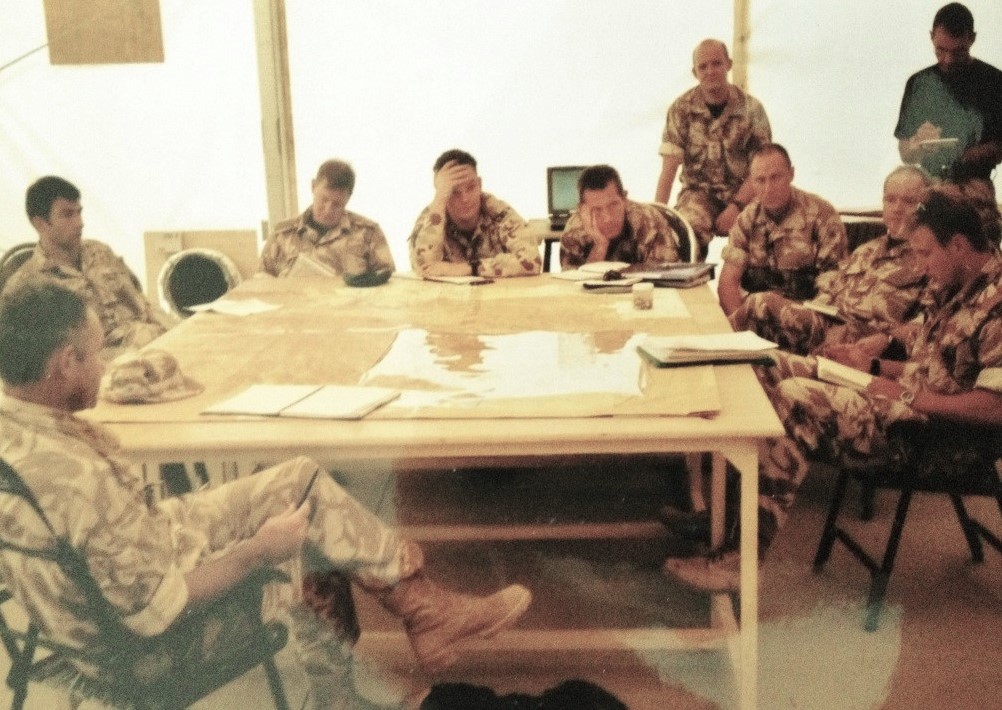
The second substantial US request came in 2005. Up to this point, British Armed Forces had run a very successful Provincial Reconstruction Team (PRT) in the north of the country. Washington now asked London if it would take over the PRT in Helmand Province as it was having difficulty gaining traction outside of the provincial capital. I deployed in October with the planning team to Kandahar, where a Royal Air Force Harrier flight was based. My task was to map out the urgent operational requirements for soldiers, vehicles, helicopters and the costs of third line support. There were also officers there to advise on reconstruction and economic alternatives to opium production. At that time, it was envisaged that we would send the Royal Anglian Regiment in 2006. However, this was changed to Headquarters 16 Air Assault Brigade together with a Parachute battalion. The resulting combat operation has been well-covered by the media in the past fortnight.
My final thought on this is to recognise the loss and sacrifices of all NATO nations in Afghanistan. I was a member of a guard of honour in Kandahar to say farewell to a Chinook crew that had been shot down. It was not just US and UK troops in that Ramp Parade saluting the dead as they were carried onto the C-17. All the national contingents were represented. To denigrate their contribution, as we heard last week, really is beyond the pale.
Helmand Task Force Planning Group in Kandahar 2005

 Rupert Wieloch