Violence in Libya… Again

The BBC and national newspapers are reporting a spate of violence in Libya yesterday as if war has erupted again. However…

This appears to be a case of a political leader from Cyrenaica entering the capital city with his own bodyguards without clearing it beforehand with the Tripoli militias. The routes the convoy took were all blocked by vehicle check points, who controlled the access. The tragic death of at least 23 people certainly lifts this above the normal night time clashes along the militia boundaries, but this level of violence was often seen in the Gadhafi era, when groups opposing the government were mercilessly crushed in places such as Benghazi and Misrata.

Most western governments have strict rules about visitors from other countries with armed bodyguards. As Prince Harry has found, it is a very sensitive area and it is not unreasonable for weapons to be removed before entering someone else’s fiefdom. What is needed in Libya is a heavy-hitting UN Head of Mission to arbitrate between the two sides and offer guidance to the Libyan politicians trying to reintegrate their country into the international community. The sooner one is appointed, the better for (almost) everyone.

Tripoli Militia

Boris Back to Benghazi with the UN?

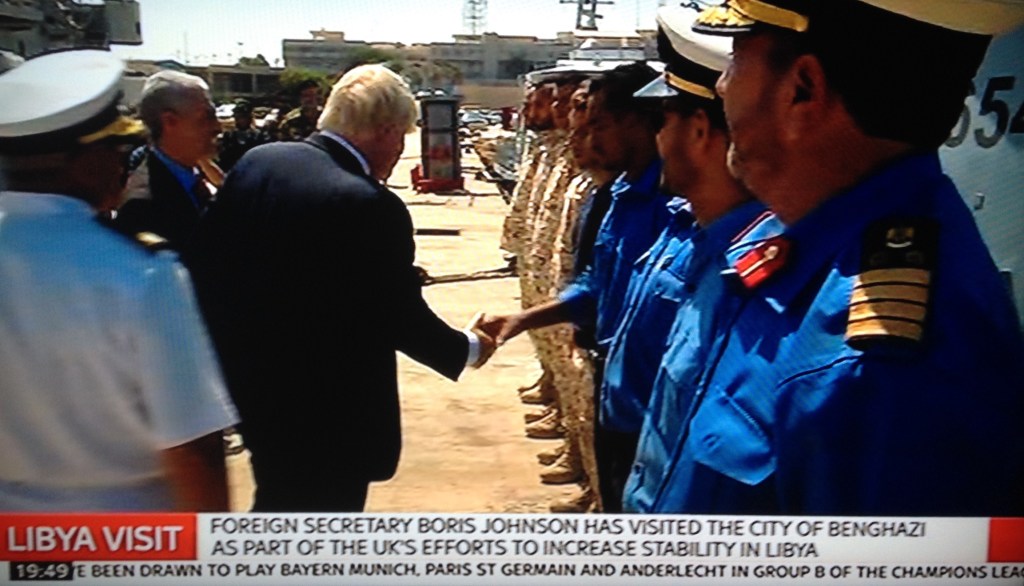
It is hard to believe that exactly five years ago, Boris Johnson was in Benghazi being introduced to some of the military personnel that Britain had trained as part of the education programme I introduced in 2012. As Foreign Secretary and then Prime Minister, he gained a good reputation with his efforts to bring stability to the country and to negotiate a peace deal during the Berlin conference before the pandemic.

We know that he is looking for a new job, and that the UN is looking for a heavy hitting politician, who can bring the sides together, so it seems to be the perfect match.

Libya UN Tangle

The saga to appoint a new head of the UN Support Mission in Libya has taken another twist this week. The proposal to appoint Senagalese diplomat Abdoulaye Bitali as the Secretary’s General’s Special Representative has been rejected by the government in Tripoli. After nine UN envoys in the past ten years, they are seeking a serious heavyweight, who can mediate between the two political authorities in Tobruk and Tripoli and deliver the presidential election that was postponed last December.

Unfortunately, this entanglement in New York is unlikely to be solved while the war in Ukraine continues. Moscow still backs Khalifa Haftar, who controls the Libyan Army in Cyrenaica and is aligned with the Tobruk House of Representatives. The USA will not allow them to take over the whole country, but neither is it in a position to help militarily. Turkey is the main provider of security assistance in Tripolitania, but it is not doing enough to support disarmament and the humanitarian agenda.

France and Italy would like to take the lead, but their history in North Africa provides a stumbling block. Egypt and OPEC countries are seen as rivals and active competitors. The only country that has a proven track record of long-term diplomatic support and friendship (when Libya was a very poor country) is Britain. It is time that London provided another strong nomination for the UNSMIL lead.

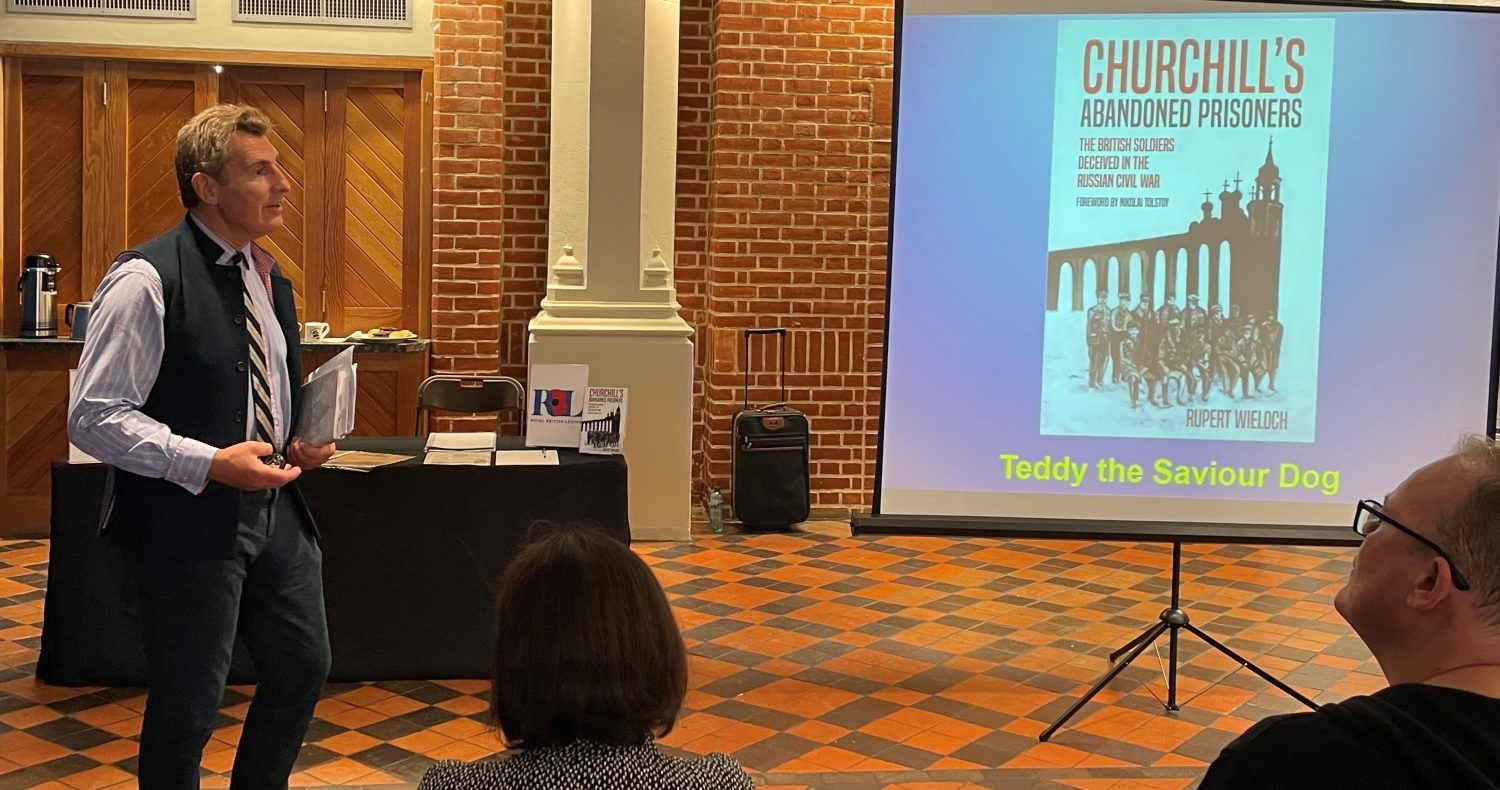
Book Talk at the English Speaking Union in London

I was fortunate to meet HRH The Duke of Edinburgh at Dartmouth House after leaving school, when I was a member of the English Speaking Union. It is therefore a huge delight to be invited to return to Charles Street and give a talk in the historic Churchill Room on Monday 19th September.

The event starts with a drinks reception at 6 pm when I will display items belonging to the main characters in the book. Apart from explaining why the details of the British campaign in Siberia were covered-up after the prisoners returned from their Moscow jails, I will discuss the impact on Anglo-Russian relations and the relevance to the current crisis in Ukraine.

I will also reveal new information about the prisoners and their ordeal, gleaned from their descendants and friends, who have contacted me since the book’s publication. Full details are available at: https://www.esu.org/event/london-branch-talk-by-author-rupert-wieloch-on-his-book-churchills-abandoned-prisoners/

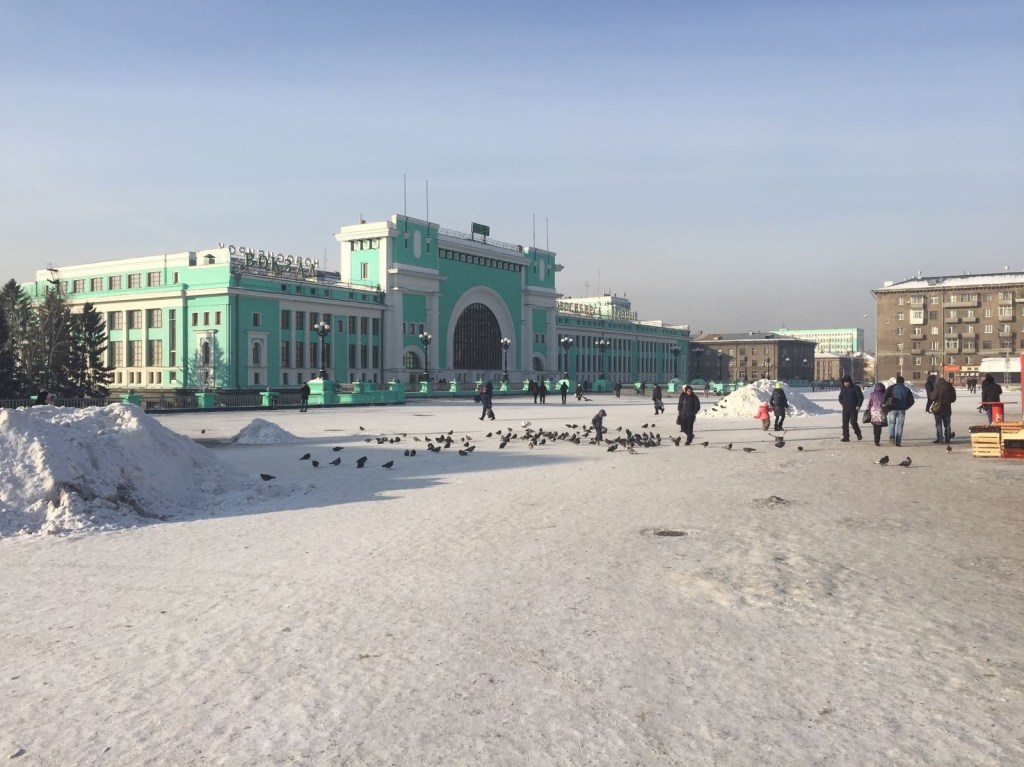
Novo-Nikolaevsk (Novosibersk) railway station, where the prisoners bought jewels from the Urals

Sunday Times on Nuclear War

The Sunday Times article on nuclear war in Ukraine echoes my earlier posts about Russian strategy. There is no doubt that Putin is willing to use tactical nuclear weapons such as the Iskander missile system, with a three mile radius of devastation, if the ends justify the means.

With China and India seemingly unwilling to side with the West, the onus lies with NATO to support Ukrainian resistance. However, the bill of £5 billion per month to maintain the current defences would be dwarfed, if it is decided to build an offensive force to retake the land Russia has annexed.

We all know that if the West falters, it will only be a matter of time before Putin restocks his army and takes another slice of the pie. What we need is strong political leadership and a reinvestment in conventional armed forces, but the financial crisis is unlikely to make this a popular choice. It is the high costs of the alternatives that makes it more likely that we will do nothing, but even that has unpalatable consequences.

Russian Tactical Nuclear Weapon System

Leadership Contenders Ignore Defence Report

This week, the House of Commons Defence Select committee published a damning report on the government’s defence and security review, exposing the flaws in the plan and the complacency in the Ministry of Defence.

Previously, I have written about the dire equipment programme (Ajax tank, etc.), lack of training, capability gaps and money siphoned from soldiers to spies, but this is the first official report that reveals the extent of the problem in the light of Putin’s war in Ukraine. Perhaps the most damning comment is the way the armed forces are being used to backfill civilian tasks because Whitehall departments are seemingly incapable of “responding to crises”.

This report provides a tremendous opportunity for the two aspiring Prime Ministers to stake a claim with the large military and former military community, who are part of their electorate. However, not for the first time, Defence has been relegated by politicians (and the media) to a side-show.

General Brian Horrocks provides an amusing vignette about the British Army of the 1930s, which “had been reduced largely to a flag basis” and lance corporals hung boards around their necks bearing the words “this represents a section”. We have a similar system now for our tanks, but it is hard to see the next government following the advice of the Select Committee and reversing the decline of the past 12 years…unless Putin wins in Ukraine.

Multinational Special Forces Operations

NATO’s Special Forces Operations in Bosnia were mostly planned in support of the International Criminal Tribunal for the former Yugoslavia (ICTY), which was formed by a UN Resolution in May 1993. Half the operations I worked on were to detain Persons Indicted for War Crimes (PIFWCs); the other half were designed to collect evidence for the Chief Prosecutor in the Hague.

The operations involved three groups. The local NATO multinational brigade provided the outer cordon; then the Italian Carabinieri Multinational Specialized Unit (MSU) deployed to set up the inner cordon and finally the Special Forces from one of four designated countries flew in to complete the mission. Secrecy was paramount and when a leak led to the failure of an operation, the US 3* general asked me to find the source. Everyone believed it was the Carabinieri, but I discovered they were blameless and traced the treachery to the heart of the NATO headquarters.

My deep respect for the Italian Carabinieri increased exponentially when I worked with them again in Baghdad. After the tragic attack against the MSU at Nasiriyah, which resulted in the highest loss of Italian soldiers since World War II, they did more than anyone to upgrade the Iraqi National Police until NATO pulled out in 2011. Their high standards of morality in the face of extreme provocation clearly demonstrated that they are an exemplary model of Special Forces in the modern world.

Italian Carabinieri Training Iraqi National Police 2008

Special Forces Morality in The Sunday Times

The article about the SAS in Afghanistan in today’s Sunday Times is the latest attack on Britain’s special forces by those who do not know the full story. Yes, there are always grey areas on operations. For example, the ICRC informed me in 2001 that SF soldiers in Afghanistan were pretending to be civilian charity workers as they travelled around the countryside and this was compromising their own humanitarian efforts.

However, facing an enemy that one day is tending the fields and the next is planting an improvised explosive device that will not differentiate between civilians and soldiers is like entering a boxing ring blindfolded with one arm tied behind your back. Of course, there will be times when the intelligence is not as good as it needs to be, resulting in tragic consequences, but there is a planning process whereby these operations are checked by competent people before they are authorised.

Strangely, my regiment was training police and patrolling in Helmand Province in 2012 and mentoring the Afghan Army on Operation Herrick 17, around the times of the alleged SAS killings. I visited them in Lashkar Gah in December 2012, when they were doing a fantastic job helping the local communities to resist the brutal fanatics who subjected them to terrifying treatment.

It is quite right that the Chief of the Defence Staff has said that he will not re-open the two investigations because we are yet to see any new evidence from either the BBC, or The Sunday Times.

Operation Herrick

SAS Accusations

I was very disappointed with the Panorama programme last night. Of course, if Richard Bilton has new evidence the MoD should reopen their investigation into the alleged killing of unarmed detainees in Helmand. However, what we were shown was a few bullet holes, which he alleged were caused by British soldiers 11 years ago and the testimony of Taliban sympathisers, much of it second-hand. The subsequent emails by people in London who did not know the context and the views of Australians who were nowhere near the events do not pass any threshold for a legal case.

Colonel Lee of the Royal Marines cannot be faulted for his clear exposition of some of the legal and moral rights and wrongs, but no-one explained how these operations were launched in the immediate aftermath of the assassination of British soldiers in Gereshk, Nah-e Saraj and Nad-Alieriod. Nor did anyone explain how NATO and Coalition Special Operations worked in unison with capital cities. We have all seen the imagery of the operation to lift Usama bin Laden and the level of scrutiny from the highest commanders for these sorts of operation, but Bilton provided no discussion about how many soldiers lives were saved in Musa Qala and Sangin and there was nothing about the intelligence feeds on operations of these sorts.

This subject (Morality in Asymmetric War) was debated at length in London in the aftermath of 9/11 under the “Greater Good Principle” and there is plenty of open source material such as the Oxford Research Group papers, which the programme could have used to avoid the criticisms of poor research and bias.

Helmand Task Force Planning Group

Ukraine Support

The venue for my talk on British involvement in the Russian Civil War this week was Holland Park, where this statue of Vladimir the Great has stood since 1988. Although he had to fight fiercely to become Grand Prince of Kiev, he became an iconic ruler and is recognised widely as a saint. His reign was marked by relative peace as he reformed some of the harsher laws in Kiev and abolished the death penalty and judicial torture.

Speaking about the British help to Russia in the First World War, which morphed into support for the White Russians, I reminded the audience of the similarities with the current assistance provided to Ukraine against the Russian invasion and identified some of the mistakes of the past. History should be used to make the future better, not worse.