
The Last British Soldier Captured in Russia

Unfortunately, the names of those captured with Brian Horrocks at Krasnoyarsk in January 1920, found in the National Archives, does not match the list of the prisoners who returned from Russia that was published in the London newspapers in November that year. This conundrum took me some time to unravel and it was not until I received a letter from the Soldiers of Gloucestershire Museum that I traced the background of the last prisoner, who joined Horrocks in the Andronovsky Prison.

Lionel Ricketts Grant was a case maker who attended Linden Road School and went on to work at the Gloucester Railway Carriage and Wagon Works and the Stephens Jam Works before joining the Army on 23 February 1916. He was wounded in France, torpedoed in the Mediterranean and served with the 7th Gloucestershire Regiment in Mesopotamia and southern Russia, before ending up in Baku. He is very modest about his adventures between the Armistice and his capture by the Bolsheviks in July 1920, but these matched any of the extraordinary stories I read in World War I memoirs.

His letter to home from the Russian Quarantine Camp at Terijoki, dated 12 November 1920, was the missing jigsaw piece that not only provided vital information about what happened to the prisoners after they left Petrograd, but also corroborated other stories, such as the role of the French Red Cross heroine, Madame Charpentier. After returning home, he married Fanny Rosina Hoyland and they emigrated to Australia on the SS Beltana with their son, Gordon. During the Second World War, he served with the Australian Army.
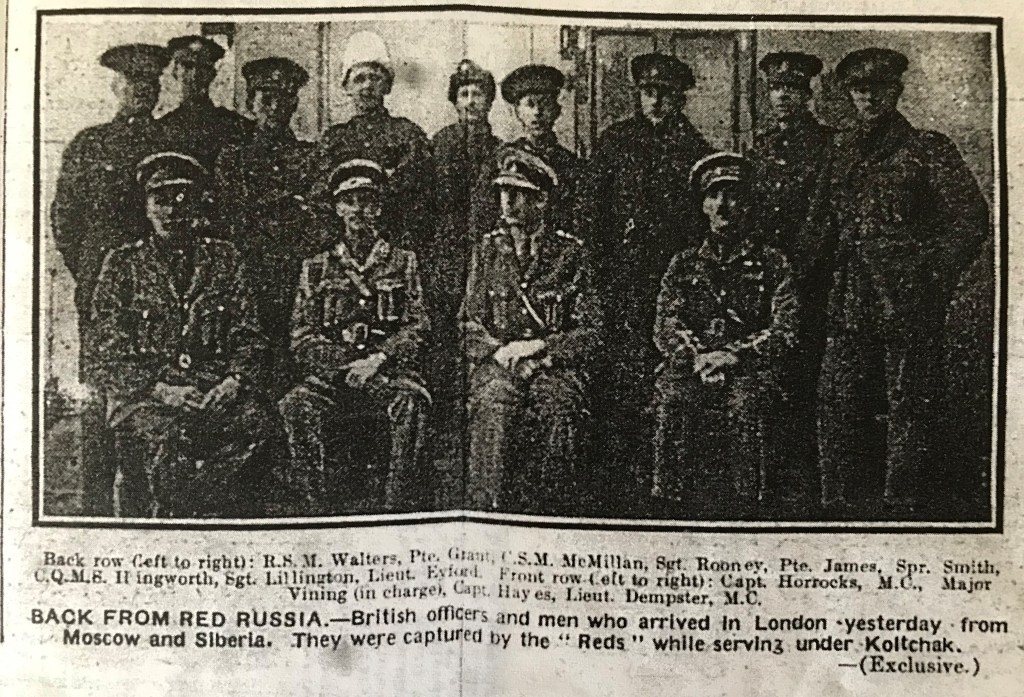
Lionel Grant is the tall soldier standing second from the left with a Gloucestershire Cap Badge

Irish War Correspondent and British Spy

I am glad that since I wrote about Francis McCullagh in Churchill’s Abandoned Prisoners, Wikipedia has published a biography about him, but I am disappointed that no mention is made about his two most important contributions to international affairs.

The first of these was his coverage of the Italian invasion of Libya in 1911. The great newspaper editor WT Stead, who died on the Titanic, described his contribution as “a potent influence on the policy of Great Britain” and wrote: “Francis McCullagh…whose ready pen, whose fearless spirit and whose presence in the firing line has made it possible to make the great public realize the criminality of the plunder-raid on Tripoli.”

His second pivotal role was during his time as a British Army officer in Siberia, for which he was appointed MBE (not mentioned in the Wikipedia article). He had already served in the Royal Irish Fusiliers at Gallipoli and due to his extensive knowledge of eastern Russia, he was sent as part of Churchill’s original team in 1918, as can be seen in the attached secret document. While working for the White Russian government in Omsk, he took charge of propaganda for the Supreme Ruler and worked closely with British Military Intelligence chief, Cecil Cameron, before he was captured with Brian Horrocks in Krasnoyarsk. His extraordinary adventures, torture and escape are told in Chapter 11 of Churchill’s Abandoned Prisoners. When McCullagh eventually returned to London, MI6 interviewed him at the Hyde Park Hotel in May 1920 and the unique information he provided heavily influenced Lloyd George’s government in their foreign policy decisions about Russia.

War With Russia In 20 Years Time?

The opening salvo in the annual game of Treasury brinkmanship began today with the Chancellor hinting at Tax Cuts and NATO warning about a Russian invasion. The scaremongering headline that governments are falling behind in their war preparations is designed to pre-empt the “behind-doors” arguments about cuts to the Defence Budget that will need to be made, in order to find the financial headroom for tax cuts. But where is the analysis that led the Head of the NATO Military Committee to liken the current situation to the 1930s when appeasement was at its height?

In 2001, before 9/11, the UK established a concepts and doctrine centre at Shrivenham that was charged with looking thirty years ahead to inform force development and the ten-year procurement of suitable equipment. I was in the original team that moved into the Alanbrooke Centre and used to teach MA students about the process of future-gazing across seven dimensions (Physical, Social, Science and Tech, Economic, Legal, Political and Military). This work was led brilliantly by a civil servant and included input from a huge array of subject matter experts. There was no other government department formally doing this and the results, known as Global Strategic Trends, were used widely in Britain and also fed into many NATO committees. It continues to be routinely updated and even has its own wikipedia page.

As we approach the second anniversary of Putin’s invasion of Ukraine, the latest analysis from the Alanbrooke Centre has led NATO to become even more pessimistic about the future. That is not to say that we have to stock our larders in case there is a Russian invasion of Britain this year, but it does mean that the Ministers charged with our protection must fund a civil-military organisation that prepares the country for the worst case scenario in the next decade.

Russian Threat

Canadian Contingent

The British Army owed a huge debt to the Canadian Expeditionary Force (CEF) that landed at Vladivostok in 1918, but never advanced further than the Maritime State. When the Ottawa government ordered their troops to return home, many individual officers and soldiers chose to transfer to the British Army and serve in Omsk and Ekaterinburg. A huge amount of their equipment was also donated to the remaining Allies and most importantly, the Canadian Mounted Police had to transfer 308 of their beloved horses to the Jaeger Artillery Brigade.

Five of the prisoners-of-war with Brian Horrocks, who attended the Café Royal dinner and signed the back of the photograph in my earlier posting, had Canadian connections. Edward Stephens was born in Bristol, but was working in Canada when the war began, so he joined the CEF, before transferring on 17 May 1919 to the British Army. Twenty year-old Bernard Eyeford was born in Manitoba to an Icelandic family and joined the Canadian Rifles, before receiving a commission in the British Army as a Railway Traffic Officer at the same time as Stephens. Fifty year-old “Uncle Charlie” Fred Walters was born in Birmingham and emigrated with his family to Canada where he worked as a riveter in Moosejaw, Saskatchewan. He joined the Canadian infantry, but transferred to the Royal Engineers in Siberia and after the war, he worked for the Canadian Railroad. Emerson MacMillan was born in Ontario, but was working in Philadelphia when he joined the British Army in 1918 and did not return to Canada after the war. Sapper David Smith, who also signed the photograph, was born in Canada, but his address on the back of the card is listed as Ashford in Kent.

Perhaps the most interesting Canadian did not attend the dinner. Bill Dempster, who was born in York County Ontario and married Eleanor Osbourne in 1911, was awarded a Military Cross for an act of outstanding bravery in Flanders on 26th September 1918. After his release from the Moscow prisons, he returned to Ontario and served in the York Rangers militia while working for the Provincial Police. In 1945, he became quite a celebrity when he was called as a key witness by the Royal Commission investigating political corruption. He spent three days giving evidence and was described unkindly by the Windsor Daily Star as head of the local “gestapo”. This clearly did not upset him too much as he was one of the oldest survivors of the prisoners, reaching the grand age of ninety in 1980.

Two of the Canadian Contingent After Their Capture By The Red Army

Important Siberian Evidence

Brian Horrocks (A Full Life), Leonard Vining (Held By The Bolsheviks) and Francis McCullough (A Prisoner of the Reds) all published memoirs of their time as prisoners-of war in Russia. Although their recollections provided vital material for my book, they were not as important as the telegrams and diplomatic despatches from the British Consuls and army headquarters that I found in various archives. The one in the photograph below, signed by Charles Wickham (who was in the same house at Harrow as Winston Churchill) provided me with a comprehensive list of the “missing” soldiers in January 1920.

This nominal roll offers three crucial bits of information that led to more discoveries: the soldiers’ ranks, regiments and initials. It also gave me an important policy perspective by differentiating between the “Military Mission” and the “Railway Mission” (there were also medical, logistics and intelligence missions, but these had closed by 1920). As with many military documents, there are mistakes, so the information has to be cross-checked (for example, Horrocks’ initials are BG not RG, Johnston is spelled with an “e” and the list does not include Sapper Smith).

Four soldiers are included who did not share prison time with Horrocks and managed to leave Russia in April: Lieutenant Colonel EA Johnston; Major RE Mills; Captain HCG (or HGO) Smith; and CSM G Campbell. In the Siberian Honours, Eric Archibald Johnston was awarded a CBE and Edgar Ronald Mills earned one of the very few Military Crosses (he was later appointed an OBE for his work in World War II). We know that Johnston worked in Argentina on the Cordoba Central Railway and was also awarded the Japanese Order of the Rising Sun 4th Class, but sadly, I haven’t been able to trace the later lives of Smith and Campbell.

After the Café Royal dinner, the intrepid prisoners scattered around the globe. My next post will focus on the Canadian contingent, including the indominable “Uncle Charlie”, who emigrated from Birmingham with his wife, Emily, to Moosejaw in Saskatchewan.

Anglo-Russian Weddings

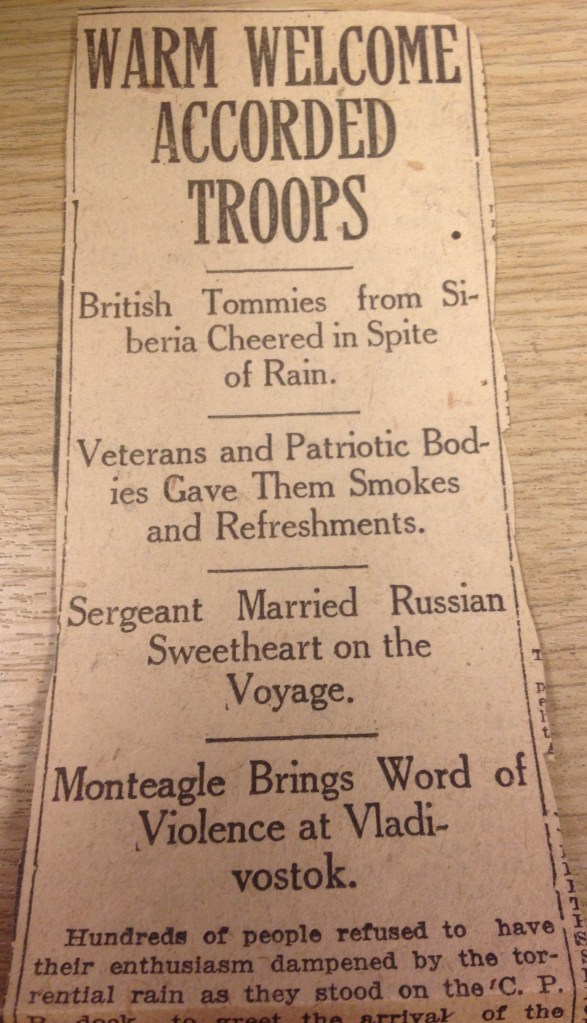
There is plenty of evidence to show that many American and British soldiers returned from Siberia with Russian wives. I found a record in the National Archives compiled by the British headquarters in Vladivostock, which lists some of the women that qualified through marriage for evacuation by sea passage. Other discoveries from university and regimental archives included the Vancouver newspaper article in the photograph below, which reports that among the 1,226 soldiers brought by the SS Monteagle were 76 Canadians and a Hampshire sergeant who married a Russian woman on board the ship.

In the case of Warrant Officer Emerson MacMillan, who was a prisoner with Brian Horrocks, his betrothed qualified as a nurse in the American Red Cross while he was in training with the Inns of Court OTC. She served in Vladivostok while Emerson was in Omsk, but did not see him because the Red Cross forbade nurses from having any relationships with men while on duty. However, while he was a prisoner-of-war in Moscow, Dallas waited for him in England and when he returned, they married in London.

The MacMillans later lived in the USA, Brazil, Portugal and Switzerland. During World War II, Emerson tracked German agents in Brazil and was awarded an OBE for his work for MI6.

Siberian Wedding and Visit to Ukraine

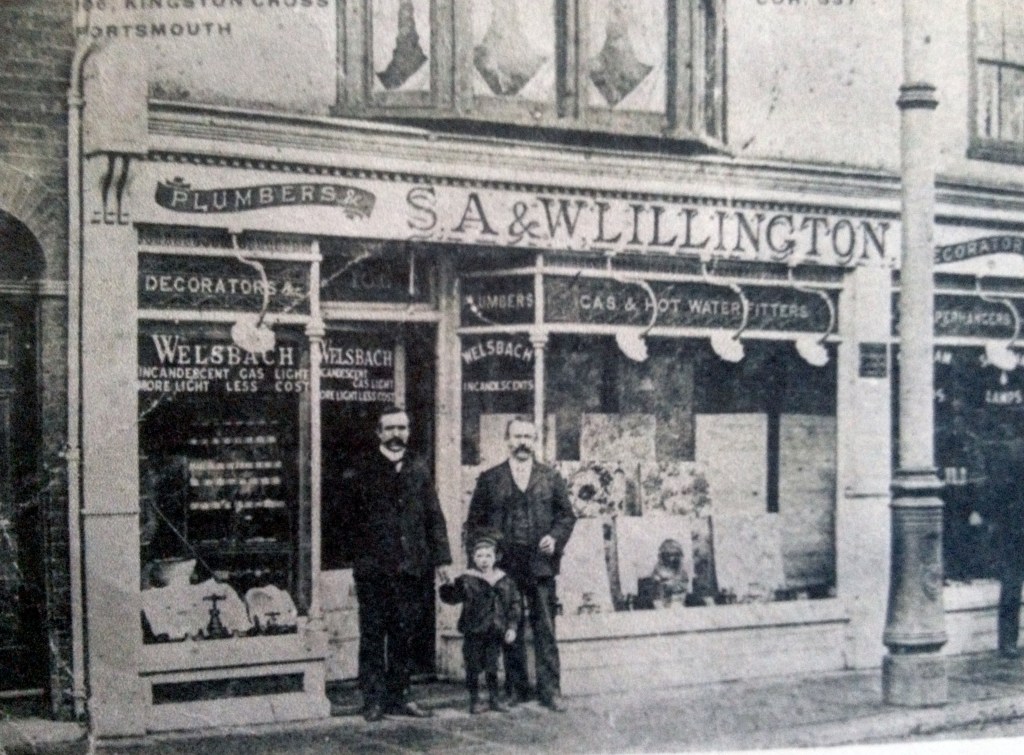
Bob Lillington learned Russian in Omsk and married a local girl named Ludmilla Martinova on 31 August 1919. Bob’s young bride travelled back to Scotland while he was a prisoner of the Bolsheviks and so he did not attend the dinner at the Café Royal because he took a train directly to join his wife in Edinburgh. Eventually, they moved south to Portsmouth where Bob’s father and uncle ran a plumbing business and Bob started work as an accountant at the Royal Dockyard.

I was delighted when his grandson contacted me and described what happened to the family after they settled in Portsmouth. Bob continued to serve in the Hampshire Regiment and was awarded the Territorial Efficiency Medal before the Second World War. Ludmilla was allowed to travel to Lviv in Ukraine to see her mother in 1955. By then, the Lillingtons were living with their sons in Southwood Road, Hayling Island.

Bob was not the only soldier to gain a wife from his time in Siberia as my next post will explain.

The Lillington Plumbing Business in Portsmouth

The Nevilles In China

After the Café Royal dinner, the prisoners-of-war who returned to London with Brian Horrocks dispersed around the world. Captain “Bim” Neville travelled home to Australia before moving to China with his family. This well-travelled officer had married “Alia” in Petrograd in 1914 and they had a daughter, Alice (6 years old) and son, Ronald (3 years old), when they settled in Shanghai.

During the Second World War, the Neville family was interned in Yangchow (or Yangtzepoo) Civil Assembly Centre Number 3 where Alice had to wear the armband in the photograph below. They left China in 1945, just as Eric Hayes was appointed Head of the British Military Mission, but it is not known whether the two former inmates of the Andronovsky prison had a reunion in Shanghai.

My next post will be about the Hampshire sergeant who married a Russian girl in Omsk before Trotsky captured the White capital.

With Grateful Thanks To The Australian War Memorial

Percy James’ Frostbite and Later Life

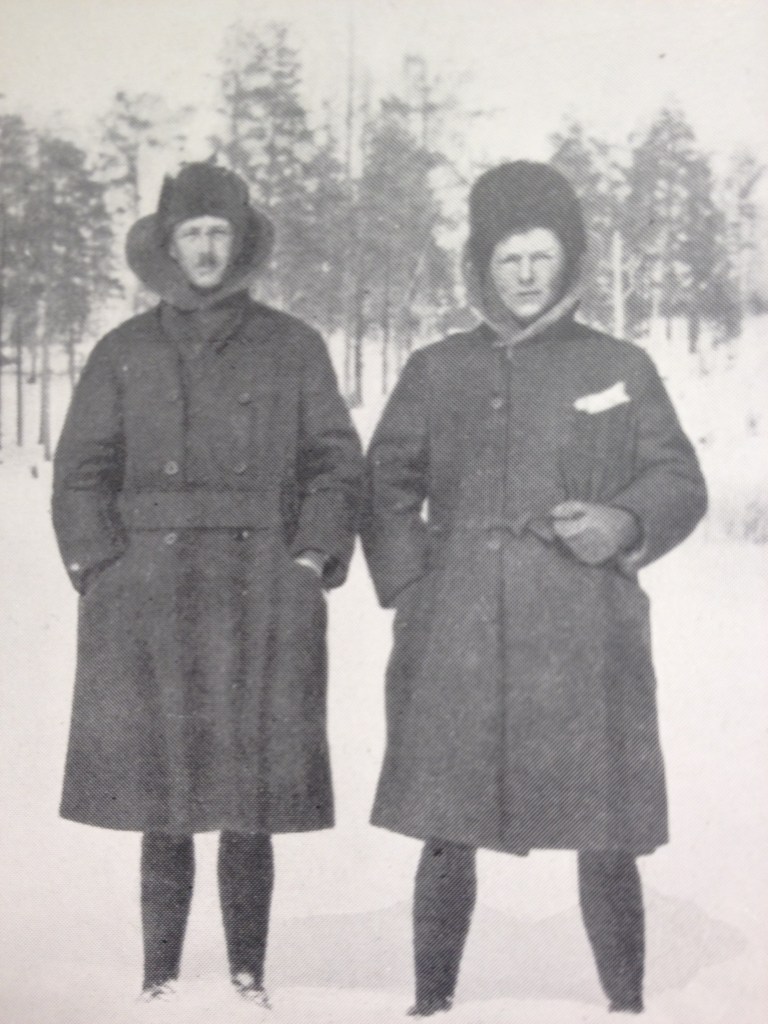
When the locomotive engine pulling the British carriages broke down, the British soldiers arranged for the 24 ladies and unfit men to be transferred to a Polish train, while they set off in sleighs along the track beside the Trans Siberian Railway Line. The Siberian winter of 1919-1920 was particularly cold and the temperature that evening dropped rapidly to below minus 20 degrees Celsius.

Some of the soldiers had purchased felt boots, but unfortunately, Percy James still wore the British issue boots which were about as useful “as a sick headache”, according to the group’s leader, Leonard Vining. When they stopped for the night, Percy had lost the feeling in a foot that had enormous blisters on the toes and heel. Vining, who knew enough about medicine not to be dangerous, applied goose fat to the frost-bitten areas and bought a pair of pymwy (felt boots) for Percy and these probably saved him from succumbing to gangrene.

Percy had transferred from the Somerset and Cornwall Light Infantry to the 1st/9th Cyclist Battalion of the Hampshire Regiment and in Omsk, he volunteered to help save the British civilians fleeing from the Red Terror. After the war, he was demobilised and returned to his family in Bath, but then married and settled in Bournemouth. I was delighted to be contacted by his family in Canada, who informed me that he helped put out fires during the Blitz in the Second World War and lived to a grand old age surrounded by his grandchildren.

Percy in India in 1918, before deploying to Siberia

Typhus Torment

Captain Dwyer Augustus Neville was not originally in Brian Horrocks’ group of prisoners. He contracted epidemic typhus during the great retreat from Omsk and was abandoned in a hospital by the accompanying British soldiers. Eventually, he recovered and was sent to join the last British prisoners-of-war in the Andronovsky prison in Moscow. We know that he returned with Horrocks because he is listed in the commander’s diary and the newspaper articles published after they all returned safely to London, even though he was not in the photograph taken at Liverpool Street Station.

Neville was born in Australia on 18th April 1892 and joined the Royal Flying Corps in February 1917. In September 1918, he was on patrol in an SE5A with Number 41 Squadron RAF when he was forced down over the Comines Canal and captured by the German Army. After he was repatriated on 13th December 1918, he volunteered for Siberia and a year later was stuck in the long line of trains trying to reach the safe haven of Vladivostok. 

Dwyer attended the Café Royal dinner and then returned to Australia. Contracting typhus does not appear to have shortened his life as he lived until October 1979 and is buried with his wife at Buderim Cemetery, Queensland.

The other prisoner to succumb to typhus was Sergeant Frank Illingworth, who can be seen in the photograph below. He had transferred from the infantry to the Royal Engineers and joined the British Railway Mission in Omsk. His signature can be clearly seen next to Horrocks’ on the Café Royal card, but I haven’t been able to discover for certain what happened to him in later life.

Typhus wasn’t the only medical problem facing the prisoners and the next post will cover the equally fearsome threat of frostbite.