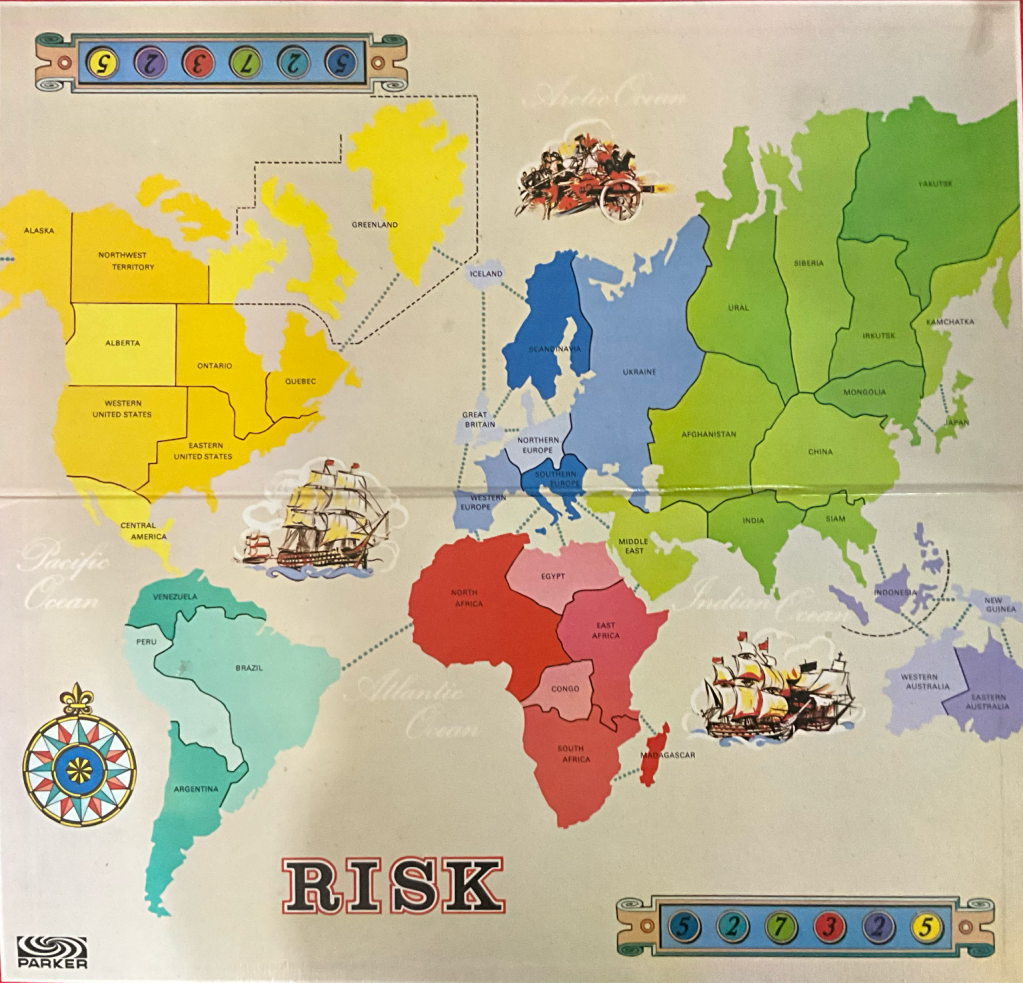
When I was six years old, I spent much time playing board-games with my best friend, who went on to win the coveted “Financial Journalist of the Year Award in the City of London. Our favourite game was a strategy game of diplomacy, conflict and conquest named Risk, which required six players to form alliances, in order to capture territories and eventually take over the world. Inevitably, the six players were whittled down to my friend and I, who could never quite defeat each other and so, more often than not it ended in a draw.
At the time of the Cold War, Risk replicated the duality of a World dominated by the USSR and USA. Today, Globalisation has provided economic opportunities for regional powers to shed their obsequience and establish true independence. So why have Russia and America launched unpopular wars against very large independent countries, which are only benefitting their main economic rival? The simple answer is medium-range missiles, natural resources and allies. In the case of Putin, his red lines have always been: Preventing Kyiv from allowing NATO to build missile bases within range of Moscow; natural resources in the Donetsk; and Ukraine’s control of the Russian outlet into the Black Sea. Strangely, America’s red lines are similar: missiles that can reach Israel (with or without nuclear warheads); Iran’s key allies (Hezbollah, Hamas, Houthis); and Tehran’s control of the Strait of Hormuz.
So after the failed diplomacy in Islamabad, the US President is again following Putin’s strategy by reverting to containment with a beefed-up blockade and an enormous amount of propaganda, in order to reinforce Israel’s Red Lines. In this high powered game of Risk, it does seem that America and Russia are using the same strategy, but that they are being outflanked by the third player, XI Jinping, because China has just become the number one car seller in the UK.
 Rupert Wieloch