Congratulations to the British Red Cross for their magnificent humanitarian deeds since 1870.
Many Red Cross volunteers served abroad in World War I after permission was granted by the War Office for them to work with the Royal Army Medical Corps. Some of these courageous medics journeyed to Russia with the British Military Missions, or to the two Anglo-Russian hospitals in Petrograd.
Lady Muriel Paget and Lady Sybil Grey opened a hospital on Nevski Prospekt in 1916 for severely wounded soldiers and followed this up with field hospitals in the Ukraine, where British nurses witnessed the misery of the Eastern Front. Across the Neva river, the British Colony Hospital continued to look after patients when the Dmitri closed down after the revolution. The matron, Mrs Violet Froom was described as Ambassador, Parson and everything combined in a Government report. It is certainly true that Captain Brian Horrocks and the last British prisoners-of-war were extremely grateful for the care and comforts that she provided when they passed through in October 1920.
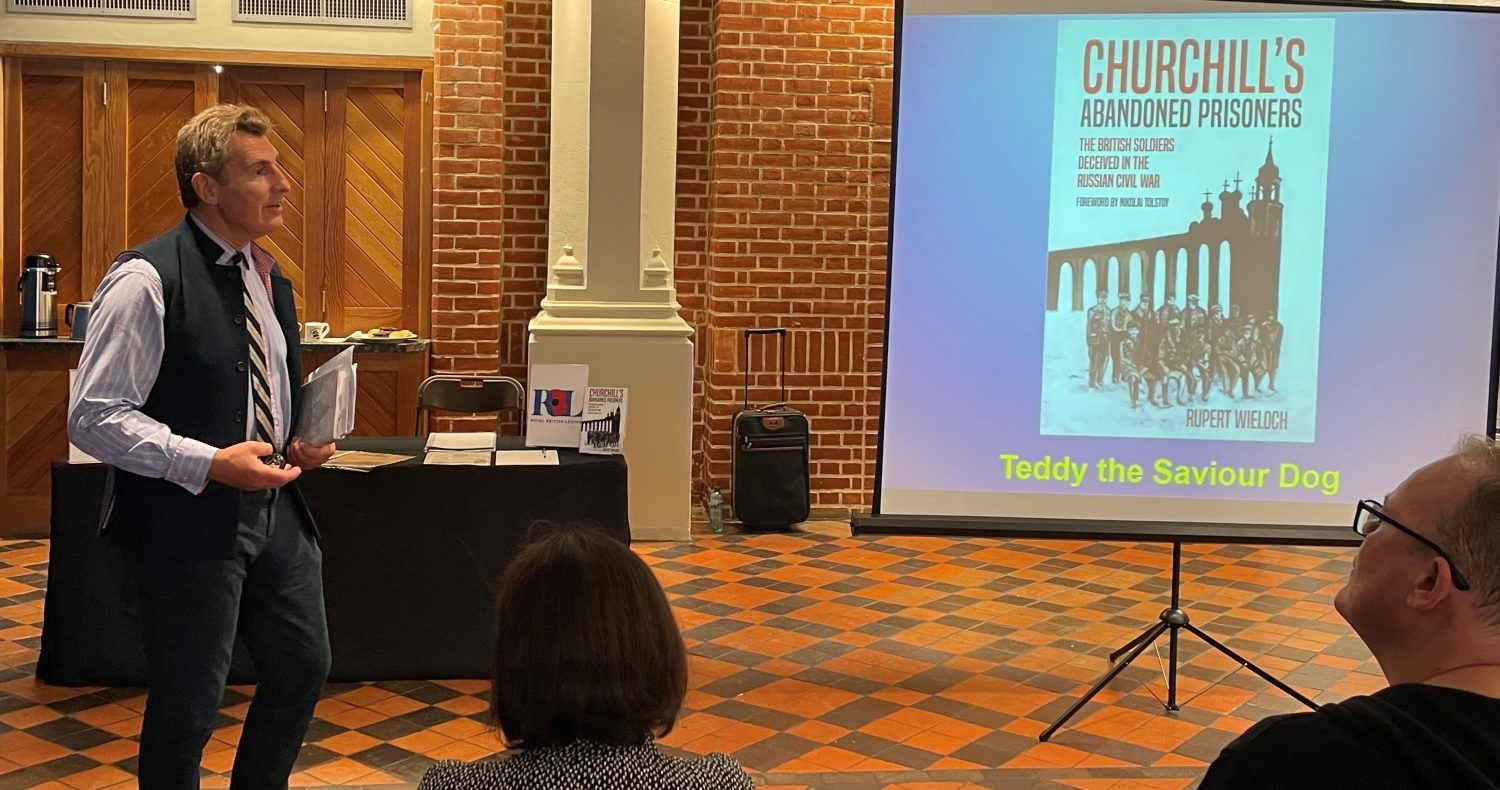
See chapters 1, 4, 5, 9, 12, 15 & 16 for VAD, Red Cross and medical stories in Churchill’s Abandoned Prisoners.
The British Colony Hospital on the Vassily Ostroff in 2019
In 1920, the Secret Police in Moscow were actively recruiting British citizens as spies against their government. A black wine trader, Benjamin Jeffers, revealed how he resisted their approaches when he was interviewed by Lord Emmot’s Committee to Collect Information on Russia in London on 15th June 1920.
Jeffers had been imprisoned for several months when he was offered freedom if he would work for the Soviet Government. His interrogators explained: “If you catch a gentleman the first time we will give you 1,000 Roubles and the next time we will give you 15,000 Roubles…” To ensure he understood the consequences of failure, they added bluntly: “If you do not catch anybody, we will shoot you.”
When the last British prisoners-of-war were sent to Ivanovsky, the Secret Police tried to recruit them as spies and they gave Emerson MacMillan and the other soldiers a “pamphlet telling them to shoot their officers and join the Bolsheviks”. This fell on stony ground because Leonard Vining and Brian Horrocks were regarded so highly by everyone under their command. See Chapters 11 and 15 of Churchill’s Abandoned Prisoners for further details.
On Thursday 22nd July 1920, fourteen British soldiers were taken under guard to the V-Tcheka headquarters at 2 Lubjanka in Moscow. The Russian dissident George Popov distinguished this from its neighbour the M-Tcheka when he wrote: “If there was any difference between them, Lubjanka 14 had the reputation of being a medieval torture chamber and scene of mass murders in an even higher degree than Lubjanka 2”.
The search of the soldiers’ belongings took five hours and many precious items were confiscated. Captain Brian Horrocks MC, who later earned fame in World War II, managed to read a piece of paper written by the vindictive Omsk commissar that stated the British had enormous sums of money hidden in their belongings. As a result, they were herded into a single cell and spent a torrid night as the officers were interrogated individually by the secret police.
The next morning, they put on their smartest uniforms as they were marched across Moscow to the notorious Ivanovsky monastery, which the Bolsheviks had converted into a political jail. There were 457 prisoners in Ivanovsky, of whom 45 were women. There was no hope here and some of the inmates who had been imprisoned without trial since 1918 had gone quite mad.
See Chapter 15 of Churchill’s Abandoned Prisoners.
In July 1920, no one was allowed to traffic a commodity in the new communist country and to reinforce the rules, the authorities imposed the death penalty on anyone suspected of “speculating”. Tons of fish rotted in Tobolsk and at Omsk, there was a mountain of salt and yet across the Ural Mountains there was none and people were starving.
The quartermaster of the British prisoners, Emerson MacMillan secretly stowed about 40 pounds of salt in a kit bag when they departed under guard for Moscow on 14th July. At the evening halt, a woman in rags stepped up to him and whispered Salee? While the guards were distracted, a handful of salt was traded for a pound of prized butter and the woman seemed to think she had the best of the deal.
On 29th June 1920, Brigadier Joss Percy left Sevastopol with the remnants of the British Mission to Southern Russia. The 150 officers and 450 soldiers had been supporting Generals Deniken and Wrangel in the Crimea. They left behind dozens of British soldiers, airmen and sailors who died in the campaign, including the last British soldier to be killed in action in World War I, Captain William Frecheville of the Royal Engineers.
Percy, who was knighted and promoted for his work in Russia, was born John Samuel Jocelyn Baumgartner, but changed his German sounding surname to Percy at the beginning of the war. A virulent anti-Bolshevik, he went on to be King Zog’s Inspector General for 12 years and instigated the successful reconstruction of Albania before Mussolini’s invasion in April 1939.
The Royal Navy’s evacuation from Batum was completed on 10th July, leaving the way clear for Brian Horrocks and the British prisoners-of-war in Siberia to be escorted to Moscow four days later. For further details, see Chapter 14 in Churchill’s Abandoned Prisoners.
On 25th June, 1950 Soviet backed troops crossed the 38th Parallel and began a civil war in Korea less than five years after the end of World War II. That same day the United Nations drafted Resolution 82, which called all members to support its attempts to resolve the crisis.
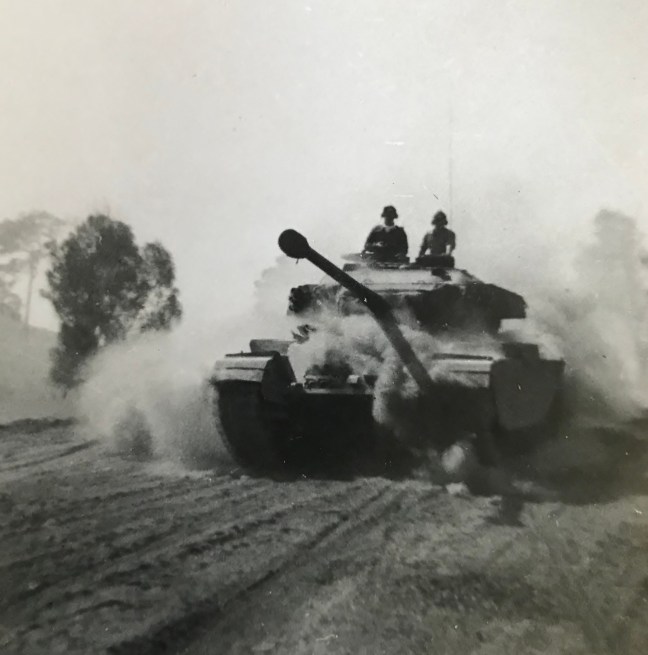
The government of Australia joined Britain and America in immediately offering troops to assist. Over 17,000 Australians served in the War under the UN flag between 1950 and 1953 with 339 dead and 1,200 wounded. The picture is of my father commanding a Centurion Tank whilst serving with 2nd Armoured Brigade at Puckapunyal during the Korean War. The poor driver looks like he had a mouthful of dust, but fortunately for him, Australia never deployed their tanks to the Korean Peninsula.
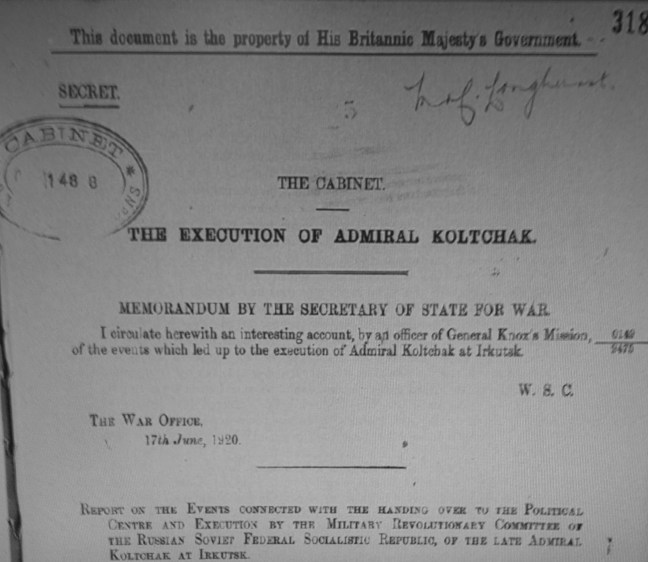
In June 1920, as the Prime Minister negotiated with the Soviet envoy, Leonid Krassin, Winston Churchill was in open rebellion. The Secretary of State for War was supported by a large section of MPs, who were appalled that Lloyd George was “grasping the paw of the hairy baboon”. On 11th June, Churchill circulated a secret memorandum to the Cabinet with his demands of the Soviet Union and a week later, he sent a Military Intelligence report describing the treacherous execution of Britain’s recent ally, Admiral Kolchak, at Irkutsk.
Above all else, Churchill demanded that “All British prisoners of war captured in Siberia..are to be returned forthwith alive and well.” He now took up the cause of Brian Horrocks, Leonard Vining and the other British PoWs being transported from Irkutsk to Moscow. With an obsessive determination, he encouraged his friends in Parliament to press the Prime Minister for action to secure their release. See Chapter 14 of Churchill’s Abandoned Prisoners…
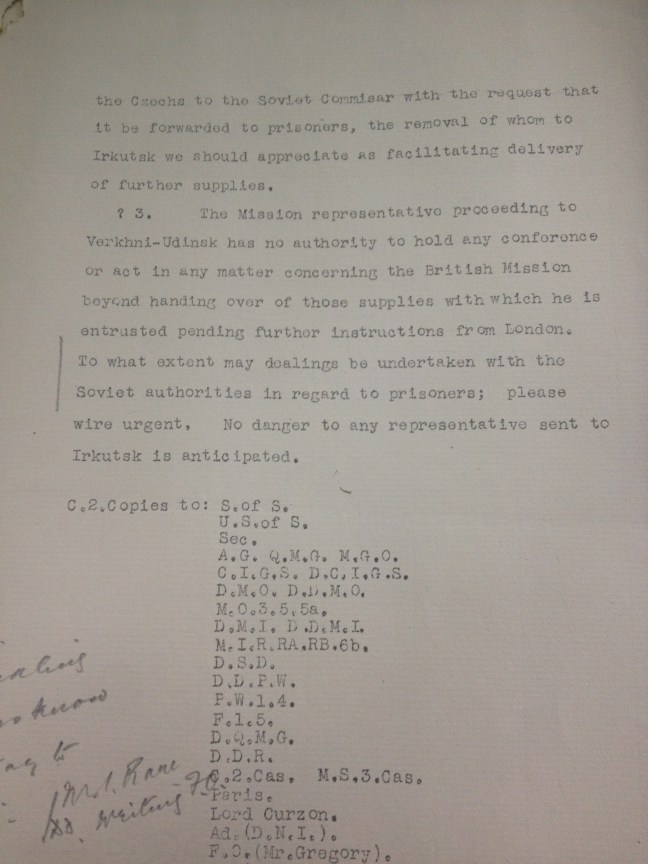
After Captain Rex Carthew departed with the British women and children from Irkutsk, Brian Horrocks and the other prisoners-of-war were left in limbo. The promised train with supplies and mail never arrived. In Vladivostok the head of the British Mission sent a telegram to the Secretary of State, Winston Churchill asking “To what extent may dealings be undertaken with the Soviet authorities in regard to prisoners; please wire urgent.” The strict policy in place was for local commanders not to say anything that gave recognition to Lenin’s Government and this did not change.
Despondency pervaded the prisoners’ carriage where they lived. In June, the Commissars, who had initially led them to believe they would go east to Vladivostok as part of the Litvinov-O’Grady prisoner exchange agreement, changed their tune and told them they were being sent 4,000 miles to Moscow. Understandably, they felt abandoned by their country and deceived by the Soviets. On 12th June, two months after they said farewell to Carthew, their carriage was attached to a locomotive and at 2 p.m. they pulled out of the station on the long, depressing journey west.
When Captain Francis McCullagh was interrogated in Lubjanka, he refused the offer to work as a double agent for the Soviet Union. Eventually, he was released with dozens of other prisoners and crossed the frontier into Finland on 15 April 1920. He was picked up by the head of the MI6 section, John Scale, who debriefed him in Helsingfors before he returned to England on the SS Dongola with the Reverend Frank North and a young Dmitri Tolstoy disguised as the son of his nanny, Lucy Stark.
In London, he was interviewed again by a Military Intelligence officer, Commander Boyce, at the Savoy Club Adelphi at the end of May and then in June by Lord Emmott’s Committee to Collect Information on Russia, which reported to the Prime Minister, David Lloyd George. The information McCullagh gives in these interviews is quite different to the story he tells in his memoir published the following year. For more on this, see Chapter 11 of Churchill’s Abandoned Prisoners.
One hundred years ago today, the Prime Minister, David Lloyd George received a note from Lord Curzon about his forthcoming meeting in London with the Soviet Minister Leonid Krassin on 31st May 1920.
The Foreign Secretary listed his main concern as the remaining British prisoners in Russia and described the three categories as: civilians in Moscow and Petrograd; prisoners-of-war in Siberia; and the naval mechanics recently detained in Azerbaijan. When the Prime Minister dismissed the problem of the prisoners as an inconvenience, the Chief of the Imperial General Staff accused him of treason and Winston Churchill attacked him for grasping “the hairy paw of the baboon”.
Meanwhile in Irkutsk, Major Vining in charge of the deceived British prisoners in Siberia, wrote in his diary: “nothing has been sent us and no telegram, or letter has reached us…Our mail, an accumulation of some ten months is at Vladivostok, this could have been sent through ten times over…”.

 The British Colony Hospital on the Vassily Ostroff in 2019
 Ivanovsky Prison
 Rupert Wieloch