
Prime Minister’s Meeting

On 17th November 1920, David Lloyd George met his cabinet at 10 Downing Street, with the agenda dominated by the question of resuming normal relations with Russia.

The Foreign Secretary, Lord Curzon and the Secretary of State for War, Winston Churchill, began the meeting by confirming that matters were in hand to send 300 British troops to help the League of Nations conduct the plebiscite in Lithuania.

The main discussion centered on the trade deal. The President of the Board of Trade, Sir Robert Horne, made an impassioned plea to vote in favour based on the dire economic situation in Britain, with business confidence low and unemployment high.

Curzon and Churchill spoke against the motion and wanted Britain to continue supporting Poland. However, the Prime Minister exclaimed: “When I mentioned the possibility of our going to war to support Poland, a shudder passed through the House and those who were clamouring against Bolshevism showed the white feather.”

The debate continued into a second day when Churchill made one final “frantic” appeal. The Lord Chancellor had mentioned that £10 million of diamond sales would be spent in England if the deal went through. However, Churchill claimed that these diamonds “were all stolen, many of them from the dead bodies of the Russian aristocracy”.

When they were asked to vote, the majority of the Cabinet sided with the Prime Minister. But Churchill asked for it to be recorded in the minutes that no Cabinet Minister was fettered with regard to speaking against Bolshevism and that night, he travelled to Oxford where he delivered a “violently anti-Bolshevik speech” at the university.

MI6 Interview

As the final preparations for the Cenotaph unveiling was happening in London, Leonard Vining was interviewed in Finland by John Scale, who had been head of MI6 in Russia before the revolution and was involved, allegedly, in Rasputin’s death in 1916.

Scale had been awarded the DSO and OBE for his intelligence work in Russia. He knew all the main British characters involved in the British Mission to Siberia, including the commander, Sir Alfred Knox and John Fraser Neilson of the 10th Hussars, who will forever be associated with the coup that brought Kolchak to power. He was also a friend of Robert Bruce Lockhart, who reveals all four of them met off the coast of Norway on the way to his ill-fated assignment in Moscow. Scale was also heavily involved in the raid on the Soviet fleet at Kronstadt in August 1918 and was lucky not to share the fate of Captain Francis Cromie.

The report from this interview was sent to the Foreign Office and Vining’s comments were used by Lord Curzon on 17th November in the Prime Minister’s Cabinet Meeting discussion about the resumption of normal relations with Russia: “we have it on the authority of Major Wining [sic] a Siberia prisoner who has reached Helsinki. he says there are considerable number of prisoners [still] in Russia.” Curzon’s vote against reopening trade was in vain as the President of the Board of Trade’s motion was passed.

100 Years On

Baltic Prisoner Exchange

The convoluted Anglo-Russian prisoner exchange was described in the House of Commons on 26th October by Cecil Harmsworth, younger brother of newspaper viscounts Northcliffe and Rothermere. Replying to Sir Frederick Hall’s question, he explained that the Russian political prisoner, Babushkin and seven Bolsheviks held in London were being transferred in the Royal Navy destroyer, HMS Dauntless, while the British prisoners-of-war crossed the Finnish frontier.

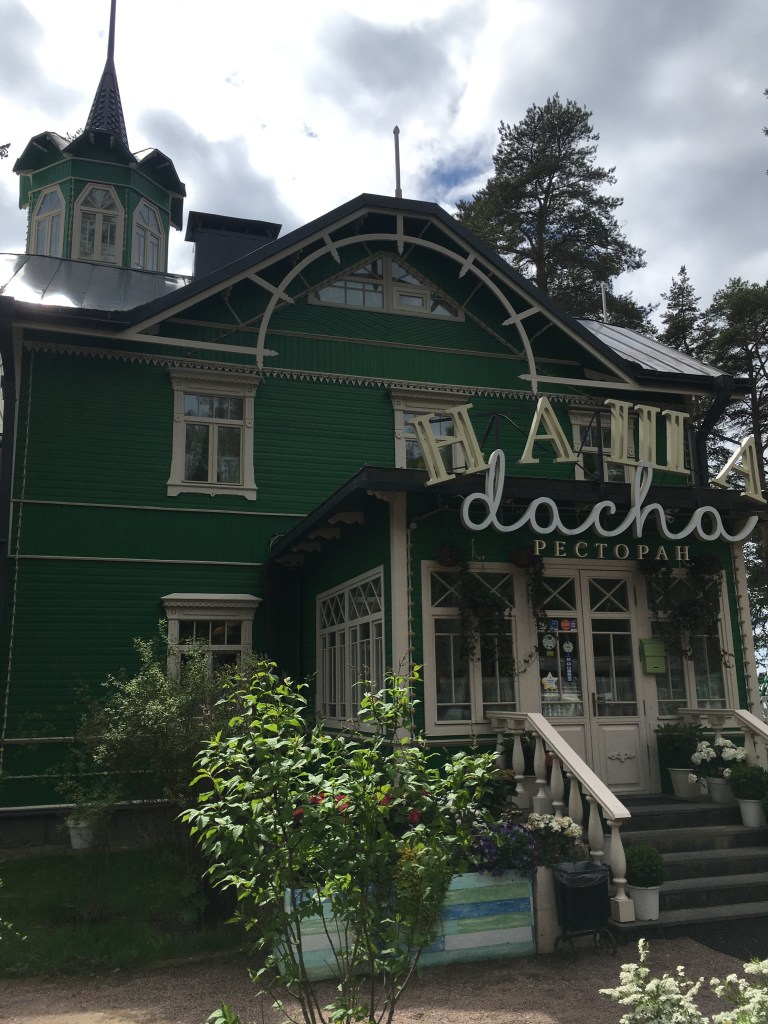
In Finland, the soldiers were met by an MI6 officer and taken by sleigh to a camp overlooking the Baltic Sea. This was formerly a collection of wooden dachas owned by the rich and famous from Petrograd. Here, they had a frustrating wait while the Unknown Soldier was buried at Westminster Abbey. Private Lionel Grant complained about the delay while “negotiations are suspended” in a letter to his regiment on 12th November.

Finally, news came through that Babushkin had crossed into Russia and the British soldiers were released at Vyborg where they rented a room each. The stillness of sleeping alone after more than two years military service was too much for the soldiers and many of them could not sleep on their first night of freedom.

Terrijoki Dacha, Now A Delightful Restaurant

The Tsarina’s Bathroom and Offers of Marriage

While the British prisoners-of-war were held in Petrograd at the British Colony Hospital, they were given a tour of opulent private apartments in the Hermitage.

Leonard Vining could not resist playing a few notes on the magnificent gold piano that “still had a very sweet tone”, but Emerson MacMillan was more impressed by the Tsarina’s white marble bathroom that was decorated with marine views: “Beautiful it was as skill and art could make it, complete in every detail, but there was no water”. Their guards were still royalist to the core and quietly admitted that Russia was worse now than it had been under the Tsar.

Back in the hospital, the soldiers received many offers of marriage. “If only you will marry us so that we can get over the frontier out of Russia”, they would say, “we will promise never to worry you again”. The most persistent propositions were made by English women married to Russians who pleaded with Vining and the others to marry their daughters. Captain Brian Horrocks felt “very sorry for these unfortunate women and would gladly have helped them to escape from the country. But we all realised that we could not possibly just abandon them on the other side of the frontier. So after much discussion and soul searching we had to say no”.

Piano in the Hermitage

Prison Release Anniversary

After the ceasefire was agreed between Russia and Poland in Riga and Leonid Krassin’s delegation returned with positive news from London, a portly official from the Soviet Foreign Ministry visited the British prisoners-of-war and informed them they would leave for Petrograd on Wednesday, 20th October.

As they assembled in the courtyard, they felt bitterly sorry for their fellow prisoners whose pale, sorrowful faces gazed after them as they made their way across the icy cobbles to the police headquarters in Lubjanka Square.

There, they were joined by four of the British “grave offenders”, including Charles Maxwell with his daughter and niece. The soldiers made tea for them and began to sing. The guards came in to tell them to stop, but they continued to belt out their extensive repertoire.

Then the Chief of Staff, Colonel Popov, arrived and demanded payment for the cart they used to carry their belongings.

Quick as a flash, Leonard Vining replied that he could take it out of the money they owed them and asked for the remainder of the roubles, which had been confiscated in July. Popov smiled and left. Afterwards, the guards told Brian Horrocks that it was the only time they had ever seen him smile.

Eventually, they were taken to the railway station and ordered to board a cattle truck with wooden bunks. They had been given no food by the authorities and the train did not depart until after midnight, but to their great relief, they arrived the next morning in Petrograd where they were delivered to the British Colony Hospital and met by the careworn Matron, Violet Froom.

The British Colony Hopital on Vassili Ostroff

Peace of Riga

One of the key obstacles to the release of the last British prisoners-of-war in Moscow was the ongoing conflict between Poland and Russia in 1920.

Poland had achieved independence after World War I, but began a war with the Bolsheviks to regain territory lost to Russia one hundred years before. Fighting continued for 18 months before General Pilsudski defeated the Red Army at Warsaw and followed this up with a successful advance east towards Moscow.

Lenin sued for peace and the two sides agreed a cease-fire in Riga on 12th October that went into effect a week later.

There were still many questions to answer. What was to happen to Ukraine and Belarus, who fought with Poland for their independence? Would the Allies accept the new frontier which was 150 miles east of the Curzon Line that had been agreed at the Paris Peace Conference? The Peace of Riga was eventually signed five months later, but sadly it did not resolve the key issues, which festered until World War II.

However, the cease-fire on 18th October did solve one problem and that was the freedom of Captain Brian Horrocks and the other British prisoners held in Moscow.

The Last King of Khiva

At the beginning of October 1920, the King of Khiva arrived in the Andronovsky jail and appealed to the British prisoners for help.

Sayid Abdullah Khan was the last ruler who could claim to be a direct descendant of Genghis Khan. He was deposed after the Red Army invasion and transported to Moscow with the tattered remains of his entourage. They were half dead from cold and exhastion, but still looked magnificent in their long flowing robes and black sheepskin busbies.

Leonard Vining gave them food and helped them settle into prison life, but he could not secure the King’s release and he died later as a Soviet prisoner.

Khiva, which lies south of the Aral Sea on the Oxus river (Amu Darya), between Iran and Russia is now part of Uzbekistan. It became famous in Britain for the daring expedition by Lieutenant Richmond Shakespear, who was knighted by Queen Victoria for persuading the King of Khiva to abolish the capture and selling of Russian slaves. A high point in The Great Game.

The Andronovsky Prison

Winchester Museum Zoom Talk

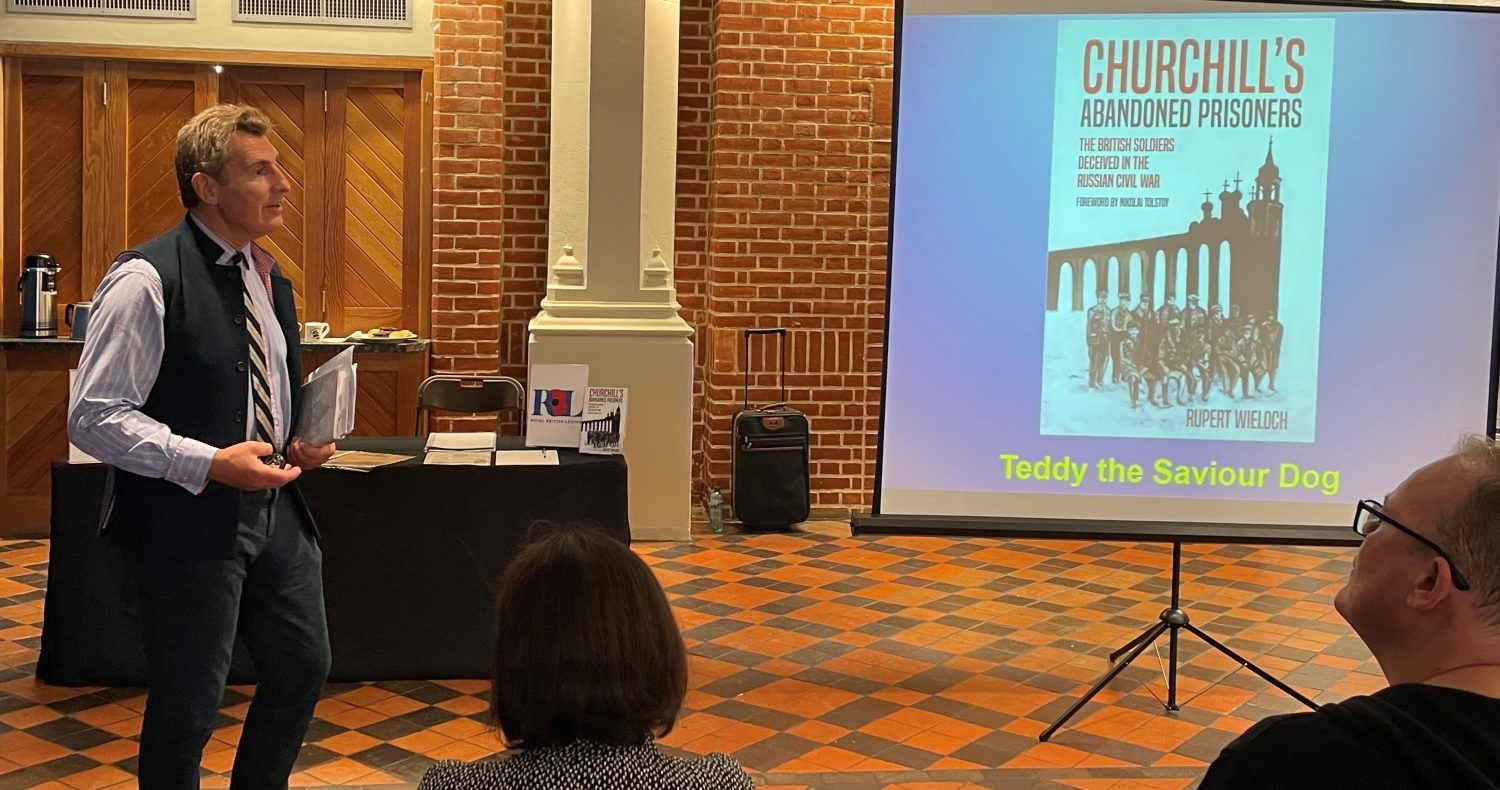
A fantastic audience joined the Zoom talk hosted by the Royal Green Jacket museum this week. All the regiments represented by the four famous military museums in Winchester played an important part in the British Military Mission to Siberia. The senior officer was Colonel Sir Edward Grogan Bt DSO of the Rifle Brigade, who attended Winchester College and was awarded a CMG in the Siberian Honours. One of his officers was William Gerhardie, who wrote so exquisitly that Evelyn Waugh exclaimed “I have talent, but he has genius!”. Gerhardie described the “courteous” Grogan as “meticulous to absurdity, but kind and very nervous – a great enigma”.

Grogan handed command of the Training School at Vladivostok to Lieutenant Colonel Henry Carter MC of the King’s Own Yorkshire Light Infantry. Carter was the second British officer to die in Siberia in February 1919 and when he succumbed to the Spanish Flu, Major Thomas Baring of the Rifle Brigade stepped into his shoes and was awarded an OBE for his part in the campaign.

One of the young officers working in Vladivostok was Captain Henry Wellesley who had won three Military Crosses leading his Ghurkas in Mesopotamia, before deploying to Russia in 1918.

Probably, the most famous son of Winchester in Siberia was Colonel Robert Johnson who was later knighted for running the Royal Mint. He was President of the Oxford Union and commanded the 9th Hampshires from when they were raised in 1911 until they were part of the Anglo-Russian Brigade at Ekaterinburg. In April 1919, he uttered the famous words: “We hope to march into Moscow…Hants and Russian Hants together.”

Johnson was awarded a CBE as was Major John Fraser Neilson of the 10th Hussars, another Winchester Regiment. Neilson ran the Military Intelligence operation in Omsk and was accused by the French contingent of inspiring the coup that brought Admiral Kolchak to power one week after the Armistice.

So many extraordinary characters served in Siberia during the two years of the British Military Mission that ended with the last British Army PoWs of World War One.

House of Commons Summer Recess

In 1920 the House of Commons rose on Monday 16th August and did not return until nine weeks later (three weeks longer than the normal summer recess). The shadow of Russia again dominated the final day’s agenda. Tetchy questions covered the Government’s policies on the blockade of the Baltic and Black Sea, the international support for General Wrangel in southern Russia, the Japanese control of Eastern Siberia, the independence of Poland and the Soviet Trade Delegation.

The Prime Minister, David Lloyd George, reported that the naval mechanics in Baku were now living in a private house. He was less clear about the British prisoners-of-war in Moscow and said “I am not sure” when asked by the interventionist, Noel Billing, whether they had been “liberated”.

The five hour Motion for Adjournment was particularly bitter. The Government sought agreement to call the House back at two days notice if the Polish-Russian situation worsened, but the future Labour leader John Clynes attacked the Government’s “supply of munitions” to Poland and threatened a General Strike if Britain intervened against the Soviet Union. He suggested that if the Secretary of State for War, Winston Churchill, could not “accept the peace policy as announced by the Prime Minister, I fail to see how he can continue to hold office in a Government whose policy he so constantly contradicts…”

The nine-week adjournment allowed the Government to negotiate with Lenin’s envoys for a prisoner exchange and a trade deal. In its Cabinet Papers of September 1920, the National Archives holds a note sent by the Foreign Secretary, Lord Curzon to Lev Kamenev detailing the conditions for any treaty and emphasizing the need to release all the British prisoners in Russia. Meanwhile, as the situation in Poland eased, the Russian Trade Committee, headed by Sir Hubert Llewellyn, proposed an amendment to the secret Draft Trade Agreement with the Russian Soviet Government.

Plight of the Grave Offenders

During the Anglo-Russian prisoner exchange negotiations in March 1920, Lenin’s envoy inserted a clause which allowed the Soviet Government to keep hold of anyone who had committed grave offences against the state. Chief among these were a group of ex-pats in the Committee for the Relief of the British Colony in Petrograd. This wealthy group of British subjects helped those less fortunate who were affected by the 1917 revolutions, but also provided funds for the MI6 network of agents, built up by Major John Scale and Captain Francis Cromie RN.

The leader of the committee was George Gibson, who worked for United Shipping. He was imprisoned following the successful British raid on the Soviet fleet at Kronstadt by the Royal Navy’s coastal motor boats on 18th August 1919. Another prominent member was Charles James Maxwell who ran John Hubbard & Co’s cotton mill. He was arrested with his niece and and cousin Miss MacPherson (his wife who died in 1907 was a member of the famous MacPherson family, who provided the first president of the Russian Football Federation).

When the Foreign Secretary, Lord Curzon, heard that these “grave offenders” were still in their Moscow jail, he described the situation as “scandalous” and made sure their release was made a condition of the Prime Minister’s trade deal.