
The announcement that the government is creating four Ranger battalions as part of a Special Operations Brigade hammers another nail in the coffin of the Country Infantry Battalions. The idea of a Tier 2 Force is not new. As part of the post-9/11 Strategic Defence Review, we proposed a similar formation to support the Special Forces, but the Chief of the General Staff vetoed the idea because he believed it would mean the line infantry would be relegated to little more than garrison troops (he was a Royal Anglian).
Since then the county infantry battalions, which were the backbone of the British Army for two hundred years have been devastated by the last three Defence Reviews. Combined with the decision to dispose of our tracked armour (all Warrior infantry fighting vehicles and 79 Challenger tanks), this will limit Britain’s ability to move off roads and tracks in combat areas and will restrict the British Army to “security force” status, wholly dependent on the US military.
The decline and fall of the British Army since the First Gulf War is a tragic tale that is entering a new chapter. Whether this proves to be the denouement, or not depends on the attitudes of society and the state of the country’s finances after the Pandemic.
After 20 years of Strategic Defence Reviews, the Government has returned to the era of the Integrated Approach. This was a pre-Millennium term that described the internal Ministry of Defence co-ordination between the Royal Navy, Army and Royal Air Force. It was supeceded by the comprehensive approach which merged Defence requirements with those of the Foreign Office and the Department for International Development in a meaningful way that put Britain at the heart of Global peacekeeping.
That all changed in 2013 when the UK and US governments failed to act against the attacks on the civilian population in Syria. The 2021 Defence Review, (announced last week) effectively neuters the British Armed Forces and puts all the money into the hands of the centralised spy masters in London and GCHQ.
Some might say that the jailing of Major General (Retired) Nick Welch is a sign that we cannot trust the leaders of the Armed Forces anymore. However, it is not so long ago that the Army offered incentives to soldiers to buy their own houses and still claim for the boarding school allowance, but now it has made this a criminal offence.
The two issues may not seem related, but our Allies and Adversaries will see them both as a sign that Britain’s role in the world has diminished further and the government is not able to fulfill its responsibility to protect civilians threatened by genocide, or deploy a meaningful militarily force abroad.
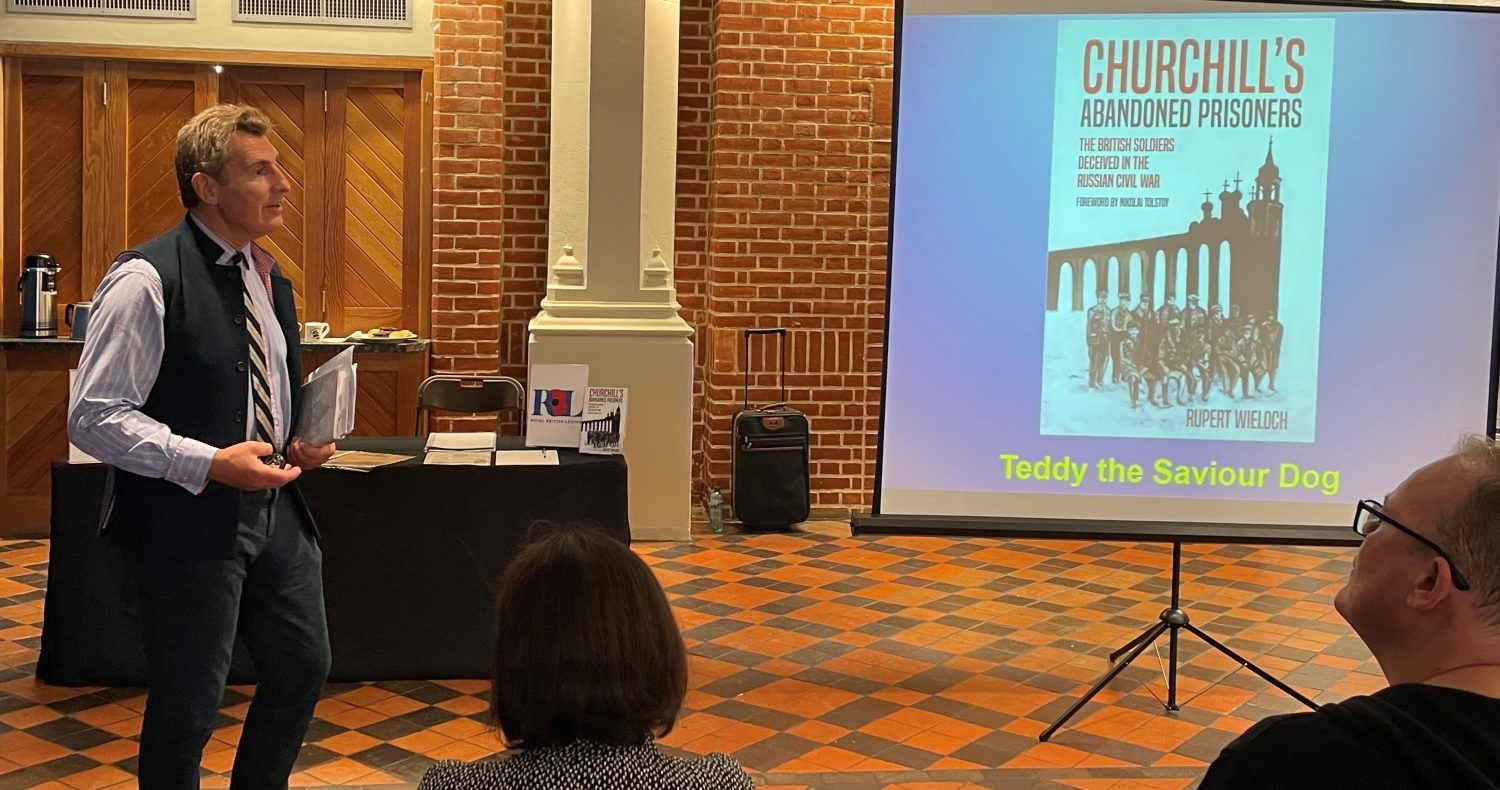
Several of the characters in Churchill’s Abandoned Prisoners will reappear in my next book, which is due to be published after Lockdown. These include journalists, diplomats, politicians and soldiers such as Brian Horrocks.
After he returned from Russia and picked up the Military Cross he had been awarded in 1920, his career in the following decade was remarkably similar to thousands of British Army officers who served in the 1980s, alternating his postings between the British Army of the Rhine and counter-insurgency operations in Ireland, which he described as “a most unpleasant form of warfare”.
One of his highlights was representing Britain at the 1924 Paris Olympics, where he competed in the Modern Pentathlon, a gruelling multi-discipline sport that involves show-jumping, fencing, running, swimming and shooting. However, this was trumped when he joyfully married Nancy Kitchin four years later.
As a slightly slow starter, he did not attend Staff College until he was 35 years-old, but his progress afterwards didn’t suggest that he would become such a meteoric success in World War II and end up commanding three different corps in North Africa and XXX Corps in North West Europe.
I wonder what he would have thought of the British Army being reduced to less than the size of one of these corps!
Two days before the Treaty of Riga was signed, the British Government finally sealed their trade deal with Lenin’s Soviet Republic.
The deal had been gestating since the Prime Minister, David Lloyd George had agreed with the Allies on 25th April 1920 “to adopt a resolution to restore trade with the Russian Soviet Federative Socialist Republic”.
Negotiations during the eleven months that led to the President of the Board of Trade, Robert Horne, signing the agreement, were fraught with problems. When Lloyd George first met with the Soviet envoy, Leonid Krassin, Winston Churchill was livid and the Chief of the Imperial General Staff accused the Prime minister of treason because the Soviets were still holding British soldiers, sailors and airmen as prisoners-of-war.
The Foreign Secretary, Lord Curzon was equally opposed to the deal and voted against it in the November Cabinet meeting, even after the prisoners were released.
The iconic treaty was a watershed moment in the history of Russia because it gave recognition to the communist government and effectively condoned the repression that led to the death of millions of lives during Stalin’s pogroms.
See chapter 15 of Churchill’s Abandoned Prisoners for the story how the negotiations progressed while the British soldiers were slowly starved in their Moscow jail.
Two important centenary anniversaries affecting the Anglo-Russian relationship occur this month. This week’s blog commemorates the end of the war between Poland and the Soviet Union.
The Peace of Riga, signed on 18th March took seven months to negotiate and benefited the Polish government more than the Congress of Soviets, which had to pay 30 million roubles compensation and abandon all rights and claims to territory west of the Ukraine.
Even though the Poles came out well, General Pilsudski the hero of the Battle for Warsaw, was highly critical of the loss of Ukraine. Meanwhile, Lenin was equally frustrated that his plans to export the Communist revolution to the West had been blunted.
The Allies were reluctant to recognize the treaty because the frontier was drawn 250 kilometres east of the Curzon Line that had been agreed at the Paris Peace Conference. Winston Churchill was a staunch supporter of the fight against Bolshevism and had tried to persuade the Government to send military support to Poland (see his secret memorandum below). However, Prime Minister David Lloyd George was more interested in a trade deal and said “When I mentioned the possibility of our going to war to support Poland, a shudder passed through the House of Commons…”. As a result, the government procrastinated and did not recognize the border until March 1923.
The peace treaty stabilized Polish-Soviet relations until Stalin invaded his neighbour on 17 September 1939 sixteen days after Hitler invaded from the West. It took another 50 years before Poland freed itself from Soviet shackles.
After peace was restored (relatively) in the West at the end of 1920, the Soviet Union turned its attention to the Japanese who still occupied large tracts of Siberia.
Their puppet was the independent Ataman Grigory Semeonov, who had done huge damage to the White cause with his bloodthirsty followers. They had tortured, murdered, raped, stolen and burned for the best part of two years, undermining Admiral Kolchak and the Allied efforts to improve life for ordinary Russians.
In 1920, the Red Army under General Eiche forced Semeonov out of Chita and into the Maritime Province (Primorsky Krai), where he continued to fight until September 1921.
Failing to settle in Japan or America, he returned to Manchuria and worked as a mercenary for the deposed Chinese Emperor Puyi (celebrated in the 1987 film The Last Emperor).
All the while, he was tracked by the KGB and when the Soviet Union invaded Manchuria in 1945, he was captured by parachutists.
The Soviets finally had their revenge and his past caught up with him in prison as he suffered a year of terrifying interrogations before he was executed on 29 August 1946 at the age of 55.
The photograph below is of Semeonov’s armoured train that threatened the Hampshire Regiment and attacked American troops in the Trans-Baikal in 1919.
With over 4,000 Canadian soldiers serving under command of Major General James Elmsley in Vladivostok and a dozen of these mentioned in the Siberian Honours, there are many Canadian Connections to Churchill’s Abandoned Prisoners. Remarkably, more than half the soldiers captured by the Red Army at Krasnoyarsk in January 1920 had a strong attachment to Canada before, or after the War.
The Banjo playing Bertie Prickett and Edward Stephens, who were both born in England, joined the Canadian Army and were members of the Expeditionary Force in Siberia, but transferred to the British Army when the Canadians were recalled in the summer of 1919. In contrast, Captain William Dempster was born in York County, Ontario, but joined the British Army and was awarded the Military Cross in Flanders, before volunteering for service in Russia and ending up in the British Railway Mission.
The youngest soldier, 20 year-old Bernard Eyford, was born in Manitoba to an Icelandic family. He was conscripted in Winnipeg on 15th July 1918 and served in the 260th Battalion Canadian Rifles, but his training as telegrapher led to his transfer to railway troops and eventually to joining Leonard Vining’s group. The oldest soldier, Fred Walters emigrated from Birmingham with his young wife Emily to Canada and moved to Moose Jaw, Saskatchewan. His attestation paper shows that he was a rivetter and plate worker when he joined the Army.
Emerson MacMillan’s family had emigrated from Scotland to Canada in the 1820s, but he was working in Philadelphia when he joined the British Army in 1918. During his training with the Inns of Court OTC, he volunteered for service in the Far East and was with Leonard Vining all the way from the Clyde, where they boarded the SS Stentor together in March 1918, through their Russian ordeal, until they said farewell to each other in London in November 1920.
Percy James’ connection came after the Second World War when two of his daughters married Canadians and he emigrated with two of his sons to Ontario, where he lived a happy life in Toronto. The final connection is with Sapper Smith. Both Leonard Vining and Francis McCullagh confirm that he was Canadian, but I haven’t been able to find his army details, or anything about him other than a contact in Kent on the back of the HMS Delhi photograph. However, this address at Willesborough, near to the Royal Engineer garrison at Chatham, no longer exists. Can anyone help?
William Dempster and Bernard Eyford after their capture at Krasnoyarsk
One of the youngest soldiers held by the Soviets in 1920 was Percy James. Percy trained as a typesetter and bookbinder before the war, but joined his local regiment, the Somerset Light Infantry before transferring to the Hampshires. He spent two years in India and unfortunately contracted Yellow Fever. Recovering in Jellalabad hospital, he created the most magnificent tapestry, celebrating Victory for the Allies with the flags of eight countries.
Travelling to Russia with the regiment, he ended up with Leonard Vining's group in Omsk, before sharing the ordeals as a prisoner-of-war in Moscow. After the prisoners' release, he was placed in quarantine in Finland and wrote home: Dearest Mother, Free at last, absolutely a free man and in the land of white bread and freedom. It's great after the terrible conditions of prison life, dirt and filth, now sleeping between clean sheets and beautiful food and smokes and I am glad to say I am none the worse off in health after my awful experiences...I do hope you are keeping well.
Returning to England, the army couldn't believe Percy had survived and suspected a Russian spy had stolen his papers, but his family confirmed his identity. Once he was demobilized, he settled in Bournemouth (where hundreds of his regimental comrades lived) with his wife and six children. He worked successfully in the publishing world until the Second World War when he volunteered for the Home Guard and the dangerous work of a munitions factory. Eventually, he emigrated to Canada where he continued to live a full and happy life with his family for many years. I am very thankful to his daughters Louise and Donna for providing the information about his later life and the photograph below of Percy in India.
To pave the way for General Knox in Siberia, MI6 sent one of their top Russian officers, Captain Leo Steveni to Vladivostok in April 1918. Steveni’s grandfather was a Swedish Consul and his mother was a Russian Countess, but he was educated at Rugby School. During the first part of the First World War, he worked in the Russian War Office at Petrograd, where he met some of the top MI6 officers including Cud Thornhill, Stephen Alley and John Scale, who played a hand in the murder of Rasputin.
Arriving in Harbin in June, the British Consul Henry Sly introduced him to Admiral Kolchak. The renowned Arctic explorer offered him railway carriage number 2013, which became his accommodation for nearly two years. Before Knox and the other members of the British Military Mission joined him in Siberia, Steveni helped some of the desperate people fleeing from the Red Terror, such as Maria Ivana Zvegintsova, nee Obolensky, who was living with her three children among dozens of refugees in a cattle wagon at Ufa.
After the November coup that brought Kolchak to power, he took over the role of military intelligence in the Stavka and provided London with detailed information about the Siberian Army’s dispositions. He was awarded an OBE for this work in 1919, but the London Gazette spelled his name incorrectly. Steveni remained close to Kolchak throughout his time in power and only left him in Irkutsk in January 1920, when the British Consul decided to move all the British diplomatic staff east of Lake Baikal. His account of the retreat from Omsk was serialized in the Manchester Guardian in July that year.
Returning home via Shanghai, he was demobilized, but soon decided to rejoin the Army and was commissioned into Brian Horrocks’ Middlesex Regiment. For several years, he languished as a junior officer, but in the Second World War, he was rapidly promoted to Lieutenant Colonel and in 1942, he was appointed Director of Secret Intelligence Service in Asia; a fitting title for someone who is included in the list of the “real James Bonds” of the spy world. For more on the role he played in Siberia, see Chapter 3 of Churchill’s Abandoned Prisoners.
After two and a half years away, Emerson MacMillan returned to America on 29th January 1921, arriving in New York with his new wife, Dallas, on board the White Star Line’s RMS Cedric.
He was interviewed by Raymond Carroll whose report was published in the Public Ledger under the title “Philadelphian Home from Reds Captivity”. This article highlights the hardships he suffered and plays down his role in the British Military Mission, describing it as the Inter Allied Economic Mission instead.
When he returned to Philadelphia, Emerson used his experience well. His engineering and management skills led to swift promotion in the railway industry, while he forged a reputation for entertaining talks about Russia, such as the one he gave at the Adelphia Hotel in May. Although, he didn’t produce a memoir (as did three of the other prisoners), he did write a number of articles that were published in the Public Ledger. Akin to all his compatriots, he felt Russia was a wonderful country that had been ruined by the Bolsheviks with their political system that was later allegorized so brilliantly by George Orwell in Animal Farm.