
The Importance of Tobruk

Easter Week not only marks the most important time in the Christian calendar, but also one of the most important events in World War II, the Siege of Tobruk. This small Libyan port had been fortified extensively by Mussolini during the Italian occupation, but was captured by the dashing Richard O’Connor on 21 January 1941. However, after O’Connor departed from the Western Desert, the Allies overextended themselves and Erwin Rommel swept them out of Libya – apart from the Australian 9th Division, based within the 16 mile perimeter of Tobruk.

On Easter Tuesday, the Commander-in-Chief, General Wavell, flew to the enclave after conferring with the Foreign Secretary Anthony Eden, who was in Cairo attempting to pull together a Balkan Alliance. Wavell was met by Brigadier John Harding (later Chief of the General Staff) and Major General Leslie Morshead who persuaded the CINC, as they toured the fortifications, that Tobruk could be held. That evening, Wavell walked into the Garrison Mess and recognised George Whittaker behind the bar (made famous in the book To War With Whittaker). The General said that he was sorry His Lordship was missing and bought Whittaker and each of the other stewards a whisky before heading back to Cairo.

Two days later, Rommel launched a devastating assault that continued throughout the Easter weekend. The result was victory for the Southern Hemisphere (with some help from the Royal Horse Artillery) and a thoroughly deserved posthumous Victoria Cross for Corporal John Edmondson from Wagga Wagga, who died of his wounds after saving the life of his sergeant on Easter Sunday. He is buried in Tobruk war cemetery with over 2,000 other Allied soldiers.

After the war, the media quickly forgot about the strategic importance of this action. However, the Easter battle was inspirational because it showed for the first time in the war, that the Blitzkrieg could be defeated. In many ways, the siege was a microcosm of the whole war and the successful resistance against all odds encouraged millions of British citizens who followed it avidly on the radio and in newspapers at a very difficult time for the country. It seems to me that in 2024, when industrial war continues to shape the world, the spirit of resistance witnessed in Tobruk remains as relevant as ever.
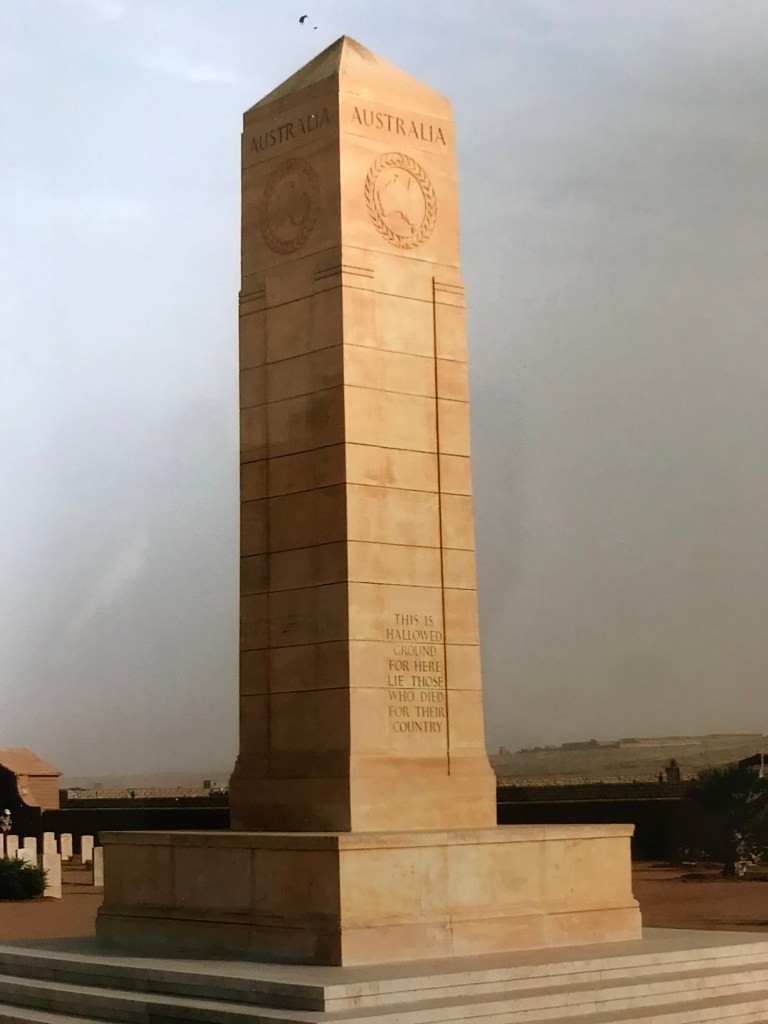
Australian Memorial at Tobruk
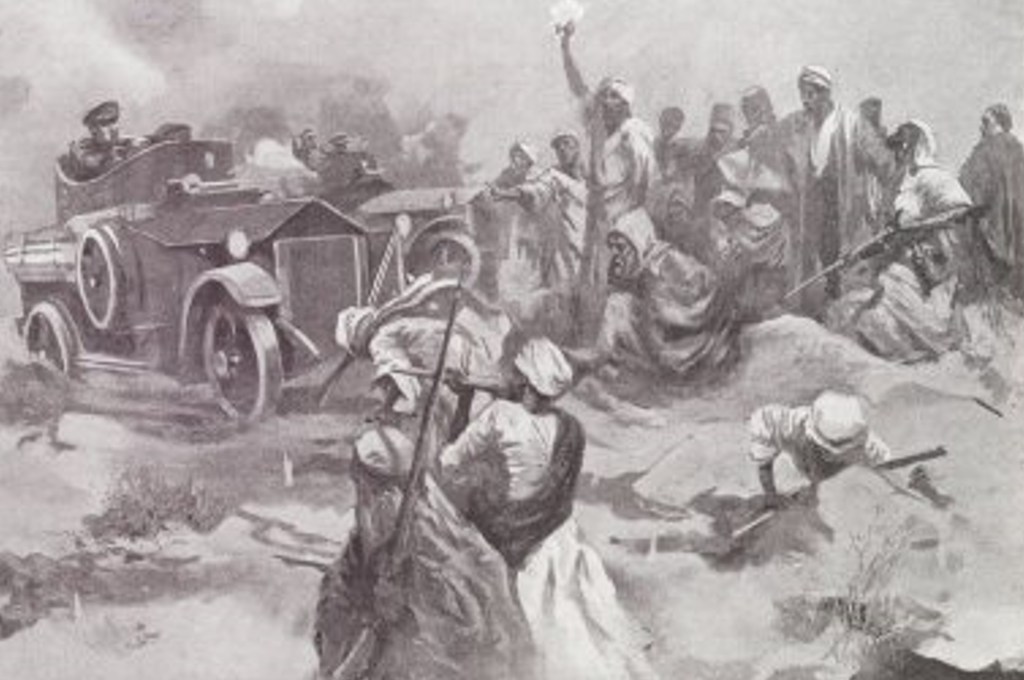
St Patrick’s Day Rescue

1916 was a very bad year for the Allies in World War I, but on St Patrick’s Day that year there was some good news from the Libyan desert. Before the streaks of sunshine rose in the East, the second Duke of Westminster led a convoy of 43 vehicles into the barren Sahara in search of a hundred Royal Navy Prisoners of War held by the Sanussi Army. The determined Duke began at a speed of 40 miles per hour, but by midday, his progress had slowed to 12 mph due to punctures and navigation halts. After 80 miles, of doubt and uncertainty, they eventually arrived at Bir Hakeim to find the emaciated prisoners and their fox-terrier pup, Paddy.

The Commander of the Western Frontier Force, Major General William Peyton, wrote a Victoria Cross citation for the Duke (and for Hugh Souter who had attacked an Ottoman machine gun force in February) but these were downgraded to DSOs in London. Peyton petitioned the King and Lord Kitchener on behalf of the two officers, but was told that the Army in France was very jealous of honours given elsewhere and the fact they were not regular officers did not help them. For his trouble, Peyton was subsequently sent to France as Field Marshal Haig’s Military Secretary!

Budget Assumptions – Thinking Beyond Tomorrow

The Public Accounts Committee and National Audit Office are, to my mind, the most important voices of reason when it comes to assessing Government policy and decision making. So when the PAC suggested, after the Budget this week, that the government does not have a credible plan to fund the MoD and pointed to a black hole in defence spending, we should take notice because the lives of our soldiers, sailors and air personnel are at stake.

But what was not clear was whether the chairwoman of the cross-party PAC was blaming the government, or the MoD. Most of the programmed money for the Armed Forces is allocated to Defence Equipment, but a large chunk is spent on infrastructure, information technology and training individuals and formations. Capability, which is what the tax-payer funds each year, is not just about ships, aircraft, tanks and missiles; it also includes the complex concept of readiness, i.e. what do we have in the locker for various scenarios with extended timelines. This concept is based on the UK’s secret Defence Planning Assumptions.

Sadly, these assumptions are flawed in several ways. For example, there is the forlorn hope that NATO Allies will fill British gaps if the balloon goes up. Other fallacies include the idea that reserves will come to the rescue of regular formations and that Defence Industry can ramp-up supply overnight. But perhaps the most deluded assumption can be summarised as “it will be over by Christmas”. One thing the wars in Ukraine, Afghanistan and Gaza have demonstrated is that modern wars need long term commitment and to succeed, you have to think beyond the day after tomorrow.

Combined Services Planning Team – Thinking Beyond Tomorrow

The Budget Looms

Twice in the past two months, the British Army has attempted to raise the profile of Defence Spending with off the record briefings by senior retired officers, but sadly I don’t expect their efforts to be rewarded this week.

In the battle for local council funding, health, social care and education, energy, transport and housing, the plight of the armed forces appears to languish at the bottom of voters’ priorities. Before 9/11, I spent 18 months touring the country explaining to audiences made up of local opinion formers how tax-payers money was being used. That digital presentation, which was based on real-life experiences, opened eyes to an exciting world that people didn’t know about. The feedback (which was monitored independently) revealed that the subtle messaging managed to persuade many civilian gatekeepers and local media correspondents to support the armed forces in the battle for funding.

A recent newspaper article suggested that due to reductions in the past decade, the British Army is no longer rated as first class by the USA. This sad fact is not disputed, but neither is it likely to make any difference this week when the focus of the Chancellor is on tax cuts and domestic issues. As we look through our binoculars at the coming budget, any uplift is likely to be put towards Security assets, rather than military hardware and as ever, the devil will be in the detail…

Three Russians Who Helped The Allies

One of the big puzzles about the British involvement in Siberia in 1918 is whether there was a higher purpose than defeating Prussia and helping those who had fought on the Eastern Front. The initial British reconnaissance mission, led by Colonel Josiah Wedgewood DSO, recommended that any involvement to assist the British refugees fleeing from the Red Terror should be conducted through the formal Anglo-Japanes treaty. The subsequent landing of a Royal Marine detachment (under Japanese command) to facilitate this humanitarian assistance and the arrival of a further scoping mission led eventually to a medium scale operation, which was divided into six parts: logistics (delivering millions of tonnes of war equipment to the White Army); medical (assisting in countering epidemic typhus); the railway mission (helping to secure and operate the Trans-Siberian Railway); training (in military acadamies, schools and formations such as the Jaeger Artillery Brigade and Anglo-Russian Infantry Brigade); fire support (such as the Royal Navy Guns commanded by Tom Jameson on the Kama river); and military intelligence.

Given the scale of the campaign, it is not surprising that some academics have suggested that there was a higher purpose to separate Siberia from Russia, but I have found little material in London archives to support this theory. There is much more evidence to suggest that the higher purpose was the same reason that the West now supports Ukraine in their efforts i.e. the British government’s hatred of military authoritarianism. They knew about this state of affairs because several Russian and British liaison officers, who served together on the Eastern Front, were involved in the Siberian Military Intelligence mission.

The MI imperative can be seen from the instructions to the Senior British Military Commander, Major General Sir Alfred Knox, which are shown in the document below. This reveals that the first group of British officers to travel to Siberia included three Russians: Henry Kartchkal Peacock had lived in Siberia for eight years and was well-versed in its culture (he was awarded an MBE in the Siberian Honours); William Gerhadi (awarded an OBE for his work as Knox’s aide), was later described by Evelyn Waugh in the highest terms: “I have talent, but you have genius”. The third member of this group, Captain Leo Steveni (awarded an OBE in the Siberian Honours), arrived in May and was already working with the White Russians when this document wes sent. Steveni’s unpublished memoir in the King’s College London Liddell Hart Collection was a vital source for my book.

Russian Prison Brutality Is Not New

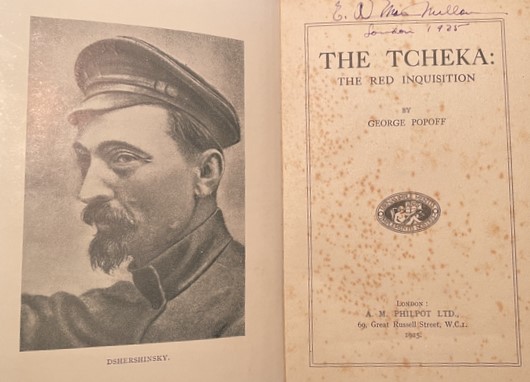
The sad death of Alexei Navalny in a Siberian prison highlights the brutal way political prisoners are treated in Russia, but this is not new. The death rate has always been high and reached a peak after the Head of the Secret Police, Felix Dzerzhinsky, developed the Nackenschuss technique in 1918, which caused instant death and avoided the loss of much blood. A full understanding of how this was used to govern the Soviet Union can be found in George Popov’s 1925 book The Tcheka: The Red Inquisition.

The Foreign Office Committee to Collect Information on Russia interviewed many of the prisoners who returned from Moscow in 1920 and published a comprehensive report that can be found in the Archives of Nuffield College, Oxford. The cross-party committee included the Conservative MP for Bassetlaw, the Liberal MP for Middleton and Prestwich and the Labour MP for Rhondda East. The Committee concluded that although the treatment of the British captives was appalling, it was better than the conditions endured by Russian political prisoners who were routinely tortured and killed.

Moscow Prisoner Exchanges

In his recent television interview with Tucker Carlson, President Putin talked about a prisoner exchange deal for US Journalist Evan Gershkovich. This diplomatic tactic has been a Russian point of reference with the West for more than a century to the early days of the Soviet Union. The Copenhagen Agreement was signed on 12th February 1920 between the British Prime Minister’s representative, Jim O’Grady (the MP for Leeds South East) and the Soviet Government’s Assistant Commissar for Foreign Affairs, Maxim Litvinov, who had been exchanged for Britain’s agent in Russia, Robert Bruce Lockhart.

The agreement reaped immediate dividends with hundreds of British civilians and prisoners-of-war released from Moscow jails in April. They followed a well-worn route by train to Petrograd (now St Petersburg) and then across the Finnish frontier to Helsingfors (now Helsinki) where they were picked up by British ships. Among this cohort were several officers captured in Siberia, including Captain Francis McCullagh, who was with Brian Horrocks in Krasnoyarsk and Lieutenant Colonel Johnson, captured at Tomsk.

During my research I found several newspaper articles with lists of refugees and prisoners-of-war returning to Britain. It has been particularly rewarding when I have been contacted by descendants of some of the military personnel, including a Victoria Cross winner and a Royal Naval Air Service officer, Anthony Mantle, who was captured in Southern Russia in 1919 and can be seen wearing his RNAS hat in the photograph below (taken, it is believed, outside the last Tsar’s summer palace).

Some of the British Prisoners-of-War in Russia Exchanged in April 1920

Deceived In Irkutsk

When Brian Horrocks and his fellow prisoners-of-war arrived in Irkutsk after their ordeal in Krasnoyarsk, they collectively breathed a huge sigh of relief. They knew a treaty had been signed recently between the Governments of Lloyd George and Lenin in Copenhagen, which made provision for the repatriation of all PoWs. Much to their relief a train carrying a Union Jack appeared a few days later with Captain Rex Carthew, who had been assigned the task of bringing them to Vladivostok.

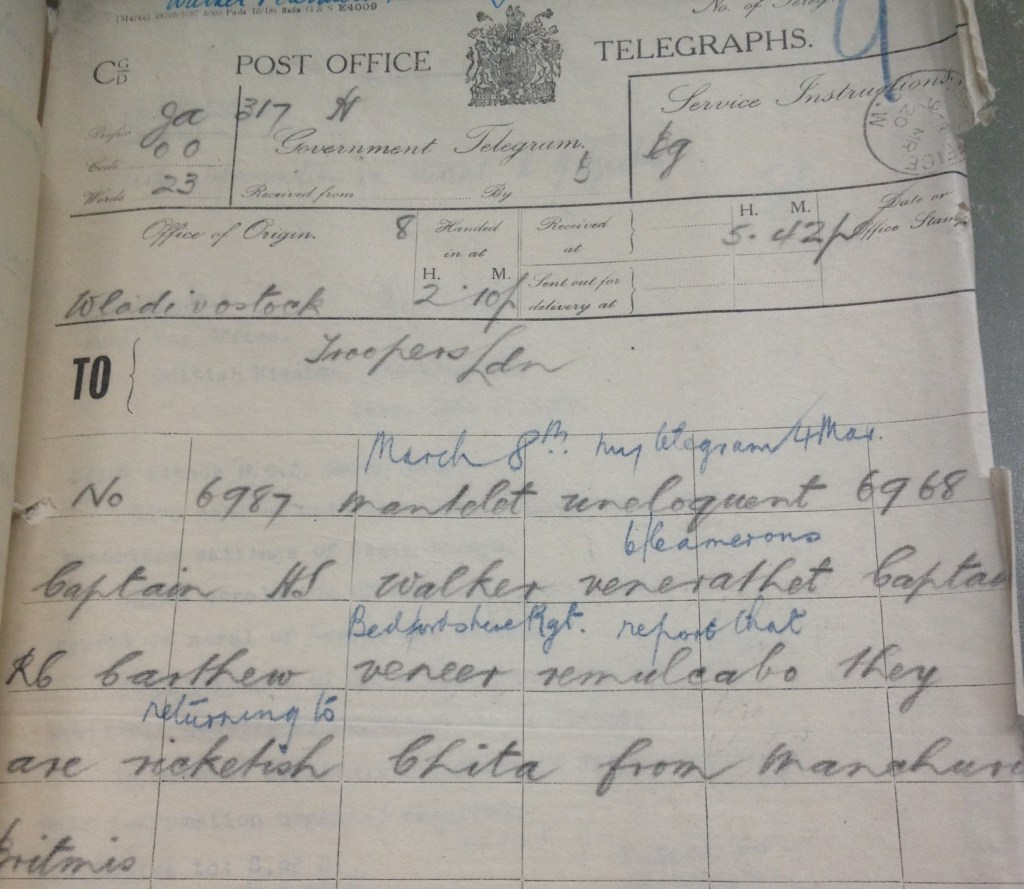
Unfortunately, the Bolshevik Commissioners, who had recently executed Admiral Kolchak, only allowed Carthew to take the last British civilians and informed the soldiers that they were being transported to Moscow as hostages. Carthew, who earned the Military Cross at the Battle of Arras in 1917 was one of the last British soldiers to serve on military operations in Siberia and waited patiently with provisions for the prisoners in Chita for two months until he knew they were not coming east before travelling home.

I found a fascinating telegram about Carthew when I was researching the prisoners’ story. It confirms his movement from Manchuria to Chita prior to arriving in Irkutsk. What makes it so interesting is that the cypher has been decoded by the recipient and it is clear that the headquarters in “Wladivostock” only deployed two officers, so they too were deceived by the Russian authorities, which reneged on the Copenhagen Treaty.

An Unrewarded Hero

Sir Brian Horrocks shared a similar background to the leader of his group in Russia, Major Leonard Vining. They were both born in India, but went to boarding school in the United Kingdom. In Vining’s case, he attended Epworth College in North Wales with his elder brothers, Herbert and Arthur. After leaving school, where he excelled at sport and music, he returned home to work with the Indian State Railways. During World War I, he was a captain in the 25th Oudh and Rohilkhand Railway Volunteer Rifles, an infantry battalion based in Lucknow tasked with guarding strategic points. After the Armistice, he volunteered for the British Railway Mission in Siberia and travelled on the SS Stentor from Glasgow in March 1919, reaching Vladivostok ten weeks later.  By November that year, he was a Major in the Royal Engineers, assigned to command the group in Omsk that was ordered to remain behind to run the Trans-Siberian Railway evacuation of people escaping from the Red Terror.

Vining was an outstanding leader in every respect. He managed not only to save the lives of tens of thousands of refugees, but he also secured the freedom of the British women and children in his care and brought out all his soldiers, alive from Russia in spite of the fearsome perils of frostbite, typhus and torture. Sir Brian Horrocks, who later commanded three Corps and knew something about leadership, provides this testimony about Vining after their departure from Russia: “I turned and shook Vining by the hand. Thanks to him our morale had always been high and discipline in our strangely assorted party had withstood the strain of all these months of captivity. On his shoulders had rested the ultimate responsibility and now he had brought the whole party safely out of the darkness of Bolshevik Russia into the light of the free world again…” So why was he not rewarded by the Government when he returned to England?

There are several contributory factors, but the main reason was the sense of embarrassment felt by the senior commanders who abandoned Vining in Siberia. One of the most damning pieces of evidence that I found was the secret correspondence in the photograph below between the Head of the British military mission and the Head of the British railway mission following the evacuation of the American and Czech railway troops. Between them, they decided to order Vining to remain behind with no means of rescue. It is clear from the telegram that the War Office was aware of this decision and thus complicit in the cover-up.

I am pleased to report that twenty years later, Vining did receive some recognition from the British Government, but this was nothing to do with his exploits in Russia. Early in the Second World War, he was in East Africa as part of the Indian Army contribution. After the Allies defeated Italy in Eritrea, Vining was placed in charge of all the transportation, including clearing the port of Massawa (now Mitsiwa) and reactivating the Eritrean railway and ropeway.  For this work, he was recommended for an OBE, but this was downgraded to an MBE, which was published in the London Gazette in 1942. Sadly, I have not been able to discover where he eventually settled, or whether he had any family, but it would be tremendous if the government was to finally recognise his outstanding humanitarian contribution in Bolshevik Russia.

Rooney The Entertainer

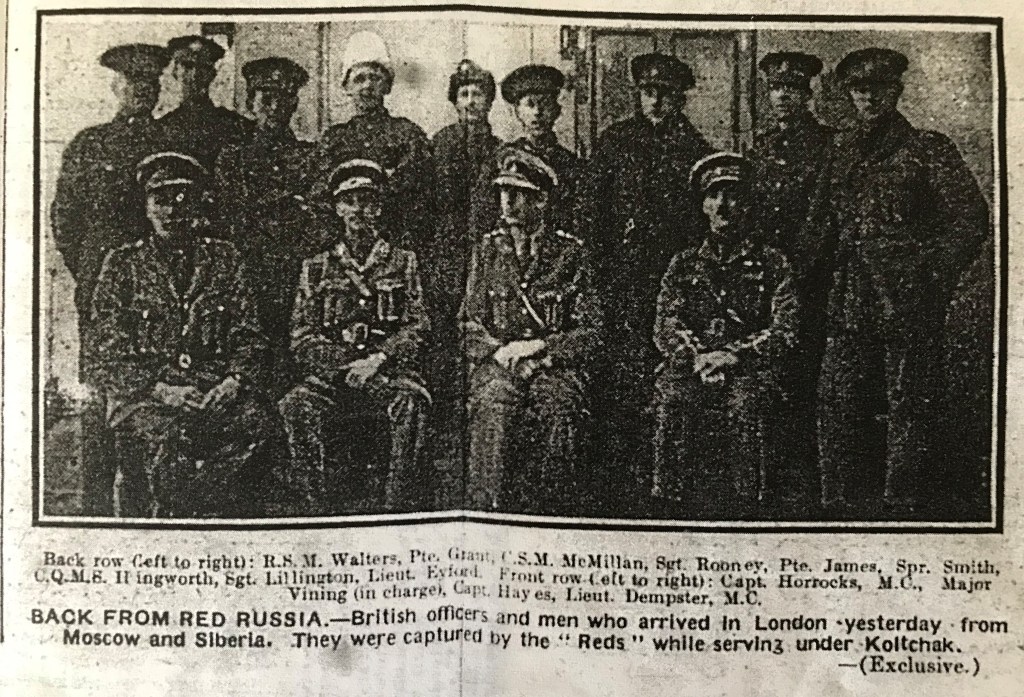
Sergeant Joseph A Rooney was the most written about prisoner-of-war in the other soldiers’ memoirs and diaries. He is described as fluent in Italian, French and German and a marvel on the piano. Apparently, he was “well-known” as an accomplished musician and performer in the theatrical world of London before the war, but how he ended up as a Royal Engineer in the British Railway Mission at Omsk in November 1919 is anyone’s guess.

There is no doubt that Rooney’s talents were much appreciated after the soldiers were captured at Krasnoyarsk because they had to earn money for food and Joe brought in more than anyone by teaching Italian during the day and playing the piano in the evening.

After the prisoners were deceived at Irkutsk and sent to Moscow, they refused to work for the Bolsheviks and to raise morale, they had a sing-song most evenings. Rooney’s inexhaustible repertoire of music-hall songs were pinpricks of light in the pervasive gloom. Later, in the Ivanovsky gaol, he wrote a play that was performed by the soldiers and earned a thunderous ovation from the political prisoners and the guards alike.

These stories should have provided me with enough leads to discover much more about Rooney’s life after returning from Russia, but sadly I have only found one subsequent reference, when he travelled to Italy with his wife in the 1930s. I have searched many theatre sources including JP Wearing’s authoritative The London Stage: Calendar of Productions, Performances and Personnel for the decades before and after the war, but found no records of his performances. Perhaps someone out there can help?

Joe Rooney is Standing, Fourth from the Left in this Photograph