Putin’s 25th Anniversary

The President of Russia was supposed to only hold the post for a decade, but constitutions can be changed (for better or worse) and we are now marking 25 years since Boris Yeltsin handed power to the then 47-year-old Secretary of the Security Council.

Initially, NATO leaders welcomed his arrival and helped him deal with many of the post-Cold War legacies, such as a broken economy and international terrorism. However, as NATO enlargement hemmed-him-in, his foreign policy changed tack and Russia became more assertive against the West.

From a practical perspective, I remember hosting friendly Russian generals on Arms Control visits and late-night-discussions after 9/11 with cordial Spetsnaz colonels. However, everything changed in 2008, when Russia invaded Georgia (Putin was actually the Prime Minister with his younger acolyte, Dmitry Medvedev, serving as President). At the time, I was with three Ukrainian special forces colonels at the time and they confided in me that their country was also under threat. Their prediction was sadly prescient.

No one knows Russia completely, but those of us who studied its history and followed the path to Putin’s invasion of Ukraine, know that the current story is all too familiar to ordinary Russian people. As we approach the New Year, my thoughts continue to be with everyone affected by Putin’s war. Here’s hoping for an end in 2025.

Lockerbie – Cause and Responsibility

The tragic 36th anniversary of the Lockerbie bombing has been marked by yet more controversy over one of Colonel Gadhafi’s most despicable acts of terrorism.

The Leader of the Scottish Alba party, who infamously released the convicted Lockerbie bomber, Abdelbaset al-Megrahi, from jail in 2009, claimed on radio yesterday that he believed Abu Agila Masud is the real bomber. Whether this is to deflect from his role in granting freedom to Megrahi, or merely to raise the stakes in the forthcoming trial of Abu Agila Masud in Washingron, is not known. However, it does re-open the wounds of the families at a moment when we should be respecting their dignified commemoration.

The BBC is rekindling the controversial theories about those responsible because a new drama “Lockerbie: A Search For Truth”, is due to air on 2 January 2025, starring Colin Firth. This will focus on the role of a Palestinian terrorist organisation, which allegedly acted in response to the shooting down of an Iranian aircraft by the USA. However, it is more likely that Gadhafi was acting in revenge for his defeat by the French and US backed Chadian army in the Aouzou Strip. The Libyan Army lost 7,000 men killed in what was known at the time as the Toyota War, but more importantly for Gadhafi, he lost access to Uranium deposits for his Nuclear Programme.

Pan Am Flight 103 was not his only revengeful target because he also sponsored the destruction of a French DC-10 flying from Brasseville to Paris. The 170 passengers and crew from 18 countries in Union de Transports Flight 772 were all killed in a very similar suitcase bomb attack, which is hardly ever mentioned in the context of Lockerbie, but is key to understanding the true cause of the bombing. Further details are in Chapter 15, Line of Death, of my book, Liberating Libya.

Gadhafi’s Nuclear Programme

Tepid Army

Tensions in the Ministry of Defence were exposed this week at my old work place in London, the Royal United Services Institute. On the one side the Minister for Veterans and People warned that the British Army would be wiped out in a few months if forced to fight a war on the scale of the Ukraine conflict. On the other, the Chief of the Defence Staff, Admiral Sir Tony Radakin, suggested that the chance of Russia invading a NATO member was “remote”.

Royal Navy Admirals, who have promoted the flawed concept of the Carrier Fleet for the past twenty years, have peddled this line since the 2010 Strategic Defence Review. During this time, the British Army has been whittled away and now cannot even deploy a full armoured division into the Field. The dependency on reserves and foreign armies for essential front line capability demeans our military reputation in NATO.

This week, the Minister spoke about the problem of numbers of soldiers, but in reality the situation is much worse because we are lacking across all the lines of development, including: Training, Equipment, Personnel, Information, Doctrine, Organisation, Infrastructure and Logistics. These are easily remembered by the mnemonic TEPID OIL. The government’s focus on personnel is all very well, but the real problem is with the Army’s equipment sustainability (including ammunition); in particular the main battle tanks and infantry fighting vehicles, which have been seriously neglected for fifteen years.

These are big stakes in the battle for government money. The Army is not only fighting for funds against Health, Education and Social Care, but also within the Defence and Security community against the Royal Navy, Royal Air Force and Intelligence Services. Recruiting a few Reserves is not the answer.

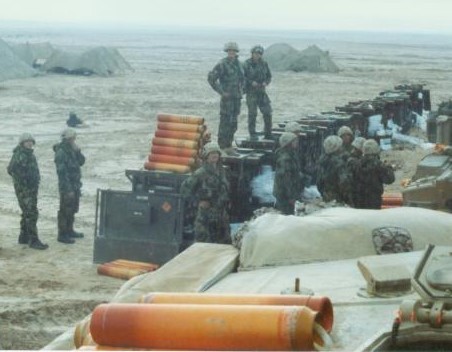
Challenger Tank Ammunition Replenishment in the Gulf

How The Ukraine War Might End

In a television interview, President Zelensky has suggested that a peace deal might be based on Ukraine (or parts of it) becoming a Member of NATO. This is not a particularly novel idea, but it does offer a glimpse of where he might be willing to compromise, if put under pressure by the Trump administration in 2025.

There are several hurdles to overcome before this becomes a reality. First, Putin’s main reason for invading Ukraine was to prevent it from joining NATO, which normally only accepts applications from countries that are not at war. Second, Putin’s current tactics are working well; he has the tacit support of a large part of Asia and Africa, so the West’s economic sanctions are not effective; and his superiority in weapons and troops is slowly wearing down his enemies.

There are other problems that the Western Media does not discuss, but those of us who lived through the last Cold War understand only too well. During that time, there were dozens of proxy-wars around the World and vast areas where travel was restricted by authoritarian regimes. As we approach 2025, it seems that we are moving closer to that global model with national independence a thing of the past and nuclear politics back in vogue.