Poppies For Remembrance

Walking through town this weekend, I saw a number of reassuring sights with poppy sellers and the Royal British Legion out in force. The collectors were a mixture of enthusiastic cadets. loyal friends and perhaps most important, sturdy veterans. Pride of place was held by a distinguished 75-year-old grey-haired soldier, who had served for over forty years in the Army Air Corps, wearing his medals and light blue beret.

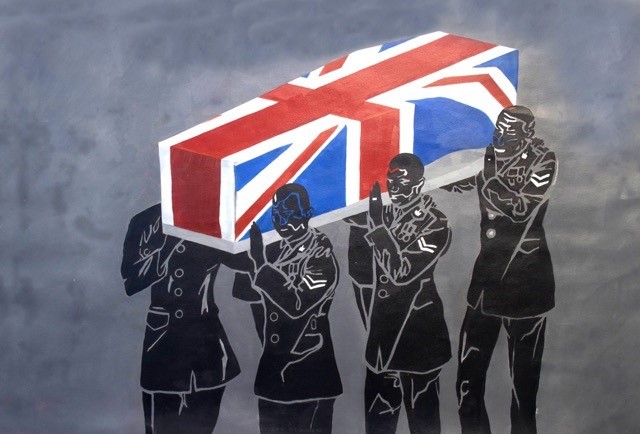
There are many veterans charities and all are as worthy as each other. However, at this time of the year it is particularly appropriate that we focus our attention on commemorating not only the end of World War I, but also those who have been killed on operations more recently. There is nothing quite like a ramp parade, when you are part of an honour guard to say farewell to fallen soldiers (or sailors and air personnel) who are returning home in a coffin. We will always remember them and wear our poppy with pride.
United Nations Day

On Thursday 24 October, the United Nations celebrates its 79th birthday, although it is likely to be a muted affair because the international community is more divided now than at any time since the end of World War II. The wars in Ukraine and the Levant take most of the headlines, but there are dozens of armed conflicts and power struggles in Africa and Asia that also worry the UN Security Council. The gap between the Nation States that still believe in traditional values and those who believe in the supremacy of individual human rights is widening.

Much has been made of the deployment of North Korean troops and Chinese weapons to support the Russian Army this week, but it is little more than British, American and German Special Forces, tanks and missiles being used by the Ukrainian Army against Russia. With the entry of China and North Korea in the Ukraine War and the continuing attacks on civilians in Gaza, the prognosis for 2025 is not good.

History shows that military solutions seldom work, so what we need is a compromise, but to achieve that, the United Nations should replace the current bureaucrats, who have failed their diplomatic tests. When I pause on Thursday to commemorate the gallant UN soldiers who have fallen in the cause of Peace, I will also be hoping for this change in leadership in New York.

A Soldier’s Soldier

It is sad to hear that General Sir Mike Jackson has died. He was highly respected in the British Army for his blunt wisdom and fierce loyalty to the cause. Although he did not begin his military career in a combat unit, he was an archetypal Parachute Regiment officer, who understood the use of force in all its complexities.

Apart from the well-published stories of Kosovo, he was also instrumental in closing the gap with Russia during the decade when London shared military intelligence with Moscow. I remember him speaking at a secret UK-France-Russia symposium in Sussex after 9/11, when the three countries pooled information about how they were dealing with the threat of international terrorism. Sadly that entente ended when Putin began his policy of aggression against his neighbours, but it was very important when Al Qaida was at its most threatening.

In many ways, Jackson’s image became the personification of the British Armed Forces when it was at its peak. That is why I used it for the front cover of the first edition of Media Operations (JWP-45) in 2001. When I spoke to him at an event recently, he was disappointed in the way the Army has been treated since his retirement and in his blunt way gave an insightful critique of what needs to happen to put it right. As a legacy to this distinguished man, I hope his advice will be taken in the 2025 Defence Review.

Crown Copyright

UNIFIL Attacked Again

I am relieved to hear that the Italian Government has decided to keep its peacekeepers on the Israel-Lebanon border despite the sporadic attacks on the UN bases along the Blue Line.

When I was based in Cyprus, we saw a lot of the Fijians who made up the bulk of the 4,000 UN peacekeepers in Lebanon. Much has changed since then, with the UNIFIL mission size increased to over 10,000 and 50 countries contributing troops. France, Spain and Italy are among the top military contributors, but it is noteworthy that Britain is not involved.

As we approach the 79th anniversary of the founding of the United Nations in October 1945, the situation in Lebanon seems to be the most important test for UN Peacekeeping since Srebrenica in 1995. The mandate is failing because the civilian population is not being protected. We need to remember Kofi Anan’s advice about what works well: “In Eastern Slavonia, we deployed a [UN] force of heavily mechanised infantry and helicopter gunships. We went in with such strength that we didn’t have to use force and we successfully fulfilled the mandate.”

This is something I hope the Government addresses in their UK Strategic Defence Review. It really is time that we honour Sir Marrack Goulding and dedicate an over the horizon capability to respond to UN peacekeeping emergencies.

UN Peace Support Operations

Where is the Working Group on Arms Control and Security Co-operation?

Sixteen years ago, I was invited to join the Middle East Peace Process working group on Arms Control and Security Cooperation by the University of California’s Institute on Global Conflict and Cooperation (IGCC). For three years, we met every six months and discussed critical military issues in the region from terrorism to nuclear security. Representatives from all the key nations in the MENA region attended, but no terrorist organisations were invited.

The workshops were taken very seriously as we heard privileged information from the IDF about their military operations in Lebanon in 2002 and 2006 and from the US Center for Strategic Studies (CSIS) about Iran’s nuclear capabilities. In the margins, the forum also used military diplomacy to reduce tensions between Israel and its near neighbours, including Egypt, Jordan, Lebanon and Turkey after they cancelled joint naval exercises.

For some reason, the US State Department withdrew funding during the Arab Spring and the group was closed down. It is now very hard to find any of its reports posted on the internet as the IGCC has shifted its focus to US-China relations. This is a great pity as the Middle East totters on the edge of catastrophe.

The world is a very different place in 2024, but the international community still needs mechanisms such as this former working group more than ever to defuse tensions. Israel also needs keep its Allies on side because, as we were told by the CSIS, it is likely that the Arabian Gulf will turn into the front line in the event of an Iranian conflict with Israel and the US.