
The British Army owed a huge debt to the Canadian Expeditionary Force (CEF) that landed at Vladivostok in 1918, but never advanced further than the Maritime State. When the Ottawa government ordered their troops to return home, many individual officers and soldiers chose to transfer to the British Army and serve in Omsk and Ekaterinburg. A huge amount of their equipment was also donated to the remaining Allies and most importantly, the Canadian Mounted Police had to transfer 308 of their beloved horses to the Jaeger Artillery Brigade.
Five of the prisoners-of-war with Brian Horrocks, who attended the Café Royal dinner and signed the back of the photograph in my earlier posting, had Canadian connections. Edward Stephens was born in Bristol, but was working in Canada when the war began, so he joined the CEF, before transferring on 17 May 1919 to the British Army. Twenty year-old Bernard Eyeford was born in Manitoba to an Icelandic family and joined the Canadian Rifles, before receiving a commission in the British Army as a Railway Traffic Officer at the same time as Stephens. Fifty year-old “Uncle Charlie” Fred Walters was born in Birmingham and emigrated with his family to Canada where he worked as a riveter in Moosejaw, Saskatchewan. He joined the Canadian infantry, but transferred to the Royal Engineers in Siberia and after the war, he worked for the Canadian Railroad. Emerson MacMillan was born in Ontario, but was working in Philadelphia when he joined the British Army in 1918 and did not return to Canada after the war. Sapper David Smith, who also signed the photograph, was born in Canada, but his address on the back of the card is listed as Ashford in Kent.
Perhaps the most interesting Canadian did not attend the dinner. Bill Dempster, who was born in York County Ontario and married Eleanor Osbourne in 1911, was awarded a Military Cross for an act of outstanding bravery in Flanders on 26th September 1918. After his release from the Moscow prisons, he returned to Ontario and served in the York Rangers militia while working for the Provincial Police. In 1945, he became quite a celebrity when he was called as a key witness by the Royal Commission investigating political corruption. He spent three days giving evidence and was described unkindly by the Windsor Daily Star as head of the local “gestapo”. This clearly did not upset him too much as he was one of the oldest survivors of the prisoners, reaching the grand age of ninety in 1980.
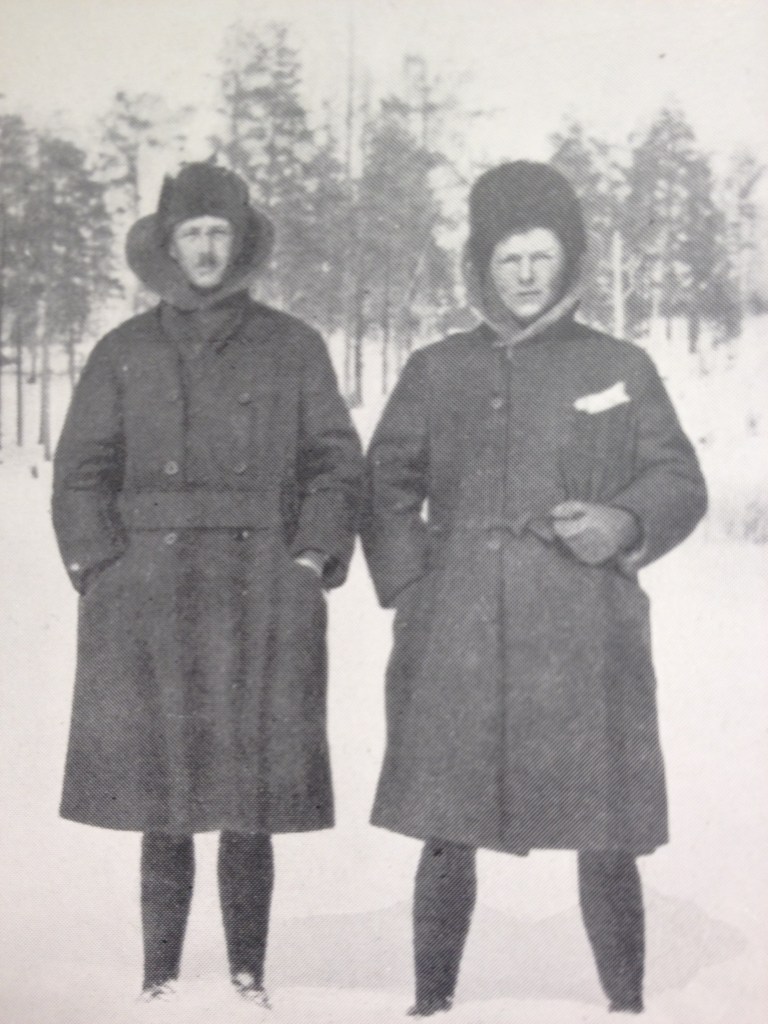
Two of the Canadian Contingent After Their Capture By The Red Army
 Rupert Wieloch