Liberating Libya is dedicated to the nine courageous soldiers who were awarded the Victoria Cross fighting Rommel’s Panzer Army Africa around Tobruk between April 1941 and June 1942. Five of these were posthumous awards and one of the recipients was killed one month after his citation was published in the London Gazette. The three survivors (Henry Bowerman Foote, Philip John Gardner and Quentin Smythe) all reached four-score years, with “Pip” Gardner the last to leave us in 2003.
There is no doubting the incredible bravery of these men, but there is also clear evidence that some of these awards had a political dimension to them. The case of Geoffrey Keyes has been analysed forensically by Michael Asher, who questions the veracity of the citation, but there is no doubt that this award during the siege of Tobruk raised the profile of Britain’s Special Forces at a key moment in the campaign. The first and final awards were to Commonwealth countries that were questioning their commitment to the Western Desert campaign and these helped to reassure the doubters back home. Of the British Army soldiers, two were Scots and there was one each from Dublin, Manchester, Bedford, London and the Welsh border area of the Wirral.
If you look at the context of the awards in terms of location and stage of the battles as well as the regiments, schools, homes and ranks, a picture emerges of preferential decisions and box-ticking. During my research for the book, I discovered several deserving cases that were downgraded by the honours committees for non-military reasons. This does not in any way diminish the awards that were made, it merely indicates the complex nature and height of the threshold needed to join this distinguished band of men.
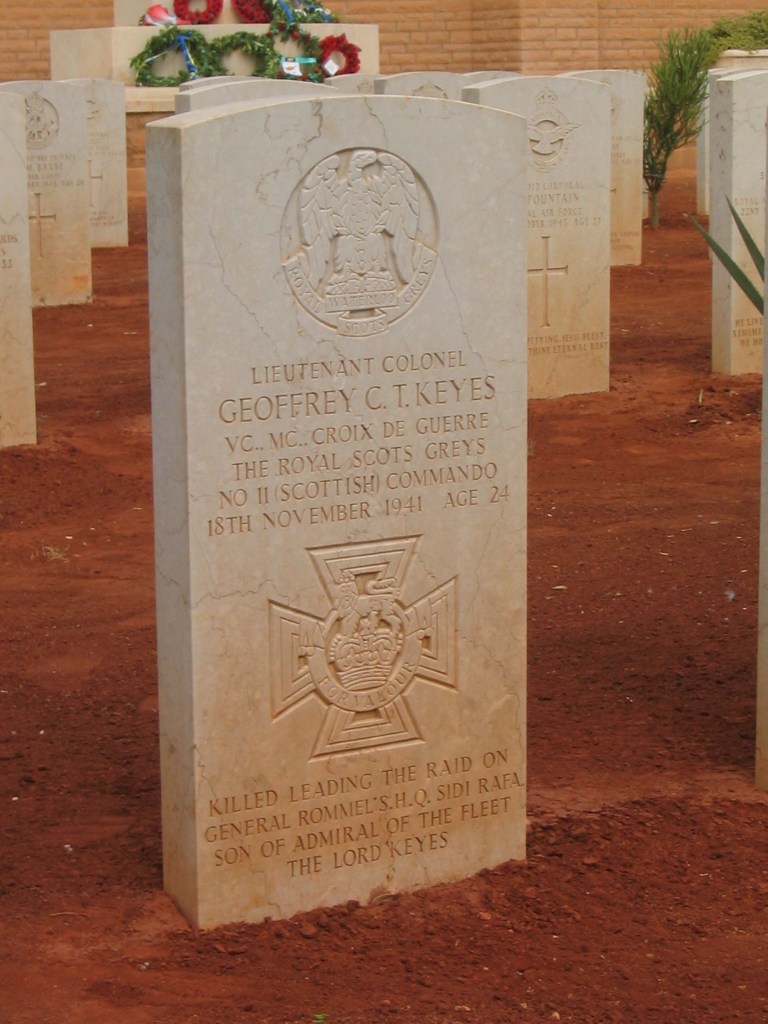
Geoffrey Keyes VC is buried in Benghazi
 Rupert Wieloch