Why Britain Won’t Support Wagner

The mayhem caused by Wagner’s so-called mutiny has raised hopes that there might soon be an end to the Russian war with Ukraine. To my mind, this is highly unlikely because Wagner offers no viable political alternative and could not possibly run a country like Russia. The simple facts are that there are 11 time zones (the world has 24), more than 100 languages and over 150 ethnic groups from Russians to Kamchadals.

If President Putin were to step down now, he probably would be replaced by a like-minded, hard-liner, who believes NATO should not get its hands on Ukraine and if the current central government collapses, Armageddon would soon follow. It is remarkably similar to the war fought in Ukraine in 1920, when General Wrangel won military victories, but failed to solve the political needs of the people. What is really needed in 2023 is a negotiated treaty with an impartial peacekeeping force deployed to monitor the confrontation zones.

Twenty years ago, the British government was so worried about the consequences of a collapse in the Moscow government and what would happen to the nuclear arsenal if the country imploded, that it actively supported President Putin in his efforts to strengthen the central government. This policy still has some bearing today and I used it as evidence in a public debate with Peter Hitchens, before the pandemic, that you can watch below.

The King’s Visit To Libya

On 19 June 1943, King George VI visited Libya and met the Tripoli Base Commander Brian Robertson who later became famous for his role in the Berlin Airlift. The King was given a rapturous welcome by the soldiers of Eighth Army in Tripoli as he was escorted by Lieutenant General Sir Bernard Montgomery in his Humber saloon.

Later that day, he boarded HMS Aurora for passage to Malta, where he presented Viscount Gort with his Field Marshal’s baton and toured the harbour, which had withstood heavy Luftwaffe attacks during the two year siege that was so pivotal to the victory in the Mediterranean and North African campaigns.

The Royal visit was repeated eleven years later when HRH Queen Elizabeth II met the King of Libya at Tobruk and the families of British troops at El Adem Air Base. The Queen’s visit cemented the close friendship between Libya and Britain that endured until the coup that brought Colonel Gadhafi to power in 1969. Further details are in part four of Liberating Libya.

Eighth Army Cheering HRH King George VI During His Visit To Libya In June 1943

The Victoria Cross Awards In Libya

Liberating Libya is dedicated to the nine courageous soldiers who were awarded the Victoria Cross fighting Rommel’s Panzer Army Africa around Tobruk between April 1941 and June 1942. Five of these were posthumous awards and one of the recipients was killed one month after his citation was published in the London Gazette. The three survivors (Henry Bowerman Foote, Philip John Gardner and Quentin Smythe) all reached four-score years, with “Pip” Gardner the last to leave us in 2003.

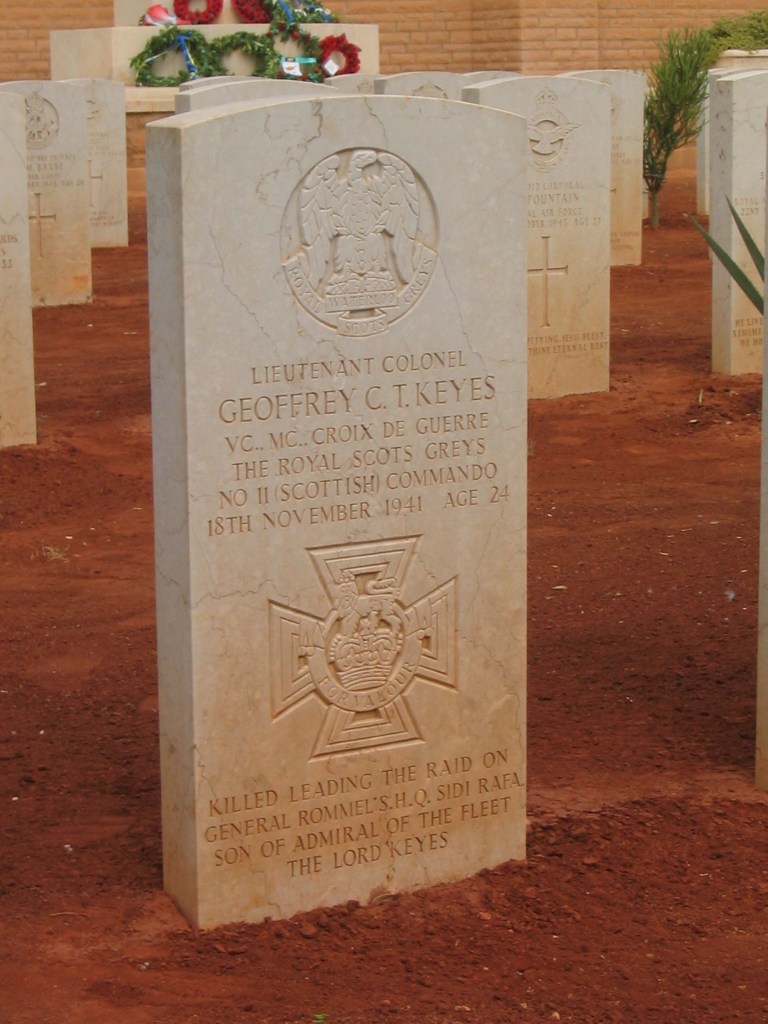
There is no doubting the incredible bravery of these men, but there is also clear evidence that some of these awards had a political dimension to them. The case of Geoffrey Keyes has been analysed forensically by Michael Asher, who questions the veracity of the citation, but there is no doubt that this award during the siege of Tobruk raised the profile of Britain’s Special Forces at a key moment in the campaign. The first and final awards were to Commonwealth countries that were questioning their commitment to the Western Desert campaign and these helped to reassure the doubters back home. Of the British Army soldiers, two were Scots and there was one each from Dublin, Manchester, Bedford, London and the Welsh border area of the Wirral.

If you look at the context of the awards in terms of location and stage of the battles as well as the regiments, schools, homes and ranks, a picture emerges of preferential decisions and box-ticking. During my research for the book, I discovered several deserving cases that were downgraded by the honours committees for non-military reasons. This does not in any way diminish the awards that were made, it merely indicates the complex nature and height of the threshold needed to join this distinguished band of men.

Geoffrey Keyes VC is buried in Benghazi

Australian War Crimes

During the Korean War, my father enlisted in the Australian Army and served on Centurion tanks in 1st Armoured Regiment at Puckapunyal until April 1955. As a result, he had a deep affection for the Australian Military Forces and spoke admiringly of the fighting qualities of “Diggers” such as Corporal John Hurst Edmondson, who earned the first Australian Victoria Cross in World War II, when he saved the life of his officer during the Siege of Tobruk (described on pages 108-9 of Liberating Libya).

If he was alive today, my father would be devastated by the outcome of the defamation case involving Ben Roberts-Smith. He would also be deeply troubled at the prospect of a series of Australian SAS war crimes trials, such as the case against Oliver Schulz.

Having planned NATO special operations against war criminals in the Former Republic of Yugoslavia and witnessed wrongdoing on military operations, I understand there is a fine line between “fighting spirit” and an “unchecked warrior culture”. However, what concerns me most with these cases is how the chain of command closed ranks and covered up the crimes, rather than rooting out the “bad-eggs” when they had the opportunity.

Centurion Tank In Australia During The Korean War